
SIP Header Manipulation with an SBC: How Session Border Controllers Normalize SIP Traffic
Two VoIP platforms that both “speak SIP” often can’t talk to each other cleanly. The problem is almost always in the headers. SIP headers carry the call metadata: caller identity, routing instructions, session parameters, and every vendor implements them slightly differently. A Session Border Controller (SBC) handles this gap by inspecting and rewriting headers in real time, at the network edge, before a mismatched value causes a call failure. This page explains how that process works, when it’s needed, and what capabilities matter most.

- SIP header
- A line of metadata attached to every SIP message. Similar in structure to HTTP headers, SIP headers carry the instructions and context both endpoints need to process a call: who is calling, where to route the response, which audio format to use, and what number to display on the recipient’s screen.
- From
- Identifies the calling party as presented to the recipient. On most PBX systems, this is the header that controls what appears as caller ID.
- P-Asserted-Identity (PAI)
- A header used by carriers to assert the verified identity of the calling party. It typically carries the real E.164 number when the From header contains an internal extension or a generic identifier. Not all PBX platforms recognize it.
- Contact
- Tells the other side where to send subsequent SIP messages within the same call. In enterprise environments, Contact headers frequently contain internal (RFC 1918) IP addresses that are unreachable from the public internet, causing routing failures at the network edge.
- Via
- Records the path a SIP request has traveled so that responses can be routed back correctly. Each SIP element that forwards a request adds its own Via entry.
- Record-Route
- Instructs both endpoints to route all future messages within a dialog through specific intermediaries, such as an SBC, rather than communicating directly.
- Diversion
- Indicates that a call has been forwarded, and from which number. Commonly used for voicemail routing and call forwarding scenarios. Not universally supported by carriers.
- SDP (Session Description Protocol)
- Not a SIP header itself, but a structured block carried inside SIP messages that governs media negotiation: which audio codecs are supported, what IP address and port to send audio to, and other media parameters. Mismatches here cause audio issues even when call setup succeeds.
- B2BUA (Back-to-Back User Agent)
- An architecture where the SBC fully terminates the incoming SIP dialog and originates a new, independent one on the other side. This gives the SBC complete control over every header on both legs, which is what makes deep header manipulation possible.
- NAP (Network Access Point)
- A logical trunk group configuration in ProSBC that defines how a specific carrier or endpoint is connected. Header manipulation rules are applied per NAP, so different carriers and internal systems can each receive different header treatment within the same deployment.
Why SIP Header Manipulation Is Necessary
SIP is an open standard, but implementation varies widely across carriers, IP-PBX vendors, softswitch manufacturers, and UCaaS platforms. These variations (sometimes called “SIP dialects”) create interoperability friction whenever two systems are connected.
The friction surfaces in predictable ways. A carrier passes a P-Asserted-Identity (PAI) header that the receiving PBX doesn’t recognize. An enterprise UCaaS platform sends Contact headers with internal RFC 1918 IP addresses that break when they reach the public internet. A calling party’s Diversion header gets dropped by a carrier that doesn’t support it. In each case, the SIP specification was followed, but one side’s interpretation didn’t match the other’s expectations.
The downstream effects are concrete: calls that fail at setup, caller ID that displays incorrectly, voicemail transfers that drop, DTMF tones that don’t register, or audio that connects on one side but not the other.
The SBC’s header manipulation engine resolves this by acting as a normalization layer. Instead of reconfiguring every endpoint, the SBC sits at the boundary between two environments and translates, rewriting headers outbound so each side receives exactly what it expects. This normalization can target any SIP header: From, To, Contact, Via, Record-Route, P-Asserted-Identity, Diversion, and custom vendor headers.
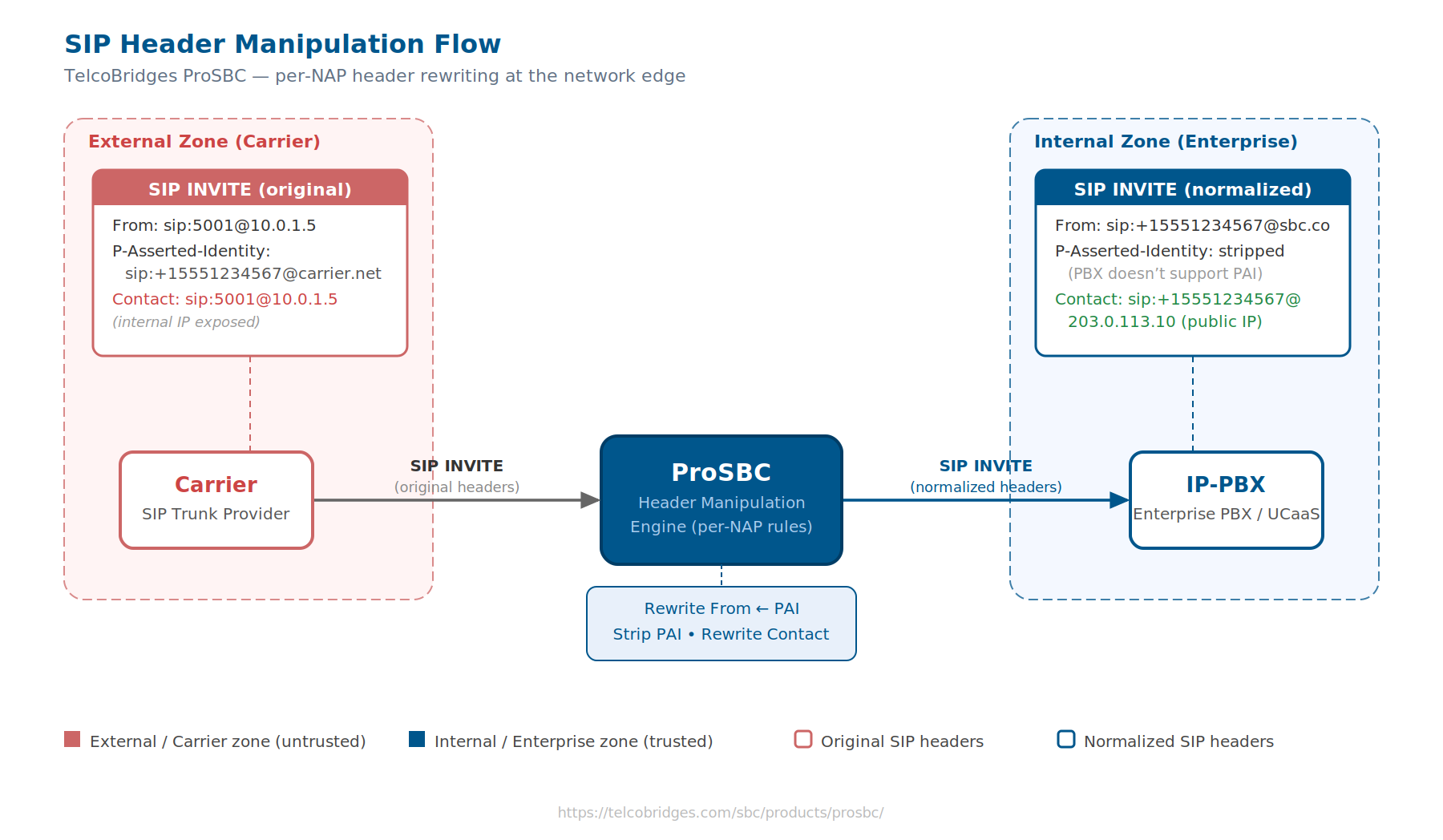
SIP header manipulation flow: the SBC rewrites headers independently on each leg, so each side receives exactly what it expects.
The B2BUA Architecture and Why It Matters for Header Control
The depth of header manipulation an SBC can perform depends directly on its architecture.
A SIP proxy forwards messages with constrained changes; it may update the Via header or modify Route, but it passes most headers through unchanged. That’s a fundamental limitation when you need to strip proprietary headers from a carrier before they reach your PBX, or inject a P-Preferred-Identity header that your UCaaS platform requires.
A Back-to-Back User Agent (B2BUA) works differently. It fully terminates the incoming SIP dialog and re-originates a new one on the other side. Every header on each leg is under the SBC’s control: the inbound leg and the outbound leg are independent SIP dialogs. Headers can be added, removed, or rewritten on either side without affecting the other.
This architecture also enables per-trunk-group scope. Most deployments involve multiple carriers and multiple internal systems, each with its own header expectations. A B2BUA Session Border Controller can apply different header manipulation rules to each Network Access Point (NAP), handling a PSTN carrier differently from a Teams Direct Routing trunk, which is handled differently from an Asterisk PBX, all within the same deployment.
Common SIP Header Manipulation Scenarios
Header manipulation covers a broad set of real-world use cases. These are the scenarios practitioners encounter most often:
Carrier-to-PBX PAI normalization. A carrier sends P-Asserted-Identity with the calling party’s full E.164 number. The PBX displays caller ID from the From header only. The SBC rewrites the From header on the inbound leg to pull the number from PAI, fixing caller ID display without touching the carrier’s standard behavior.
Topology hiding. Internal servers place their RFC 1918 addresses in Contact, Via, and Record-Route headers. If these reach an external carrier, they leak internal topology and often cause call routing failures. The SBC rewrites these headers to its own public address, hiding the internal network from external parties entirely.
Diversion header management. Forwarded calls carry Diversion headers that some carriers reject or handle incorrectly. The SBC can strip Diversion on the carrier-facing leg, add it back on the PBX-facing leg, or convert between Diversion and History-Info depending on what the downstream system expects.
Proprietary header cleanup. Many IP-PBX and UCaaS vendors add proprietary X- headers for internal call tracking. These are harmless internally but can confuse or be rejected by carrier systems. The SBC strips them before the call leaves the network.
DTMF signaling translation. Endpoints use different methods: RFC 2833 (RTP-based), SIP INFO messages, or in-band tones. When a carrier expects one method and the PBX sends another, DTMF fails. The SBC handles the conversion at the signaling layer so digits pass correctly across the boundary.
What to Look for in an SBC Header Manipulation Engine
Not all SBC implementations offer the same level of control. When evaluating an SBC for environments with complex interoperability requirements, these are the capabilities that separate workable from flexible:
Per-NAP rule scope. Global header rewriting is too blunt for multi-carrier deployments. The engine needs to apply different rules per trunk group, so carrier A and carrier B get different header treatment without interfering with each other.
Support for all SIP methods. Header manipulation requirements appear in INVITE, BYE, REFER, NOTIFY, and other SIP messages, not just call setup. An engine that only handles INVITE will miss mid-call and call-transfer scenarios.
Encrypted trunk support. Header manipulation must work on SIP over Transport Layer Security (TLS) trunks (default port 5061), not only plaintext SIP. Deployments with encrypted carrier connections need to apply normalization after decryption and before re-encryption.
Programmable / API-driven rules. Static configuration handles predictable header mismatches. Dynamic environments, where routing decisions depend on external data such as LNP dips or fraud scores, benefit from an SBC that exposes header manipulation through a scripting or API layer, so rules can respond to real-time call context.
Production debugging tools. Header changes that look correct in lab often behave differently in production. Call trace and live packet capture (Wireshark-compatible) let you compare the inbound and outbound SIP INVITE side-by-side to confirm that rewriting rules are producing the expected result.
Frequently Asked Questions
Can an SBC add headers that the originating endpoint never sent?
Yes. A B2BUA SBC creates an entirely new SIP dialog on the outbound leg. Headers on that leg are constructed from scratch, so the SBC can inject headers that were absent from the inbound leg. For example, adding a P-Preferred-Identity before forwarding to a carrier, even if the originating PBX didn’t include it.
What is the difference between a SIP proxy and an SBC for header manipulation?
A SIP proxy is limited to modifying routing headers (Via, Route) in ways the specification permits. A B2BUA SBC terminates the incoming SIP dialog and originates a new one, giving it complete control over every header on both legs independently.
Does header manipulation affect call audio?
Header manipulation is a signaling-layer operation. It does not directly affect RTP media streams. However, correcting SDP headers, which govern codec negotiation, can resolve audio quality or compatibility issues caused by mismatched codec capability declarations.
How do you verify that header manipulation rules are working correctly in production?
Use the SBC’s built-in call trace or packet capture to capture a live SIP INVITE before and after the SBC processes it. Comparing the two shows exactly which headers were modified, added, or removed on each leg.
Conclusion
SIP header manipulation is the practical mechanism that keeps multi-vendor, multi-carrier VoIP networks running. The normalization layer concept is central to any SBC deployment: it removes the requirement that every endpoint in your environment speak exactly the same SIP dialect. Whether you’re connecting a carrier trunk to an IP-PBX, bridging a UCaaS platform to a legacy softswitch, or enforcing topology hiding for security, header manipulation at the SBC is the lever that makes it work.
When evaluating an SBC for header manipulation, the key factors are the granularity of per-trunk rules, support for encrypted trunks, and the quality of debugging tools that let you confirm rules are behaving correctly under production conditions.
ProSBC for SIP Header Normalization
ProSBC operates as a full B2BUA, giving network administrators complete control over SIP headers on every call leg. Its header manipulation engine applies rules per-NAP: ProSBC supports up to 1,024 Network Access Points (NAPs) / Trunk Groups, making it practical in complex multi-carrier environments without requiring endpoint reconfiguration. ProSBC includes live Wireshark packet capture and call trace for real-time debugging of header behavior in production, and its Ruby-based API module layer allows header decisions to be driven by routing script logic for environments that need programmable, context-aware normalization.
ProSBC is available as a virtual machine (VMware, KVM/Proxmox), on AWS and Microsoft Azure, or on baremetal servers, deployable wherever your network edge is.