Efficient Transition to IP with Decentralized Gateways
By placing smaller Class 4 switch gateway units directly at each central office, operators can streamline routing and introduce SIP where it makes sense, without forcing a full cutover of every TDM subscriber.

Challenges
According to the FCC, roughly 18 million switched access lines remain in service in the US. Centralized switching architectures often require large, coordinated migration events that introduce avoidable risk.
Modernizing the voice network is no longer just about replacing aging switches; it increasingly depends on creating a structure that is simpler and more efficient to operate. Yet many of the transport layers built for TDM — muxes, backhaul circuits, and other legacy paths — remain in place even though they no longer add value and are expensive to maintain.
Engineering teams must support both TDM and IP environments, which slows progress and increases operational overhead. Regulatory reporting, including NECA requirements, demands clear functional separation that becomes harder to maintain when the network relies on multiple legacy components.
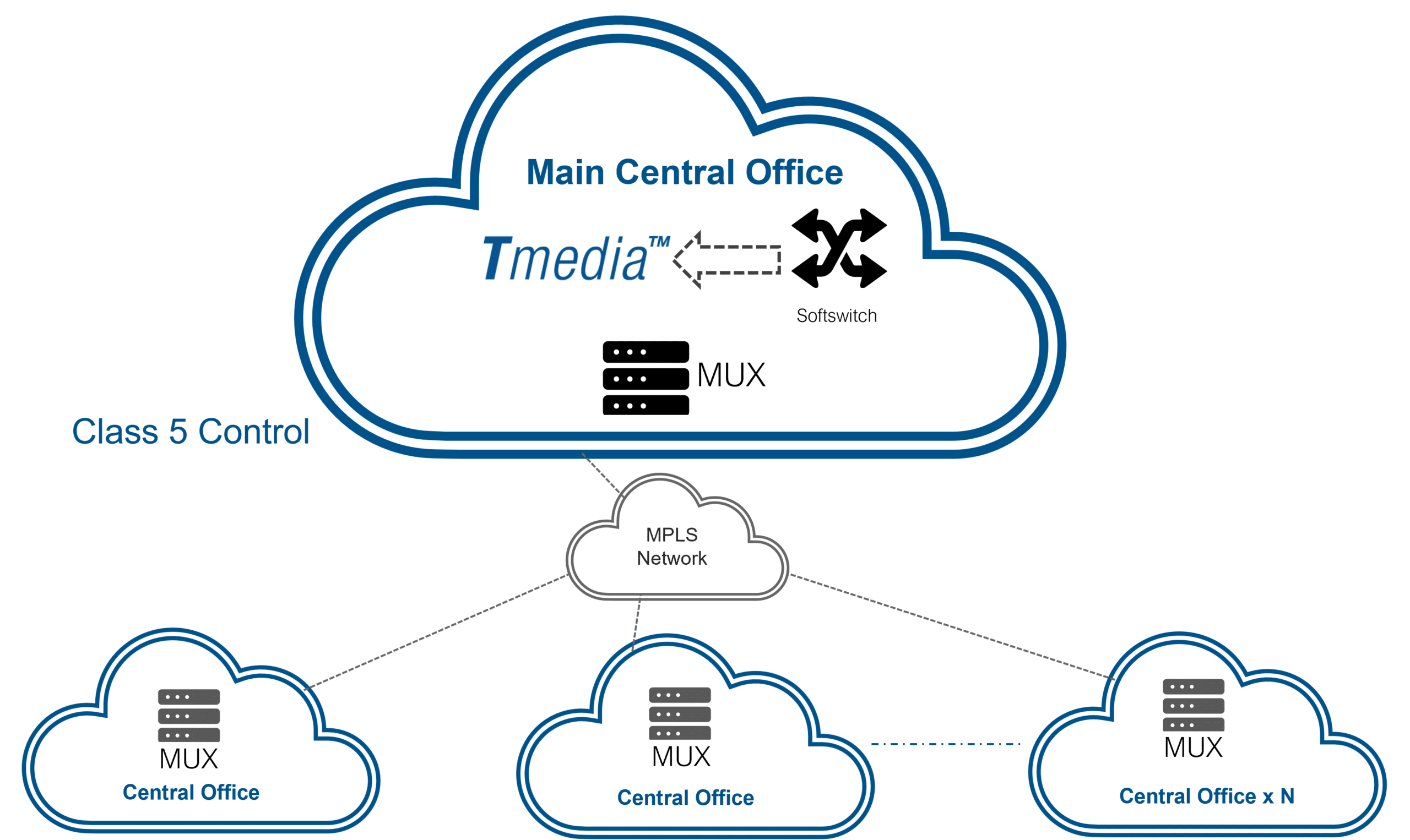
Centralized Architecture — TDM backhauled to a single core. Click to enlarge.
Solution
Decentralized architecture using TelcoBridges Tmedia gateways gives operators a more flexible way to modernize their networks. Instead of relying on a single large switch replacement, each central office receives a right-sized Class 4 IP-enabled switch that handles local access, signaling, and IP-interworking. This lets teams introduce IP gradually instead of committing to a full system cutover.
The Tmedia gateway terminates GR-303, SS7, or CAS and most TDM signaling locally and converts traffic to IP for delivery to a cloud or virtual softswitch. Because the solution runs over the existing IP network, operators can remove muxes, pseudowire systems, and other legacy TDM transport elements that no longer serve a purpose.
High-availability options are also available for sites that require continuous service during maintenance or hardware replacement.
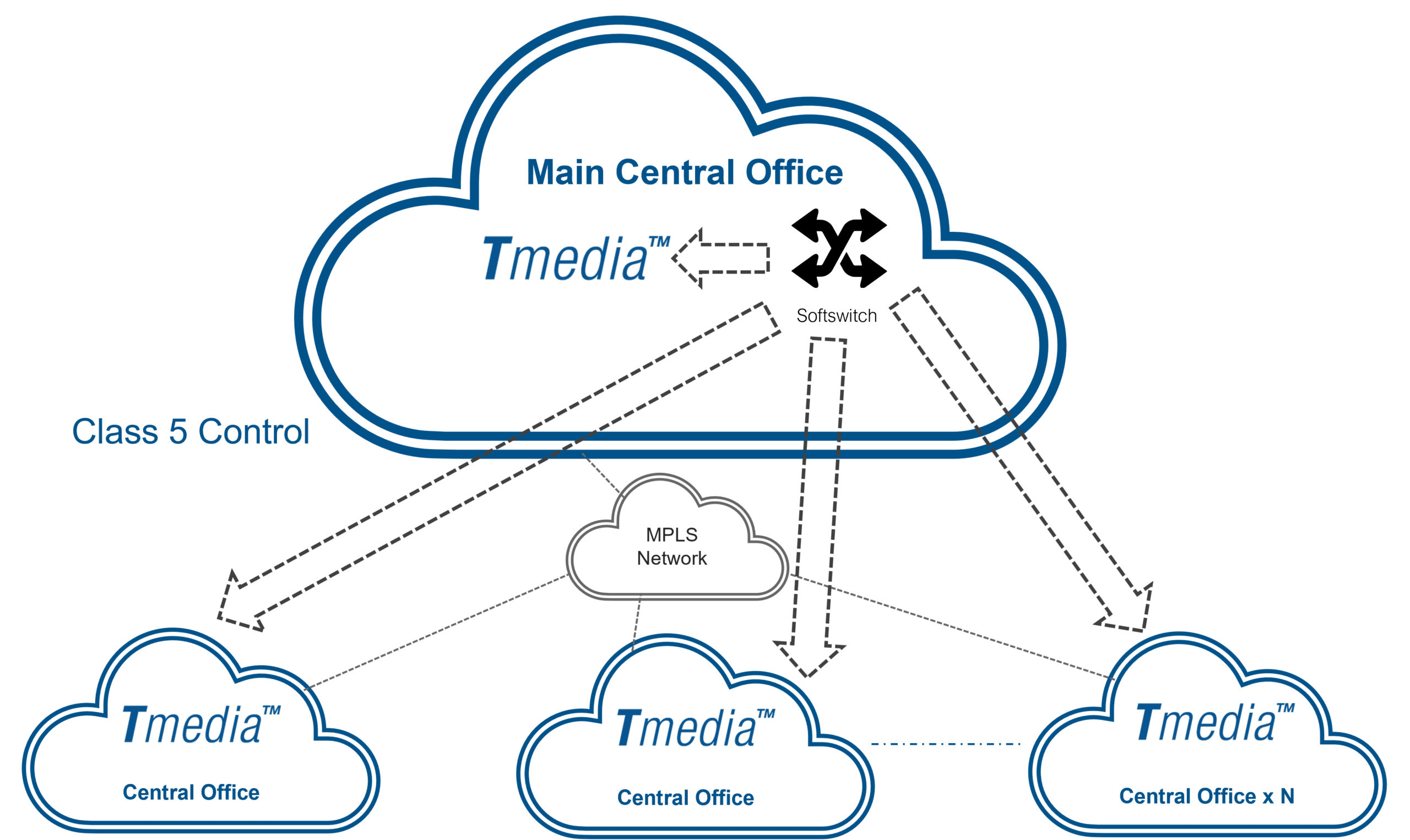
Decentralized Architecture — Access terminated locally at each site. Click to enlarge.
Results
As operators shift to this model, the first thing they notice is how quickly the cost pressure eases once legacy transport and switching gear come off the books. Day-to-day operations get easier because each site is cleaner and more predictable.
Deployments move faster than expected, and NECA alignment stays steady throughout the process. With SIP/IP in place, cloud-based call control fits in naturally, and teams retain the flexibility to keep TDM or SS7 where it is still needed.
Ready to modernize your network?
Discover how Tmedia can meet your network demands. Fill out the form below, chat live now, or call us at +1 450 903-8194 to arrange a consultation.
By submitting this form, your information will be processed in accordance with our Privacy Policy.