Oracle ACME Packet Alternative: ProSBC for Service Providers Cutting SBC Costs by 25x

Oracle ACME Packet has defined the carrier-grade Session Border Controller category for over two decades. The Acme Packet hardware platform, acquired by Oracle for $2.1 billion in 2013, set the standard for high-capacity SIP session management at the network edge. That reputation is earned. But reputation and pricing run on different timelines: at approximately $30 per session per year on multi-year capital expenditure for small and mid-sized deployments, Oracle’s SBC was priced for an era when purpose-built hardware was the only path to carrier-grade performance.
ProSBC, by TelcoBridges, is a carrier-grade software SBC built on more than 20 years of SIP deployment experience. Starting from as low as $1.40 per session per year, ProSBC delivers the security, interoperability, and scale service providers expect from an enterprise SBC, without the hardware lock-in or the procurement model that strains today’s budgets. This page is for the engineer or operator weighing the two.
Why Oracle ACME Packet Buyers Start Looking for Alternatives
The decision to evaluate Oracle alternatives rarely starts with product dissatisfaction. Acme Packet SBCs work. The trigger is almost always one of these:

Hardware end-of-life forcing a decision
Oracle has announced end of life for several Acme Packet hardware models, including the Net-Net 3810, 4250, and 4500 (CPU1) platforms. When the SBC hardware hits EOL, the choice is between buying new Oracle hardware on another multi-year cycle or evaluating whether software can deliver the same capabilities without the appliance dependency.
Renewal sticker shock at scale
Oracle SBC pricing is structured as a CapEx commitment, typically on a three-year cycle. For a service provider running 1,500 concurrent sessions, that works out to approximately $45,000+ per year in Oracle licensing. The same 1,500 sessions on ProSBC works out to approximately $3,750 per year.
CapEx friction in an OPEX world
Service providers, MSPs, and cloud-first enterprises have moved to operational expenditure models: annual subscriptions, monthly billing, pay-as-you-grow. Oracle’s multi-year CapEx commitment with hardware depreciation schedules runs against that trend. Procurement teams that have eliminated CapEx from every other infrastructure category still face it with their SBC.
Enterprise sales process mismatched to mid-market buying
Oracle’s procurement model involves enterprise sales engagement, custom quotes, and multi-month evaluation cycles. For a mid-market ISP or MSP with 500 to 5,000 sessions, that process is disproportionate to the purchase. These buyers want to download software, test it against their infrastructure, and make a decision in weeks.
Virtual SBC available, enterprise pricing stays
Oracle does offer a virtual SBC (vSBC/E-vSBC) on KVM, VMware, Hyper-V, AWS, Azure, and Oracle Cloud Infrastructure. The deployment flexibility is real, but the pricing model still reflects Oracle’s enterprise positioning. Moving from hardware to virtual Oracle does not solve the cost problem on its own.
Procurement teams flagging vendor lock-in
A purpose-built appliance with a vendor-prescribed configuration model and proprietary integrations creates exit costs that grow with deployment size. Multi-year CapEx renewals quietly extend that lock-in. Operators who reach scale on Oracle eventually re-evaluate whether the same capabilities can be delivered on commodity infrastructure with portable contracts.
Where Oracle ACME Packet Excels
Oracle’s SBC platform has genuine strengths.
Carrier-grade heritage, Tier 1 references
Oracle’s Acme Packet platform is deployed by Tier 1 carriers worldwide. If a procurement committee needs to see that the SBC vendor is used by the largest telcos on the planet, Oracle delivers that credibility.
Compliance positioning
In buyer research with enterprise decision-makers, two of four respondents chose Oracle specifically for compliance support and access to reference customers in regulated industries. Where regulatory compliance requires vendor-specific certifications or audit documentation, Oracle’s compliance infrastructure has value.
Broad protocol support
Oracle ACME Packet supports SIP and H.323. Session recording, NSEP RPH (National Security/Emergency Preparedness), and DoS/IDS capabilities are included. The platform covers protocols and features that matter in government, defense, and large carrier environments.
Purpose-built hardware performance
The Acme Packet hardware lineup, from the AP1100 (small/branch) through the AP3900/AP4600 (mid-range) to the AP6300/AP6350/AP6400 (high-capacity), is purpose-built for session border control. Where dedicated hardware is a requirement rather than a preference, Oracle’s platform delivers.
If you are a Tier 1 carrier with 50,000+ sessions, an existing Oracle communications stack, compliance mandates that specifically require Oracle certifications, and a procurement process that accommodates multi-year CapEx, Oracle’s ecosystem has value that justifies the premium.
The ~25x Price Gap: What the Numbers Actually Look Like
The single most compelling reason to evaluate ProSBC as an Oracle alternative is the cost differential. The figures below use Oracle’s approximate $30/session/year pricing (a market estimate; Oracle does not publish list pricing) and ProSBC’s published as low as $1.40/session/year (starting from; per brochure 05.2025).
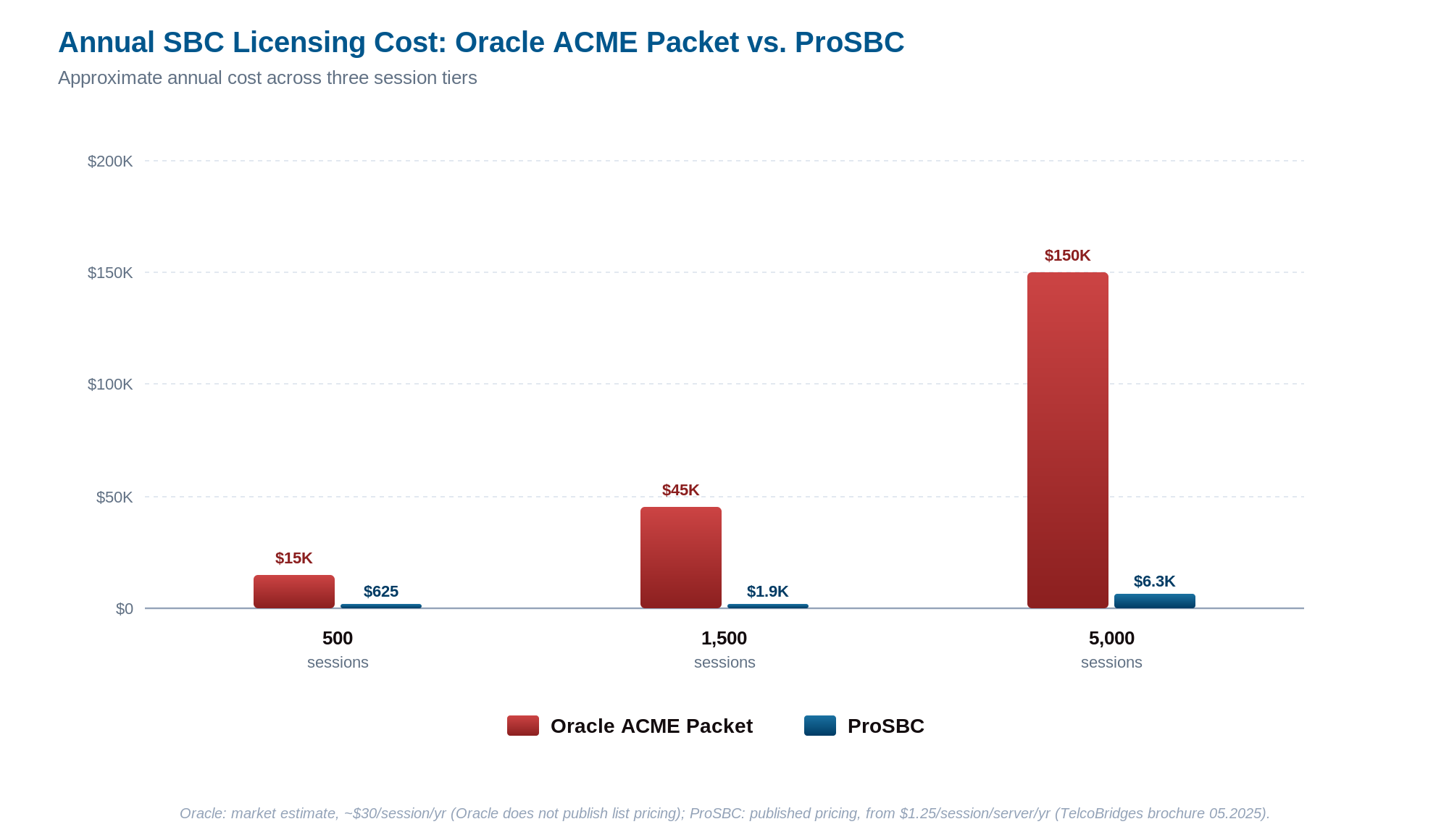
Annual licensing cost across four session tiers. Click to enlarge.
| Sessions | Oracle (annual, approx.) | ProSBC (annual, starting from) | ProSBC + 1+1 HA | ProSBC Managed Service |
|---|---|---|---|---|
| 500 | ~$15,000 | $1,250 | $2,000 | ~$6,000–$7,200/yr |
| 1,500 | ~$45,000 | $3,750 | $4,125 | ~$12,000–$18,000/yr |
| 5,000 | ~$150,000 | $7,500 (incl. 24/7 support) | $12,500 | ~$60,000/yr |
Three-year total cost of ownership widens the gap further. Oracle’s CapEx model includes hardware depreciation, maintenance contracts, and refresh cycles. ProSBC’s OPEX model is a flat annual subscription with no hardware to depreciate and no refresh cycle to plan.
The Managed Service option deserves its own line. TelcoBridges offers a fully managed ProSBC deployment via ProSBC+ with 1+1 High Availability, 24×7 support, setup, integration, testing, and ongoing monitoring. Customers can choose to have it hosted by TelcoBridges or deployed on their own platform (AWS, Azure, VMware, KVM). Even at managed-service pricing, ProSBC undercuts Oracle’s software-only license by a wide margin. For service providers who want carrier-grade SBC performance without building an internal SBC operations team, this is the comparison that matters: $5,000 to $20,000 per year for managed ProSBC versus $60,000 to $100,000 per year for an internal SBC engineer, on top of Oracle licensing.
Oracle does not publish pricing. The ~$30/session/year figure is a market estimate based on publicly observed deal sizes and may vary substantially by deal structure, volume, region, and negotiation. ProSBC pricing is published in the TelcoBridges brochure (05.2025) and starts from as low as $1.40/session/year. Contact both vendors for current terms.
ProSBC vs. Oracle ACME Packet: Head-to-Head
Sixteen data points across five categories. Filter chips zero in on the category that matters most for the evaluation. Where Oracle leads on a row, we say so.
Oracle specifications vary by hardware model, software version, and license tier. Verify current Oracle capabilities directly with Oracle. ProSBC figures from TelcoBridges brochure 05.2025. Pricing and specifications may change; contact both vendors for current commercial terms before a final evaluation.
Why Evaluate ProSBC
Oracle migration is not the right call for every operator, but a few patterns recur across the deployments TelcoBridges has helped move off Oracle ACME Packet.
- Oracle contract up for renewal at 500 to 10,000 sessions
- Peering SBC for carrier-to-carrier SIP trunking
- Up to 1,024 NAPs for multi-carrier management
- CDR output (text/RADIUS) for billing reconciliation
- STIR/SHAKEN for FCC compliance, partner-flexible
- The price differential alone justifies the evaluation
- SBC vendor cost outpacing the service margin on top of it
- Published pricing (as low as $1.40/session/yr) so margins can be modelled before any vendor call
- 30-day self-serve trial; validate in a lab without a sales engagement
- 1+1 HA for SLA-backed managed voice services
- Bring your own fraud, STIR/SHAKEN, and routing tools
- MaaS monitoring or full Managed Service for operational flexibility
- AP3810, AP4250, or AP4500 has hit end of life
- Hardware refresh decision sitting on the desk
- ProSBC on existing VMware or KVM eliminates the appliance dependency
- AWS or Azure deployment for cloud-first refreshes
- Real-time toll-fraud protection and per-call risk scoring
- SIP/TLS and SRTP for remote and WFH agent security
Why Service Providers Choose ProSBC
ProSBC is a carrier-grade software SBC built on more than twenty years of SIP deployment experience. It runs on any infrastructure, scales to carrier-grade capacity, and ships with the programmability and integrations service providers need.
Software-only, no proprietary hardware
ProSBC runs as a virtual machine on VMware, KVM/Proxmox, and uCPE, deploys natively on AWS and Microsoft Azure, and installs on baremetal for maximum performance. No appliance to rack, no firmware tied to specific hardware models.
Self-serve trial, running in about 20 minutes
The 30-day free trial includes 500 concurrent sessions with immediate download and online activation. No sales call required. After the trial, the permanent ProLab license (3 sessions, no time limit) keeps the lab environment running for ongoing integration and regression testing.
Open Ruby routing API, not just ACLI
Oracle is configured through ACLI: functional and well-documented for static SBC operations. ProSBC’s Ruby API module framework executes during call processing and can query external systems (LNP databases, CRM, billing platforms) on every call. That difference is static configuration versus real-time per-call decision logic.
Real-time fraud detection, open integrations
Per-call risk scores from TransNexus ClearIP, SecureLogix, or YouMail directly influence routing decisions. ProSBC queries the fraud platform during call setup and routes, blocks, or flags the call based on the response. Bring the fraud platform you already have.
STIR/SHAKEN with partner flexibility
ProSBC implements full STIR/SHAKEN signing, attestation (A, B, C levels), and verification, sending signing requests to any external HTTP-based service. Choose TransNexus, Neustar, or another provider. Primary and secondary signing URLs provide redundancy; if both are unavailable, ProSBC appends a P-Identity-Bypass header rather than dropping the call.
1+1 HA and a Managed Service option
ProSBC+ adds active/standby redundancy for maximum uptime. The Managed Service option pairs ProSBC+ with 24×7 support, setup, integration, and monitoring on the customer’s chosen platform (AWS, Azure, VMware, KVM) or hosted by TelcoBridges.
SIP normalization for multi-vendor interconnect
Header manipulation, codec negotiation, and protocol adaptation for carrier interconnect environments where no two carriers send identical SIP. Cleanly mediates between Oracle-fronted partners during a phased migration.
MaaS monitoring, standalone or bundled
MaaS is a hosted monitoring platform for ProSBC infrastructure, available standalone or bundled with the Managed Service. Real-time dashboards, threshold-based alerts, historical analysis. A monitoring product, not the Managed Service itself.
Frequently Asked Questions
How does ProSBC pricing compare to Oracle ACME Packet?
ProSBC’s published pricing starts from as low as $1.40 per session per year, billed as an annual OPEX subscription. Oracle does not publish pricing, but market estimates put it at approximately $30 per session per year on a multi-year CapEx basis. For a 1,500-session deployment, that translates to approximately $3,750/yr (ProSBC) versus approximately $45,000/yr (Oracle). Actual Oracle pricing varies by deal structure, volume, and region; contact both vendors for current terms.
Is ProSBC carrier-grade like Oracle?
ProSBC supports up to 60,000 simultaneous sessions per server, 350,000 endpoint registrations, and 1,024 Network Access Points. It is built on more than 20 years of SIP deployment experience by TelcoBridges and is deployed by ISPs, VoIP providers, and carrier networks. The platform is carrier-grade by any capacity or reliability measure. The distinction is deployment model (software vs. purpose-built hardware) and pricing model (OPEX vs. CapEx), not capability.
Can ProSBC handle the same session volume as Acme Packet?
ProSBC supports up to 60,000 simultaneous sessions per server. Oracle’s session capacity varies by hardware model, with the AP6300/6350/6400 series designed for the highest capacities. For most mid-market deployments (500 to 10,000 sessions), ProSBC’s per-server capacity exceeds what a single Oracle hardware unit delivers at the same price point.
What does migration from Oracle to ProSBC look like?
Most service providers migrating from Oracle to ProSBC run both platforms in parallel during a transition period, migrating NAPs and trunk groups incrementally. TelcoBridges also offers a Managed Service option that includes setup, integration, and testing for teams that want migration support.
Does ProSBC support STIR/SHAKEN like Oracle?
Yes. ProSBC implements full STIR/SHAKEN signing, attestation (A, B, and C levels), and verification via integration with external HTTP-based signing services. Validated integrations include TransNexus ClearIP and Neustar. ProSBC’s open API model lets the operator choose a signing partner rather than using a vendor-prescribed implementation.

Evaluate ProSBC as Your Oracle ACME Packet Alternative
ProSBC gives service providers a transparent, programmable, software-only SBC with the per-session economics, open integrations, and operator flexibility that purpose-built carrier hardware was never priced to deliver. The 30-day trial is self-serve and immediate: download, activate online, and pressure-test the SBC against real infrastructure before any vendor conversation.
If a fully managed deployment fits better, the Managed Service option pairs ProSBC+ with 24×7 support and day-to-day setup and monitoring on your platform.