SBC for Contact Centers: Security, Interoperability, and Cost Control at Scale

A contact center with 1,000 agents handling inbound and outbound calls simultaneously generates enormous SIP traffic: thousands of concurrent sessions, multiple carrier interconnects, real-time routing decisions, and zero tolerance for downtime. Every one of those calls crosses the network edge. That edge is where a Session Border Controller (SBC) sits, and the choice of SBC directly affects voice quality, security posture, carrier flexibility, and operating cost.
Whether you are migrating a legacy on-premises contact center to a cloud platform like Genesys Cloud or NICE CXone, consolidating multiple sites behind a single voice edge, or hardening your existing infrastructure against toll fraud and telephony denial-of-service (TDoS) attacks, the SBC is the control point. This page covers what contact centers need from an SBC, where legacy SBC solutions create friction, and how ProSBC by TelcoBridges addresses those requirements at carrier-grade scale and a fraction of the cost.

Why Contact Centers Need a Dedicated SBC
Contact centers are not typical enterprise voice deployments. The session density is higher, the carrier relationships are more complex, the uptime requirements are stricter, and the attack surface is larger. Here is what that means for SBC selection.
Voice Security at Scale
Contact centers are high-value targets for TDoS attacks, toll fraud, and call spoofing. A TDoS attack flooding a contact center with thousands of simultaneous fake calls can shut down operations entirely, blocking legitimate callers from reaching agents. Toll fraud exploits, where attackers route unauthorized international calls through compromised trunks, can generate tens of thousands of dollars in fraudulent charges overnight.
A purpose-built SBC provides the front line of defense: SIP over TLS for encrypted signaling, SRTP for encrypted media, DoS/DDoS mitigation rules that detect and block attack traffic before it reaches the platform, dynamic blacklisting for known bad actors, and SIP registration scanning protection that catches brute-force registration attempts.
Multi-Carrier SIP Interoperability
Large contact centers rarely work with a single SIP trunk provider. You may have one carrier for domestic traffic, another for international, a third for toll-free, and a fourth as a failover path. Each carrier uses slightly different SIP implementations: different header formats, different codec preferences, different DTMF signaling methods.
An SBC with a Back-to-Back User Agent (B2BUA) architecture terminates and re-originates every call, applying SIP header manipulation, negotiating codecs, and translating between carrier formats. Without this normalization layer, interoperability issues cascade into dropped calls, one-way audio, and failed transfers.
BYOC for Cloud Contact Center Migration
If you are moving to a cloud Contact Center as a Service (CCaaS) platform, Bring Your Own Carrier (BYOC) is the deployment model that lets you keep your existing SIP trunk providers, phone numbers, and carrier contracts. The SBC sits between your carriers and the cloud platform, handling SIP interconnection, media routing, and topology hiding.
BYOC gives contact centers control over carrier selection, number portability, call quality monitoring, and cost management. Without BYOC (using the CCaaS vendor’s bundled telephony), you lose visibility into the carrier layer and often pay a premium per minute.
Regulatory Compliance
Contact centers face a growing set of voice-specific regulatory requirements. PCI DSS compliance for voice payment processing demands isolation of the voice path handling cardholder data. Lawful interception capabilities may be required for regulated industries. The SBC is the enforcement point for all of these.
Intelligent Call Routing at the Edge
Beyond security and interoperability, the SBC can make real-time routing decisions before calls even reach the contact center platform. Priority routing based on calling number, geographic routing to the nearest site, overflow routing during volume spikes, least-cost routing across carriers, and integration with external databases (CRM lookups, fraud scoring APIs, number portability databases) for routing decisions that reflect business logic, not just network topology.
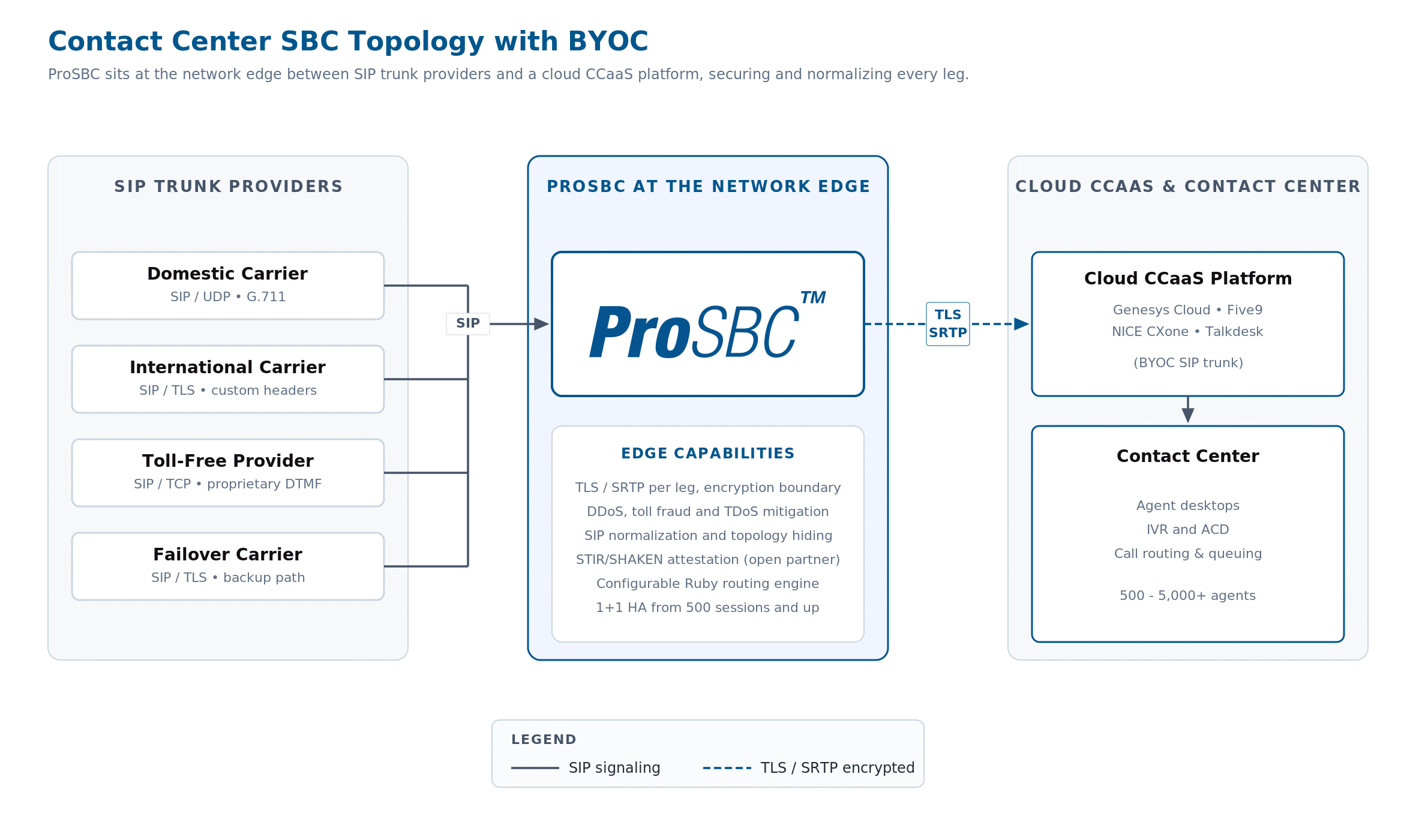
Contact Center SBC topology: ProSBC sits at the network edge with multiple SIP carriers on the carrier side and a cloud CCaaS platform on the contact center side. The SBC handles SIP termination, encryption, normalization, and routing per leg. Click to enlarge.
What to Look for in a Contact Center SBC
Not every SBC is built for contact center workloads. When evaluating options, these are the requirements that matter.
- Session capacity that matches your peak volume. A contact center with 1,000 agents may need 2,000 to 3,000 concurrent sessions at peak, accounting for IVR sessions, calls in queue, conferences, and transfers that generate multiple simultaneous SIP sessions per agent. Build in headroom for seasonal spikes and growth.
- High availability as a baseline, not an upgrade. Active/standby redundancy should be available at every deployment size, not reserved for enterprise-tier pricing. Contact centers are revenue-generating operations. Every minute of voice downtime has a measurable cost in lost calls, abandoned customers, and SLA penalties.
- 24/7 support that matches your operating hours. Contact centers run around the clock. Your SBC vendor’s support model must match. Look for direct access to senior engineers, not tiered help desks where your ticket gets escalated through multiple levels before reaching someone who understands SIP.
- A hosted and managed service option for operations that prefer it. Not every contact center wants to build and maintain SBC expertise internally. Some operations, especially those that lost their SBC specialist or never had one, benefit from a fully managed SBC service where the vendor hosts the platform (or runs it on the customer’s infrastructure), handles deployment, monitors the service, applies updates, and troubleshoots issues.
- Deployment flexibility for compliance and architecture. Two top-level deployment models matter: a self-hosted, self-managed license (you run the software on your own infrastructure) or a hosted and managed service delivered by the vendor. Within either model, the SBC should run on-premises for PCI DSS and data sovereignty requirements, in the cloud (AWS, Azure) for co-location with your CCaaS platform, on virtualization platforms (VMware, KVM), or in hybrid configurations for phased migration.
- A configurable routing engine with external integration. The SBC should support HTTP-based queries to external systems for real-time routing decisions: CRM lookups, fraud databases, number portability APIs, call scoring services. Static routing tables are not enough for contact center complexity.
- Transparent, predictable pricing. SBC costs should scale linearly with session count, not step-function with hardware appliance tiers. Published per-session pricing lets you model costs accurately when planning capacity.
How ProSBC Serves Contact Centers
ProSBC is a carrier-grade, software-only SBC by TelcoBridges, built on over 20 years of SIP deployment experience. Here is how it maps to contact center requirements.
Scale for High-Density Voice
ProSBC supports up to 60,000 simultaneous sessions per server and 350,000 endpoint registrations on a single instance. A contact center with 2,000 agents and 5,000 concurrent sessions at peak runs comfortably on one ProSBC deployment with substantial headroom. There is no need for multiple appliances, load balancers, or complex clustering to reach contact center scale.
Maximum Uptime
ProSBC is a hardened solution that secures millions of calls every day, and has for close to a decade. With HA at all session counts, active-active configurations, and geo-redundancy, ProSBC helps contact centers reach 99.999% uptime, backed by a team of Level 3 experts available 24/7 if issues ever arise.
Security Suite Built for the Voice Edge
ProSBC includes SIP over TLS for signaling encryption, SRTP for media encryption (including RTP-to-SRTP conversion for carriers that do not support SRTP natively), DoS/DDoS protection with configurable mitigation rules, dynamic blacklisting and call access control by IP range and calling/called number patterns, and SIP registration scanning protection that detects and blocks brute-force registration floods.
Fraud detection integrations with TransNexus ClearIP, SecureLogix, and YouMail provide real-time call scoring and routing based on spam risk, fraud probability, and robocall databases.
BYOC-Ready Architecture
ProSBC deploys between your SIP trunk providers and your CCaaS platform (Genesys Cloud, Five9, NICE CXone, Talkdesk, or any SIP-compatible platform). Its B2BUA architecture provides full topology hiding (your internal network addresses are never exposed to carriers or the CCaaS platform), SIP header manipulation for multi-carrier normalization, and configurable routing rules for carrier failover, least-cost routing, and geographic distribution.
High Availability at Every Scale
ProSBC+ provides 1+1 active/standby High Availability for maximum uptime and minimal downtime. Unlike some competitors that restrict HA to large-scale or enterprise-tier deployments, ProSBC offers HA for deployments as small as 500 sessions, at under $2,000 per year based on current brochure pricing.
Hosted and Managed Service: A Full Deployment Option
In addition to the self-hosted, self-managed software license, TelcoBridges offers a hosted and managed deployment option. The package includes ProSBC+ with 1+1 HA, 24/7 support by Level 3 telecom engineers, initial setup, carrier integration, testing, and ongoing monitoring. Hosting is the customer’s choice: TelcoBridges hosts the platform on its own infrastructure, or the service runs on the customer’s platform (AWS, Azure, VMware, KVM). In both cases, the customer retains full administrative access. Pricing for the hosted and managed service is quote-based, scoped to deployment size, hosting choice, and integration scope.
For contact centers that do not want to recruit and retain a dedicated SBC engineer, the hosted and managed service replaces multiple $60,000 to $100,000 per year internal resources with a fully supported voice edge.
Configurable Routing with External API Integration
ProSBC’s Ruby-based routing engine exposes a wide range of call parameters and supports HTTP-based queries to external systems for real-time routing decisions. Contact centers use this for CRM-driven routing (look up the caller in the customer database before routing), fraud scoring (query TransNexus ClearIP or SecureLogix mid-call-setup), number portability dips, and custom business logic that goes beyond what static routing tables can express.
Transparent Pricing at Contact Center Scale
For the self-hosted, self-managed license, ProSBC publishes its pricing: starting from as low as $1.40 per session per year. At 1,400 concurrent sessions (a mid-size BPO), the annual SBC license is approximately $3,500. At 5,000 sessions, approximately $7,500 per year, with 24/7 support included at this tier at no additional cost.
Pricing for the hosted and managed deployment option is quote-based and scoped to the customer’s deployment size, hosting choice, and integration scope.
Contact Center SBC Deployment Scenarios
BPO Migrating to Genesys Cloud
A business process outsourcer with 680 agents and approximately 1,400 concurrent sessions is moving from an on-premises Avaya platform to Genesys Cloud. They need BYOC connectivity to maintain existing carrier contracts and phone numbers. ProSBC deploys on AWS alongside the Genesys Cloud infrastructure, handling SIP interconnection with three carriers and TLS/SRTP encryption. The managed service option provides 24/7 monitoring and support without requiring the BPO to hire a dedicated SBC engineer.
Multi-Site Contact Center Consolidation
A financial services company operates contact centers in three cities, each with its own legacy hardware SBC and carrier connections. They consolidate voice infrastructure behind a single ProSBC instance (with HA) in their primary data center, using configurable routing to direct calls to the appropriate site based on geography, agent availability, and business rules. Total cost: under $10,000 per year for 5,000 sessions with 24/7 support included, replacing three hardware SBC appliances and their associated support contracts. ProSBC is also available hosted and managed by TelcoBridges, so as a contact center you can focus on your core operations while an experienced vendor manages the infrastructure for maximum uptime and reliability.
PCI-Compliant Payment Processing
A financial services contact center handles voice-based payment card transactions and must maintain PCI DSS compliance. They deploy ProSBC on-premises on their own VMware infrastructure, retaining full administrative control (meeting PCI DSS self-administration requirements). SIP over TLS and SRTP encrypt the voice path end-to-end. No managed service is used because PCI DSS requires the organization to maintain direct control over the cardholder data environment.
ProSBC vs. Legacy Contact Center SBC Options
The SBC market for contact centers has historically been dominated by hardware-first vendors. Here is an honest comparison.
| Requirement | ProSBC | Oracle E-SBC | Ribbon SBC | AudioCodes Mediant |
|---|---|---|---|---|
| Max sessions per instance | 60,000 | Model-dependent | Model-dependent | Up to 10,000 (Mediant 9000) |
| Pricing model | From as low as $1.40/session/yr (published) | ~$100/session/yr (unpublished) | Unpublished, premium | Unpublished |
| HA for small deployments |  Yes (500+ sessions) Yes (500+ sessions) |
Enterprise tier | 8K+ models | Yes |
| Hosted and managed service (vendor-delivered) | TelcoBridges- or customer-hosted |
Partner-delivered | Partner-delivered | Partner-delivered |
| Self-serve trial | 30-day free + permanent lab |
 No No |
No |
Channel partner only |
| Deployment | Software: VM, cloud, baremetal | Hardware + VM | Hardware + VM | Hardware + VM |
| Level 3 24/7 support | Direct from TelcoBridges |
Tiered | Tiered | Tiered |
Where competitors have advantages
AudioCodes has deep integration with Microsoft Teams environments. Ribbon has established carrier relationships and strong SIP interoperability documentation. Oracle wins enterprise RFPs where compliance certifications and reference customer access are the deciding factors.
Where ProSBC wins for contact centers
Price transparency on the self-hosted license, software-only deployment flexibility, a hosted and managed service delivered directly by the vendor (not through a partner), self-serve evaluation (no sales call required to test), and a configurable routing engine that adapts to contact center business logic.
Getting Started
Test in your lab with ProSBC Lab, a free, permanent, 3-session license. Set it up in approximately 20 minutes and validate SIP interoperability with your carriers and CCaaS platform.
Evaluate at scale with the 30-day free trial, which provides 500 concurrent sessions for production-level testing. No sales call required.
Talk to a specialist if your deployment needs managed service, HA planning, or multi-carrier integration design — contact TelcoBridges to discuss your requirements.
Frequently Asked Questions
What does an SBC do in a contact center?
An SBC sits at the network edge between your contact center and your SIP trunk providers (and/or cloud CCaaS platform). It secures voice traffic with encryption and DDoS protection, normalizes SIP signaling between different carriers, handles call routing decisions, and enforces regulatory compliance requirements.
Do I need an SBC for Genesys Cloud BYOC?
If you are using the Bring Your Own Carrier (BYOC) model with Genesys Cloud, an SBC sits between your SIP trunk providers and the Genesys Cloud infrastructure. The SBC handles SIP interconnection, media routing, topology hiding, and security. This gives you control over carrier selection, phone number portability, and call quality monitoring.
How many SBC sessions does a contact center need?
A common starting estimate is 1.5 to 2.5 concurrent SIP sessions per agent at peak, depending on your IVR complexity, transfer rates, and conferencing usage. A 1,000-agent contact center typically needs ~2,000 concurrent sessions. Build in 20-30% headroom for seasonal spikes.
Can an SBC protect a contact center from DDoS attacks?
Yes. A purpose-built SBC includes DoS/DDoS mitigation at the SIP layer: rate limiting, call admission control, dynamic blacklisting, and SIP-specific attack detection (INVITE floods, REGISTER floods, malformed packet filtering). This is the layer that network firewalls cannot address because firewalls do not understand SIP signaling.
What deployment options does TelcoBridges offer for contact centers?
ProSBC is available in two deployment models. The first is a self-hosted, self-managed software license: your team licenses ProSBC and runs it on your own infrastructure (on-premises, AWS, Azure, VMware, KVM). The second is a hosted and managed service delivered by TelcoBridges: the vendor handles deployment, 24/7 monitoring, updates, and troubleshooting. With the hosted and managed service, hosting itself is the customer’s choice: TelcoBridges hosts the platform on its own infrastructure, or the service runs on the customer’s platform (AWS, Azure, VMware, KVM). Contact centers that lack dedicated SBC engineering staff, or that prefer to focus resources on their core operations, often choose the hosted and managed path.
Deploy a Contact Center SBC with ProSBC
ProSBC is a carrier-grade, software-only Session Border Controller built for the session density, multi-carrier complexity, and uptime requirements of production contact centers. It runs as a full B2BUA with independent TLS/SRTP per leg, scales to 60,000 sessions on a single instance, and includes the security and routing capabilities discussed throughout this article: DoS/DDoS mitigation, dynamic blacklisting, SIP registration scanning protection, a Ruby-based routing engine with HTTP integration for CRM and fraud-scoring lookups.
For contact centers that prefer to focus on agent operations rather than SBC engineering, ProSBC is also available as a fully hosted and managed service with ProSBC+ HA, 24/7 Level 3 support, and your choice of TelcoBridges hosting or your own AWS/Azure/VMware/KVM infrastructure.
Prefer to evaluate on your own first? Start your 30-day free trial.