Understanding SIP Signaling: Fundamentals of VoIP Call Control and Interoperability

Every voice call that travels through an IP network relies on a carefully orchestrated sequence of messages to establish the connection. SIP signaling is the protocol that controls this orchestration. Unlike the audio stream itself (which uses RTP), SIP is the control plane: it tells the network where to send the call, when to ring the destination, and when to hang up. Understanding SIP signaling is foundational for anyone working with VoIP networks, SIP trunking, or carrier interconnection.

How SIP Signaling Controls the Call
SIP (Session Initiation Protocol) is a request-response protocol similar in structure to HTTP, but designed specifically for establishing, modifying, and terminating real-time communications sessions. It operates by defining two primary roles: a User Agent Client (UAC) that initiates requests, and a User Agent Server (UAS) that receives and responds to them. These roles are implemented and controlled by Session Border Controllers and other network intermediaries.
The core SIP methods handle distinct phases of a call lifecycle. INVITE initiates a new session: when you dial a number, an INVITE message is generated. ACK confirms that the called party has answered and the connection is established. BYE terminates the session when either party hangs up. Additional methods like REGISTER manage user location services (allowing the network to know where to find a user), and OPTIONS queries a server’s capabilities.
SIP servers respond with status codes that mirror HTTP structure. Codes in the 1xx range (100 Trying, 180 Ringing) are informational. Codes in the 2xx range (200 OK) indicate success. 3xx codes signal redirection, 4xx codes indicate client-side errors (like “user not found”), 5xx codes reflect server problems, and 6xx codes represent global failures that should not be retried. These responses allow the calling side to understand what happened and whether it should retry.
SIP runs across three primary transport protocols: UDP (connectionless, typically port 5060), TCP (connection-based, also port 5060), and TLS (encrypted, port 5061). TLS is essential for secure carrier-to-carrier peering and compliance-driven environments. The choice of transport depends on network reliability requirements and security policies.
Understanding the Basic SIP Call Flow
A SIP call follows a structured sequence: INVITE initiates the session, provisional responses (180 Ringing, 183 Session Progress) signal progress, 200 OK confirms the answer, ACK completes the handshake, RTP carries the audio, and BYE terminates the call. Each step in this sequence is a point where an SBC can inspect, modify, or enforce policy on the signaling.
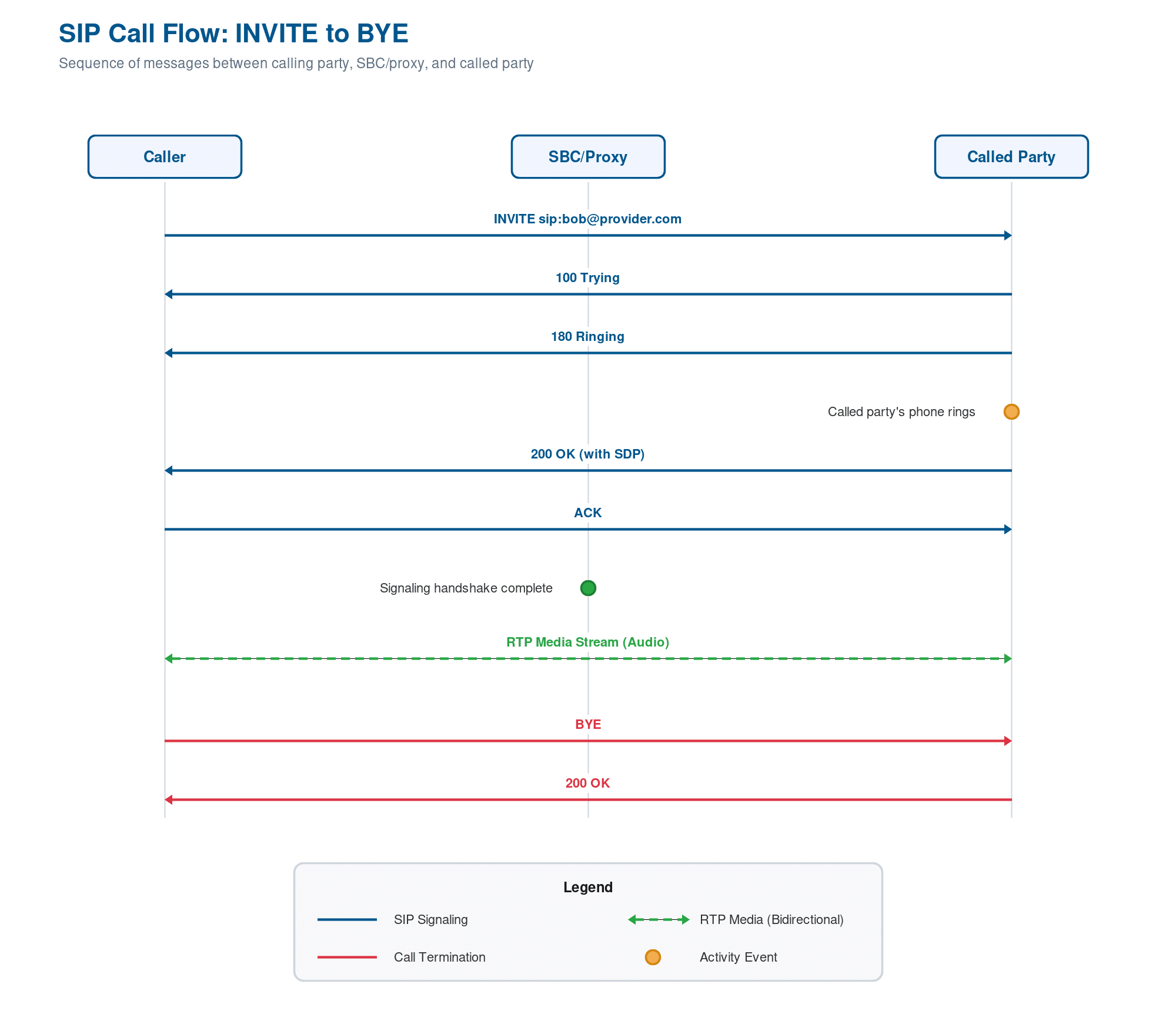
Click to enlarge.
For the full step-by-step walkthrough of every SIP message in a complete call, including failure flows, re-INVITE, and CANCEL, see SIP Call Flow Explained. For the structure of the INVITE message itself, see SIP INVITE Structure and Headers.
SIP Headers and Message Anatomy
Every SIP message has three parts: a request or status line, a set of headers, and an optional message body (typically SDP for media negotiation). The headers carry the routing trail (Via), the identities (From, To), the dialog identifier (Call-ID), and the transaction sequence (CSeq). In production, SIP header manipulation at the SBC is what makes multi-vendor interoperability work, because vendors implement header conventions differently.
The SIP Headers Complete Reference covers every header field-by-field. The SIP INVITE message reference walks through a production INVITE with annotated headers and SDP. For the SBC’s header rewriting mechanics, see SIP Header Manipulation.
SIP Proxies vs. B2BUA
A SIP proxy forwards messages without terminating sessions, keeping it lightweight but limiting its control over media and policy. A B2BUA (Back-to-Back User Agent) terminates the inbound session completely and originates a new one toward the destination, giving it full control over signaling and media on both call legs. Session Border Controllers are B2BUAs, which is why they can enforce per-call policy, normalize headers, transcode codecs, and manage routing independently on each side.
For the full comparison of when a proxy is sufficient and when a B2BUA SBC is required, see SIP Proxy vs SBC.
Why SIP Signaling Matters for Interoperability
SIP is standards-based, but vendors implement it with different header conventions, timing behaviors, and codec negotiation patterns. One vendor’s INVITE may include headers another vendor’s parser does not expect. Without normalization at the network edge, multi-vendor peering is brittle. The SBC’s SIP header manipulation engine inspects and rewrites every message in real time to bridge these incompatibilities, which is why carriers managing diverse networks of PBXs, contact centers, and cloud platforms rely on SBCs as the normalization layer.
For a practical look at how SIP normalization works trunk by trunk, see SBC SIP Trunk.
Conclusion
SIP signaling is the control-plane protocol that orchestrates every VoIP call, from initial setup through final termination. It’s a request-response architecture that allows intermediaries to inspect, route, and manipulate call flows without touching the media. Understanding the basic call flow (INVITE, 180 Ringing, 200 OK, ACK), the role of headers like Via and Contact, and the architectural difference between proxies and B2BUAs provides the foundation for designing, deploying, and troubleshooting VoIP networks.
For enterprises and carriers building multi-vendor networks, the ability to normalize SIP signaling across different platforms is critical to reliability. That’s where a B2BUA architecture (like the one at the heart of a Session Border Controller) becomes invaluable.
ProSBC and Intelligent SIP Signaling
SIP signaling is vendor-agnostic, but the implementation of an SBC determines how effectively it can bridge different vendor dialects. ProSBC operates as a true B2BUA, giving it complete control over SIP signaling on both the incoming and outgoing call legs. This means ProSBC can inspect every SIP message, validate it against your policy rules, normalize headers for downstream systems, and route calls based on complex criteria embedded in the signaling itself.
ProSBC includes a built-in SIP header manipulation engine that allows you to rewrite headers in real time, removing vendor-specific fields, adding required headers, or translating between different SIP dialects. This capability has proven essential for enterprises integrating multiple PBX platforms, contact centers moving to the cloud, and carriers managing interconnections with upstream providers.
For secure carrier-to-carrier peering, ProSBC supports SIP over TLS (encrypted signaling), ensuring that the control plane is protected from eavesdropping and tampering. Combined with SRTP for media encryption, this provides end-to-end security for voice communications.
Prefer to evaluate on your own first? Start your 30-day free trial.