SBC SIP Trunk: How a Session Border Controller Secures and Normalizes SIP Trunking
Every SIP trunk terminates somewhere. When that termination point is your PBX or UC platform with nothing in between, your internal voice infrastructure absorbs every signaling quirk, every malformed header, and every attack vector the public network throws at it. A Session Border Controller (SBC) sits at that boundary instead, giving you one controlled enforcement point for security, interoperability, and traffic management. Software-based SBCs built on more than a decade of carrier and enterprise SIP deployment now fill that role without dedicated hardware appliances.
This article covers what the SBC performs on SIP trunk traffic, why those functions matter in production, and what to weigh when sizing and placing one.

What an SBC Does at the SIP Trunk Border
A full-featured SBC operates as a Back-to-Back User Agent (B2BUA). It does not relay SIP packets between your trunk provider and your PBX. Instead, it terminates the inbound SIP session on one side and originates an entirely new session on the other, per RFC 3261. That architecture gives the SBC complete control over signaling and media on both call legs.
The distinction matters. A SIP proxy passes messages through with minimal modification. A B2BUA SBC can inspect, rewrite, and re-originate every SIP message. That capability unlocks several functions any production SIP trunk deployment ends up needing:
Topology hiding conceals your internal network addresses from the trunk provider. External parties normally see only the SBC’s public-facing address rather than internal PBX, media-server, or endpoint addressing. Proper normalization and topology-hiding policy prevent internal addressing details from leaking into external SIP paths.
Call admission control enforces session limits per trunk group. If your contract supports 100 concurrent calls, the SBC blocks the 101st before it ever lands on the PBX and consumes resources the PBX cannot give it.
Media anchoring forces RTP to traverse the SBC when enabled, allowing encryption, quality scoring (MOS), recording enforcement, and media policy control.
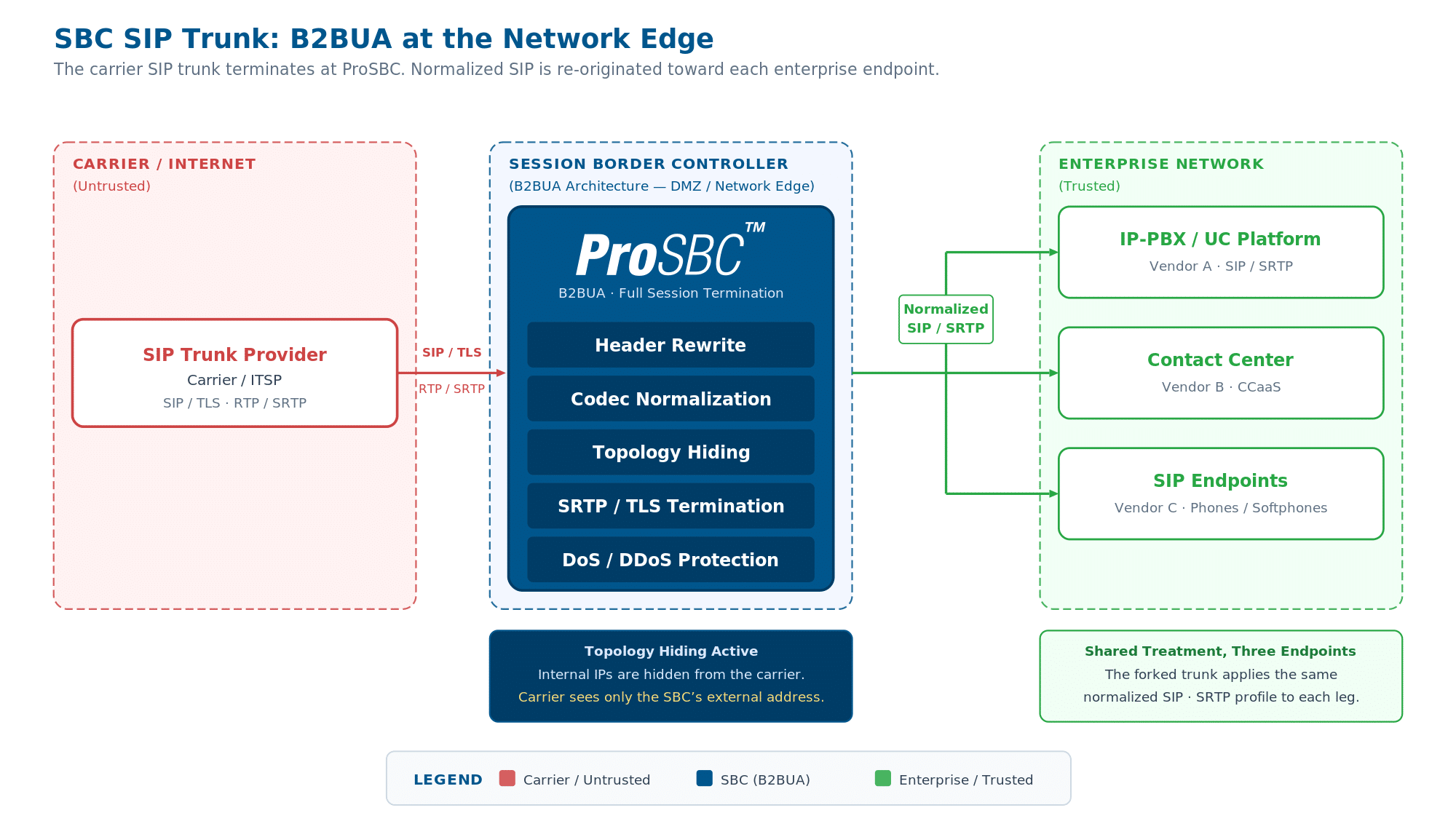
SBC SIP trunk topology: the SBC terminates the carrier SIP trunk and re-originates normalized SIP toward each enterprise endpoint, with independent signaling and media policies on every leg. Click to enlarge.
Security at the Trunk Boundary
A SIP trunk reachable from the public internet is a target. The SBC layers defenses at the network edge so the PBX never has to absorb the threat landscape directly. The SBC security reference covers the full five-layer model; the trunk-specific concerns are:
Encryption bridging is the function unique to trunk-facing SBCs. The carrier leg may deliver SIP over UDP with unencrypted RTP; the PBX leg may require TLS and SRTP. The SBC terminates each transport independently, so neither side dictates the other’s security posture. This is the same pattern that makes Teams Direct Routing work when the carrier does not support encryption.
Toll fraud on SIP trunks is where the SBC earns its keep financially. Per-call risk scoring on attributes like destination prefix, time-of-day anomalies, and calling patterns blocks fraudulent calls in real time before they generate carrier charges. For service providers, the programmable layer integrates with third-party fraud scoring via API. DoS protection, access control lists, and dynamic blacklisting round out the edge defenses.
SIP Normalization and Multi-Vendor Interoperability
The core interoperability problem in SIP trunking is dialect mismatch. Your carrier sends SIP with one set of header conventions. Your PBX expects a different format. Your contact center expects a third. Without normalization, calls fail silently, caller ID renders wrong, or DTMF digits vanish mid-call.
The SBC’s SIP header manipulation engine rewrites headers on both call legs to match each endpoint’s expectations. Common normalization tasks include rewriting From and P-Asserted-Identity headers for caller ID presentation, adjusting Diversion headers for call-forwarding interoperability, and tuning Contact and Via headers to match the transport parameters each side expects.
DTMF interworking is a frequent pain point in multi-vendor environments. One system sends DTMF as RFC 2833 RTP events, another uses SIP INFO, and a third still relies on in-band audio tones. The SBC translates between all three transparently, so IVR systems and voicemail platforms receive digits regardless of how the originating endpoint sends them.
Codec negotiation follows a similar pattern. When the trunk provider’s codec offer does not match the PBX’s preferred codec list, the SBC mediates the Session Description Protocol (SDP) exchange to find common ground, or bridges the mismatch by transcoding when no common codec exists. For the production trade-offs between codecs in that exchange, the G.711 vs G.729 comparison is the reference most operators reach for.
Deploying an SBC on a SIP Trunk
DMZ placement is the standard pattern for trunk-facing SBCs. One interface faces the carrier’s SIP trunk delivery; another faces the enterprise LAN where PBX, contact center, and UC platforms sit. That dual-homed position is what makes topology hiding and per-trunk enforcement work.
Sizing per trunk group starts with 90 days of CDRs from the carrier. The number that matters is concurrent sessions at the 99th percentile peak, not the average. Each carrier trunk group is its own NAP with its own session ceiling, so a deployment with three carriers has three independent capacity targets. The SBC buyer’s guide covers the full sizing framework.
Trunk failover is where HA intersects with trunk design. An active/standby SBC pair handles node failures, but multi-carrier trunk failover is a routing-engine decision: if Carrier A’s trunk goes down (detected via SIP OPTIONS keepalives or BFD), the SBC advances calls to Carrier B automatically. The VoIP HA reference covers the underlying failover patterns.
Trunk-level observability means per-trunk CDR output for billing reconciliation, per-call MOS scoring to catch quality degradation on a specific carrier before customers complain, and live SIP trace for diagnosing header-level interop issues. Operators replacing hardware SBCs typically gain the observability and API access that appliance platforms either bury behind paid tiers or do not expose at all.
Frequently Asked Questions
Do I need an SBC if I have a firewall with SIP ALG?
No. SIP ALG was primarily designed to assist NAT traversal rather than provide full session control. In production deployments it is frequently disabled because it can interfere with SBC behavior. A firewall handles IP-layer policy; an SBC handles SIP-layer policy. The two coexist, and SIP ALG should be off when an SBC is in path.
Can the SBC sit on the same VM as the PBX or contact center platform?
Technically yes, but the entire point of the SBC is being an enforcement boundary. Co-locating it with the workload it’s supposed to protect collapses that boundary. In production, the SBC runs on a separate VM (or pair of VMs for HA) on a different network segment.
How do I size for concurrent sessions versus CPS?
Pull 90 days of CDRs and look at peak concurrent sessions at the 99th percentile, not the average. For high-churn environments (contact centers, outbound dialers, AI voice traffic), also size for calls-per-second (CPS). A 1,000-session-capable SBC running at 100 CPS handles very different load than the same SBC running at 10 CPS, even at the same peak concurrent count.
Does transcoding require hardware?
It depends on volume and codec mix. Software transcoding handles modest counts comfortably. Carrier-grade transcoding at scale, especially mixing AMR-WB or G.729 with G.711, is where hardware transcoding acceleration earns back its cost. The SBC handles the SDP negotiation either way; hardware vs software is a question of how many concurrent transcoded sessions you need and at what latency.
Can one SBC handle TLS/SRTP toward Teams and unencrypted transport toward the carrier?
Yes. An SBC with independent per-leg transport configuration uses TLS/SRTP on the Teams-facing trunk group and whatever transport the carrier supports on the other side. RTP-to-SRTP conversion happens transparently between the two legs. This is the standard pattern for Teams Direct Routing deployments where the carrier still delivers unencrypted media.
Conclusion
The SBC is the single piece of voice infrastructure that lets you treat the SIP trunk as a controllable boundary instead of a direct line into your PBX. Topology hiding, call admission control, media anchoring, and per-trunk header rewriting are the operational backbone; TLS/SRTP, DoS/DDoS mitigation, dynamic blacklisting, and toll fraud scoring are the security backbone. Together they take the “hope the trunk provider is well-behaved” assumption out of the design.
When evaluating an SBC for SIP trunk deployments, the load-bearing decisions are architecture (B2BUA for full header control), per-leg transport flexibility, the granularity of the SIP header manipulation engine, and the quality of the debugging tools you have when something does not behave the way the spec sheets suggested.
Run ProSBC on Your SIP Trunks
ProSBC is a carrier-grade, software-based SBC built on full B2BUA architecture, with a SIP header manipulation engine designed for multi-vendor normalization. It runs up to 60,000 sessions per server with 350,000 endpoint registrations and up to 1,024 NAPs, which is enough to absorb complex multi-carrier configurations on a single instance.
Deployment options cover VMware, KVM/Proxmox, AWS, Microsoft Azure, and baremetal. Subscription pricing starts from as low as $1.40/session/year, which replaces the hardware CAPEX model with predictable OPEX. For organizations that prefer to evaluate before committing, the 30-day trial is self-serve and the install is a software-only process measured in minutes rather than weeks.
Prefer to evaluate on your own first? Start your 30-day free trial.