What Is the PSTN? Public Switched Telephone Network and the Migration to IP Voice

Almost everyone has used the PSTN, and almost no one can say what it actually is. It is the dial tone you grew up with, the number on the side of a delivery van, the line a fax machine still rings. As a network, though, it is a specific piece of engineering with a clear architecture, and that architecture is now being switched off country by country. Understanding how the public switched telephone network works makes the migration to IP voice far easier to reason about, because almost every design decision in a modern voice network exists to replace something the PSTN used to do.
In this article, we’ll walk you through what the PSTN is, how circuit switching and SS7 signaling actually move a call, how phone numbers route through the switching hierarchy, why carriers are retiring the whole thing, and where the boundary between the old network and IP voice sits today. TelcoBridges has spent more than 20 years working on both sides of that boundary, from TDM media gateways to the ProSBC software session border controller, so the PSTN-to-IP border is familiar ground.

What Is the PSTN?
The Public Switched Telephone Network (PSTN) is the aggregate of the world’s circuit-switched telephone networks, interconnected so that any telephone can reach any other telephone. It is not a single system owned by one company. It is thousands of operators, national carriers, regional exchanges, and interconnection agreements, all speaking common signaling and numbering standards so a call placed in one country can complete on a handset in another.
The name describes the design. “Public” means it is open to any subscriber who pays for a line, rather than a private network reserved for one organization. “Switched” means the network sets up a connection on demand for each call, rather than keeping every endpoint permanently wired to every other endpoint. And it is a network of networks, glued together by the signaling and numbering conventions covered below.
For most of the twentieth century the PSTN was the only way to make a phone call. That monopoly on voice is what makes it the reference point for everything that came after. When people say a VoIP call “reaches the PSTN” or a number is “ported off the PSTN,” they are describing the boundary between this legacy circuit-switched world and the packet-switched networks replacing it.
Circuit Switching vs Packet Switching
The single most important thing to understand about the PSTN is that it is circuit-switched. When you place a call, the network reserves a dedicated end-to-end path for that conversation and holds it open until someone hangs up. The standard voice channel is a 64 kbit/s digital circuit (a DS0), and that capacity belongs to your call alone, whether you are talking, listening, or sitting in silence.
Packet-switched networks work the opposite way. In a VoIP call, your voice is digitized, compressed by a codec, and chopped into small packets that travel independently across shared IP links, as defined by the Real-time Transport Protocol in RFC 3550. No path is reserved. The same fiber that carries your call carries thousands of others at the same instant, and during the gaps in your speech that capacity is used by someone else.
That one difference drives almost everything. Circuit switching gives predictable, constant-quality voice at the cost of efficiency, because reserved capacity sits idle whenever no one is speaking. Packet switching is dramatically more efficient and far cheaper to scale, though it has to actively manage jitter, packet loss, and latency to match the quality circuit switching delivered by default. The economics also diverge sharply: a circuit-switched network charges by holding a resource for the call duration, while a packet network charges for bandwidth it can oversubscribe.

Circuit switching reserves one dedicated path end to end for the full call, while packet switching breaks voice into RTP packets that share IP links with all other traffic. That difference accounts for the PSTN’s inherent quality and the cost efficiency of IP voice. Click to enlarge.
How the PSTN Is Built: The Switching Hierarchy
The PSTN is organized as a hierarchy of switches connected by trunks. Start at the subscriber end. The copper pair running from a telephone to the nearest telephone-company building is the local loop. That loop terminates at a central office (CO), where a local exchange switch, historically a class-5 switch, serves all the subscriber lines in its area and connects calls between them.
When a call has to leave the local area, the central office hands it up to a tandem or toll switch (historically class-4). These higher-tier switches do not serve subscriber lines directly. Their job is to interconnect central offices with each other and with other carriers, routing the call across the country or handing it to an international gateway. The links between all these switches are trunks: T1 and E1 circuits carrying bundles of DS0 voice channels using time-division multiplexing (TDM), where each channel gets a fixed repeating time slot on the shared line.
The original Bell System defined a five-level hierarchy, from local end offices up to regional centers. Decades of higher-capacity switching and fiber transport flattened that structure, and a modern PSTN is effectively a two-tier arrangement of local and tandem switching. The principle has not changed: subscriber lines aggregate into local switches, local switches interconnect through tandems, and TDM trunks carry the voice between them.
Signaling: How the PSTN Sets Up a Call
Setting up a circuit takes more than the voice path itself. The network needs to know which number you dialed, whether the destination is busy, when to start billing, and when to tear the circuit down. That control information travels on a separate signaling system rather than mixed into the voice channel, an arrangement called out-of-band signaling.
The system that does this is Signaling System No. 7 (SS7), a global signaling network that runs parallel to the voice trunks. SS7 carries the messages that establish, manage, and release calls. At a conceptual level it has three kinds of nodes: service switching points (SSPs) that originate and terminate calls, signal transfer points (STPs) that route signaling messages between them, and service control points (SCPs) that hold the databases. The call-setup protocol carried over SS7 is ISUP (ISDN User Part), while SCCP and TCAP carry database queries for services such as toll-free routing, number portability lookups, and caller-ID name retrieval.
Out-of-band signaling was a major advance. It made call setup faster, enabled an entire generation of network services, and kept control traffic off the revenue-bearing voice paths. It also became a well-documented security weakness later in the network’s life, since the SS7 trust model assumed every connected operator was legitimate. One historical quirk worth noting is that text messaging began as a side channel inside SS7’s spare signaling capacity, an origin story that still shapes how messaging crosses networks today.
Phone Numbers and Routing: E.164 and the NANP
On the PSTN, a phone number is a routing address, not just a label. The international format is standardized as E.164, which caps a fully qualified number at 15 digits and structures it as a country code followed by a national number. In North America, that national portion follows the North American Numbering Plan (NANP): a three-digit area code (NPA), a three-digit central-office prefix (NXX), and a four-digit subscriber line number.
Historically, those digits told the network exactly where to send the call. The NXX prefix mapped to a specific central-office switch in a specific rate center, and routing data such as the Local Exchange Routing Guide (LERG) translated number blocks into switch destinations. Dial a number and the hierarchy walked the digits outward, tandem by tandem, until it reached the right local switch.
Local number portability broke that tidy assumption. Once subscribers could keep a number when changing carriers, the digits no longer reliably indicated which switch or even which operator owned the line, so the network had to query a portability database before routing. That shift from “the number is the location” to “the number must be looked up” is one of the deeper changes the move to IP voice inherited and had to accommodate.
Why the PSTN Is Being Retired
The PSTN is being switched off for reasons that reinforce each other. The equipment is the first. Manufacturers have largely stopped building class-5 switches and TDM line cards, and operators increasingly source spare parts for legacy platforms on the secondary market. Keeping a network alive on hardware nobody makes anymore is a losing position.
The economics are the second. Running a circuit-switched network and an IP network in parallel means paying twice for overlapping capability, and the copper local loop is expensive to maintain compared with fiber and IP transport. Once an operator has an IP core, the TDM network is mostly cost.
The third reason is a hard regulatory and carrier-driven calendar that is now well underway. In the United Kingdom, Openreach stopped selling new PSTN and ISDN lines nationally in September 2023, and the full switch-off of the PSTN is scheduled for 31 January 2027, a date extended from an original December 2025 target to give vulnerable users, particularly telecare alarm customers, more time to migrate. In Australia, the legacy copper PSTN has been progressively decommissioned as services moved onto the National Broadband Network (NBN), with that transition substantially completed through 2025. In the United States, there is no single national switch-off date; instead, the Federal Communications Commission’s technology transitions framework lets carriers retire copper and TDM facilities on a service-by-service basis, so the US sunset is a rolling series of carrier filings rather than one deadline. Across continental Europe, several incumbents moved earlier, with Deutsche Telekom among the operators that completed an all-IP migration well ahead of the UK timetable.
Knowing why and roughly when the sunset is happening is one thing; actually moving a subscriber base off TDM without losing customers is a separate operational project, with its own migration calendar, deployment choices, and regulatory obligations that do not pause for a cutover. That subscriber-migration playbook is a topic in its own right, distinct from the network explainer here.
The PSTN-to-IP Border: Where Old Meets New
For as long as any part of the PSTN remains in service, IP voice networks have to reach it and accept calls from it. A subscriber on a modern SIP-based service still has to call a landline that has not migrated, and a remaining TDM customer still has to reach VoIP users. That meeting point is the PSTN-to-IP border, and it is where a few specific functions live.
Two translations happen at this border. On the media side, a media gateway converts the TDM bearer channels into RTP packet streams and back, bridging the 64 kbit/s DS0 world to codecs running over IP. On the signaling side, the legacy SS7 or ISUP signaling has to be mapped to the Session Initiation Protocol defined in RFC 3261, which is the control protocol of IP voice, a job handled by SS7-to-SIP signaling gateways. Once a call is on the IP side, a session border controller (SBC) sits at the edge to secure and control it: hiding internal topology, normalizing SIP signaling between mismatched systems, anchoring media, and enforcing call admission and security policy. Because the SBC is a Back-to-Back User Agent (B2BUA), it terminates the call on one side and re-originates it on the other, which is what gives it that control.
Mobile networks reach the PSTN through the same kind of boundary. In an IP Multimedia Subsystem (IMS) core, a media gateway control function interworks calls between IMS and the circuit-switched PSTN. Whatever the technology on the IP side, the pattern is consistent: gateways translate the bearer and signaling, and an SBC governs the IP edge.
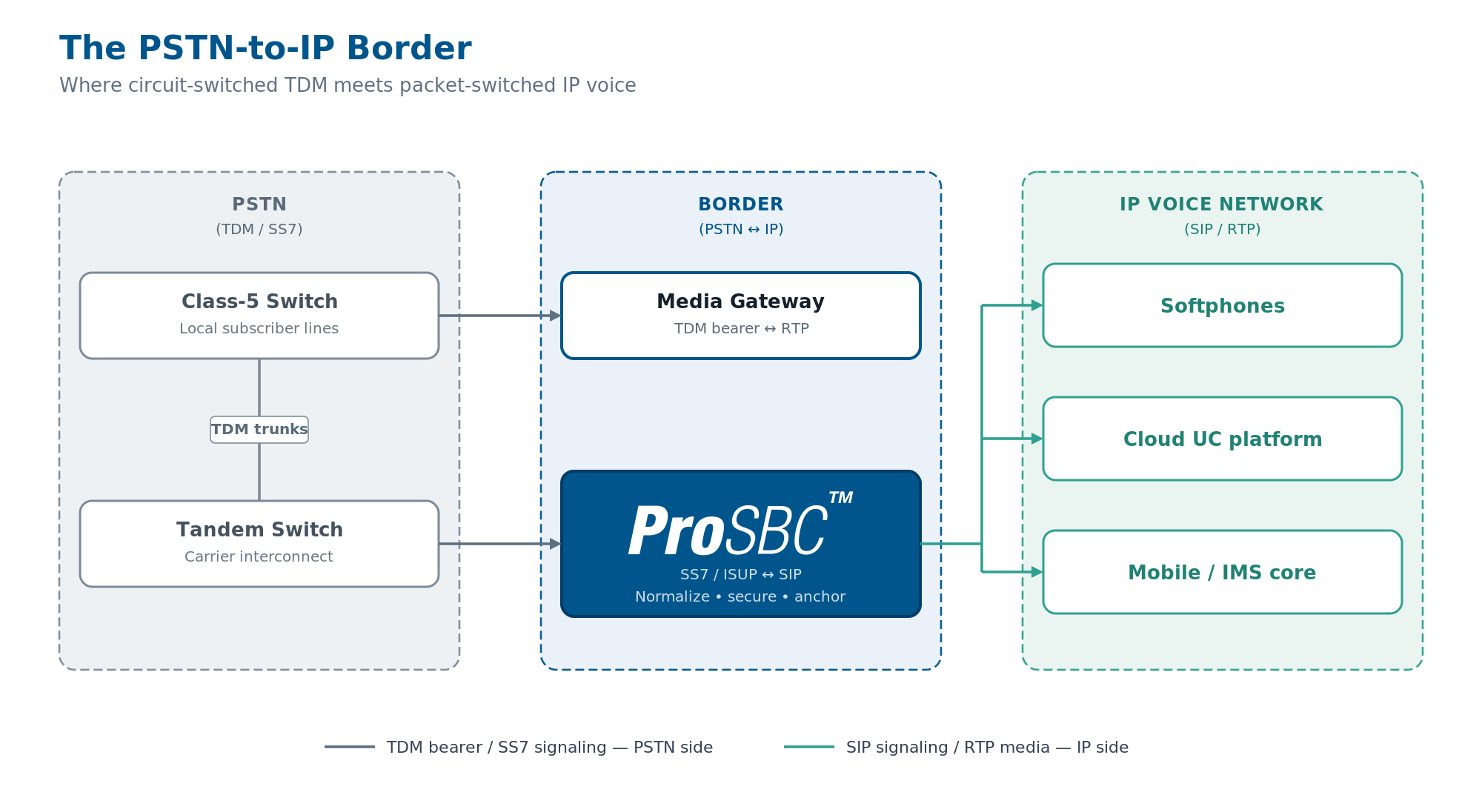
At the PSTN-to-IP border, a media gateway converts TDM bearer channels to RTP while a signaling gateway maps SS7/ISUP to SIP, and the SBC secures and normalizes the IP edge before traffic reaches softphones, cloud UC, or a mobile IMS core. Click to enlarge.
Frequently Asked Questions
Is the PSTN the same as a landline?
No. A landline is the access connection at the subscriber’s premises, the copper pair and the phone on the desk. The PSTN is the entire switched network behind it, including the central offices, tandem switches, trunks, and SS7 signaling that connect every landline to every other phone.
Is the PSTN going away completely?
The underlying TDM infrastructure is being retired, but the services it delivered are not disappearing. Phone numbers, emergency calling, and ordinary telephone service continue, carried over IP instead of circuit-switched TDM. From a subscriber’s perspective the phone still works; the network underneath has changed.
What is replacing the PSTN?
IP-based voice: SIP trunking and VoIP for fixed services, and mobile networks built on IMS for cellular. These packet-switched networks deliver the same calls more efficiently and add capabilities, such as integrated messaging and video, that the circuit-switched PSTN was never designed for.
What is the difference between the PSTN and VoIP?
The PSTN is circuit-switched: it reserves a dedicated channel for each call. VoIP is packet-switched: it breaks voice into packets that share IP links with all other traffic. That difference accounts for VoIP’s lower cost and greater flexibility, and for the quality management VoIP requires that the PSTN handled inherently.
Does VoIP still touch the PSTN?
Yes, until the global sunset is complete. Calls between IP networks and the remaining PSTN cross a border where media gateways translate the bearer and an SBC governs the IP edge. As more of the world’s voice moves to IP, that border shrinks, but it does not disappear while any TDM service remains in operation.
Conclusion
The PSTN is the global circuit-switched telephone network: a hierarchy of local and tandem switches, joined by TDM trunks, set up call by call over SS7 signaling, and addressed through the E.164 and NANP numbering plans. It worked extraordinarily well for a century, and it is now being retired because the hardware is end-of-life, the economics favor a single IP network, and regulators and carriers have set the dates. What survives is the service: numbers, emergency calling, and dial tone, delivered over IP. The piece that endures through the whole transition is the border between the two worlds.
Bridge the PSTN and IP Voice with ProSBC
Whoever bridges the PSTN and IP voice needs something at the border that secures and normalizes the IP side. That is exactly the SBC’s job. ProSBC is a carrier-grade software SBC that sits at the PSTN-to-IP and IP-to-IP edge, normalizing SIP signaling between legacy and modern systems, anchoring and securing media, and giving carriers and service providers control over how calls cross the boundary.
It runs virtual, in the cloud, or on baremetal, scales to tens of thousands of sessions per server, and is available either self-hosted or as a fully managed service. A permanently free three-session ProSBC Lab lets you stand up an interconnect and test it before you commit to anything.
Prefer to evaluate on your own first? Start your 30-day free trial.