correlated capture · analytics · support · real MCP depth
Voice Intelligence:
Homer Comparison
A side-by-side look at core capabilities, total cost of ownership, and day-to-day operational differences.
Looking for the VoIP Monitor comparison instead?
The Real Cost of Building vs. Buying
Homer’s primary appeal is its zero-dollar license. However, in production voice networks, software licensing is rarely the largest component of a monitoring system’s total cost. The bulk of the investment lies in ongoing engineering hours: building cross-leg correlation rules, constructing custom dashboards, scaling the underlying storage architecture, and maintaining the deployment over time.
Voice Intelligence is scalable voice data for better AI outcomes. Instead of asking your team to build and maintain everything from scratch, automated correlation, fleet analytics, anomaly detection, and node management work immediately out of the box, fully supported by TelcoBridges and already connected to AI. For lean teams managing complex infrastructure, or for teams managing growing voice networks, trading setup and maintenance overhead for immediate visibility offers a far better return on investment.
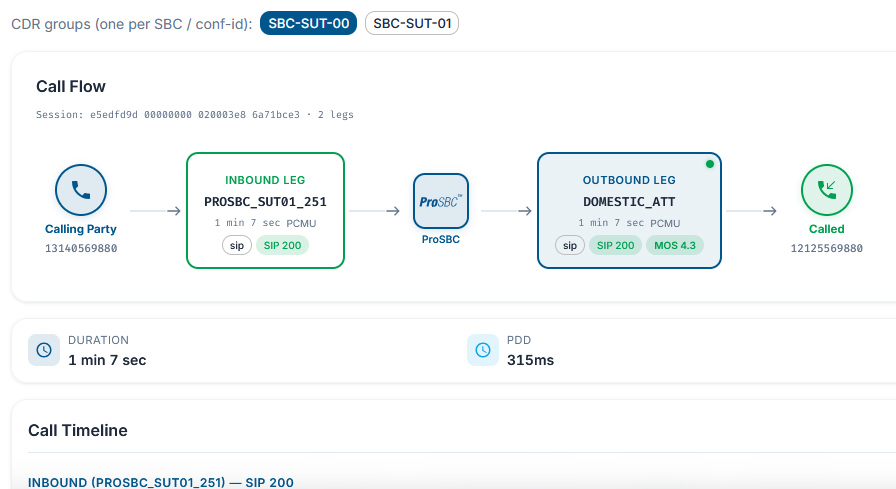
A whole call correlated end to end, on day one, with no rules to write or dashboards to build. With Homer this view is something you configure and maintain yourself.
Capability Comparison
| Capability | Voice Intelligence | Homer |
|---|---|---|
| SIP capture and call-flow reconstruction |  Yes Yes |
Yes, a core strength |
| Cross-fleet leg correlation | Automatic |
Configured rules |
| Analytics and dashboards out of the box | Included |
 Build by hand Build by hand |
| Anomaly and fraud detection | Built in |
Not a focus |
| Device health and capacity management | Built in |
Separate tooling |
| Element management system | Built in |
Not a focus |
| AI can act on the SBC via MCP | 100+ SBC actions |
No native MCP |
| Support and long-term maintenance | Backed by TelcoBridges |
Community, self-hosted |
| License cost | Commercial | Free |
Where Homer Is Strong
Homer earns its place. It is free, it is proven at scale, and for a team that has already invested in configuring its correlation and dashboards, it does the core SIP-capture job well. Operators with small networks who like to own and tune their stack often prefer that control, and an open-source tool with an active community has real staying power for those willing to maintain it.
Teams that have spent time fine-tuning Homer’s correlation rules for complex network topologies rely heavily on that precision. While Voice Intelligence correlates call legs across the fleet automatically, validating that automatic correlation against a custom-tuned Homer deployment is a key step during any evaluation on your network.
Where Voice Intelligence Pulls Ahead
Voice Intelligence combines call-level troubleshooting and network management into two core components. Trace automatically correlates call legs across the entire fleet and exposes full SIP message detail without requiring manual correlation rules. Nodes adds hardware-level health metrics, such as per-node CPU, RAM, and memory utilization, alongside aggregate historical trends and direct fleet management controls. Both arrive fully configured and backed by TelcoBridges support.
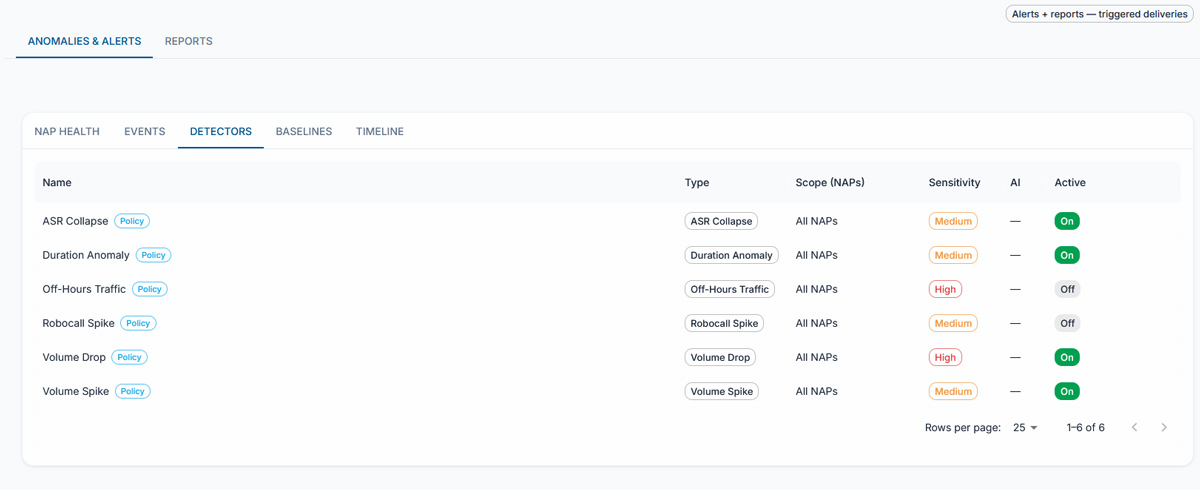
Anomaly detection illustrates this operational scope. Because health metrics and call data are correlated across the network, Voice Intelligence establishes traffic baselines and automatically flags deviations (off-hours surges, ASR drops, or robocall spikes) without manual setup. While Homer focuses strictly on capturing and displaying signaling data, Voice Intelligence provides the network-wide context needed to identify and address operational drift automatically.
Unlock Your Network’s Full Potential With AI
Effective AI on a voice network requires two fundamental components: a clean, correlated dataset across your entire fleet, and an SBC platform that an AI model can safely act upon.
Voice Intelligence provides the data foundation by ingesting SIP signaling, CDRs, and node health into a single correlated dataset with automated anomaly detection. ProSBC provides the execution layer as the first SBC to natively support the Model Context Protocol (MCP), exposing over 100 role-scoped actions directly to an AI model.
Combined with our built-in assistant (or the LLM of your choice), this architecture enables true operational automation. Correlated telemetry gives the AI an accurate picture of network behavior, while the MCP server provides a safe, auditable framework to execute configuration changes, policy adjustments, and mitigation actions with human oversight.
ASR dropped from 91% to 67% on NAP twilio-east in the last 4 minutes. Z-score 4.2.
87% of the failed calls returned SIP 408 (timeout) from twilio-east. The same calls succeed on twilio-west. Looks like Twilio-east peering degradation, not your SBC. Recommendation: lower routing weight on twilio-east temporarily.
Apply weight change via EMS? This is reversible. Stays auditable.
Frequently Asked Questions
Homer is free. Why pay for Voice Intelligence?
Because the license is rarely the real cost of a monitoring system. Voice Intelligence arrives correlated, analyzed, and supported, which saves the engineering time Homer asks you to spend on setup, dashboards, scaling, and maintenance. For a small team, that time is often the deciding factor.
Does Voice Intelligence correlate call legs as well as Homer?
It correlates automatically across the fleet rather than through rules you configure. On simple topologies that is a clear win in setup effort. On complex topologies, matching a finely tuned Homer setup is something we prove against your own network during evaluation.
Is Homer’s AI integration comparable?
Not really, because the two are solving different problems. TelcoBridges was the first SBC vendor to ship an MCP, and the ProSBC MCP exposes more than a hundred defined actions on the SBC, scoped by role, while Voice Intelligence supplies the correlated data a model reasons over. Together they let an intelligence layer both understand the network and act on it, which is what unlocks the full potential of AI on a voice network. An open-source capture store has neither of those halves, so there is no equivalent to compare against.
Can I migrate from Homer?
Operators in the beta ran both side by side while validating that Voice Intelligence covered their troubleshooting jobs. That parallel approach lets you keep Homer until the platform has earned the switch on your own network.
Get Out-of-the-Box Visibility for Your Fleet
Stop spending engineering hours building and maintaining custom capture stacks. Voice Intelligence delivers correlated call flows, node management, and AI readiness from day one.
Complete the form below to connect with our team and see how Voice Intelligence works on your network.
Simple to buy, fast to deploy: fixed monthly billing, priced on maximum concurrent calls, with no long-term commitment and deployment in 48 hours.
By submitting this form, your information will be processed in accordance with our Privacy Policy.
Want the full platform picture first? Start with the Voice Intelligence overview.