What Makes ProSBC API Integration So Powerful?

As telecom networks continue to evolve, service providers are increasingly relying on SBC APIs to extend functionality, improve call handling, and integrate with external platforms. In a recent TelcoBridges podcast, CEO Maximilien Le Sieur and VP of Client Technical Services Luc Morissette discussed how the ProSBC APIs are helping customers bring intelligent, flexible services to market—faster and more efficiently.
Here’s a practical look at how Session Border Controller APIs—and specifically, ProSBC’s implementation—are shaping the future of voice.
What Is an SBC API?
An SBC API allows a session border controller to interact with external services during the call setup or processing phase. This connection is typically established through REST APIs, using JSON-formatted data.
With this model, an SBC like ProSBC can send relevant call information—such as caller ID, dialed number, SIP headers, or metadata—to a remote platform. The external system processes the request and returns a result, which can be used to adjust the call flow, validate the call, or trigger another action in real time.
This architecture is increasingly vital for enabling features such as authentication, fraud detection, number portability checks, AI-based analytics, and advanced routing decisions.
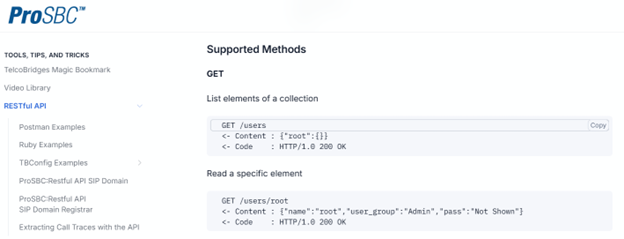
Above: a screenshot of ProSBC RESTful API. Source: ProSBC Documentation.
Why SBC APIs Matter?
APIs are becoming a critical component of modern telecom solutions. As regulations become more stringent, fraud becomes more sophisticated, and users demand greater transparency, service providers need to connect their SBCs to specialized third-party services that can perform authentication, enrichment, and analysis in real time.
Rather than building all of this functionality in-house, APIs allow providers to leverage external platforms and expertise—quickly and cost-effectively.
The ProSBC API was designed to make this integration simple, scalable, and flexible, enabling both prebuilt and customized use cases to run smoothly within the call flow.
Key Use Cases for ProSBC API Integration
- STIR/SHAKEN Authentication
With regulatory frameworks like STIR/SHAKEN now mandatory in several countries, call authentication has become a core part of network operations. ProSBC supports API-based integration with identity verification platforms. When a call arrives, ProSBC sends data to the authentication service, receives a signed identity token, and inserts it into the SIP signaling. This allows the terminating provider to verify the legitimacy of the call in compliance with regulations.
- Fraud Detection and Reputation Checking
ProSBC can connect to fraud detection databases or AI-based fraud engines via API. These systems evaluate whether a number has been associated with robocalls, spoofing, or other suspicious behavior. Based on the response, ProSBC can drop the call, reroute it, or flag it for further analysis—all in real time.
This integration helps providers protect their customers and their networks without compromising performance.
- Number Portability and CNAM Lookups
APIs are also used to query services for Local Number Portability (LNP), Caller Name (CNAM), and toll-free number resolution. Traditionally, these were managed through legacy telecom databases. Now, with modern APIs, ProSBC can fetch updated routing and caller name information dynamically during call setup.
- Enterprise Branded Calling
Even with call authentication in place, recipients often don’t answer calls from unknown numbers. Branded calling enhances trust by displaying a business name, logo, or call purpose directly on the device screen. While this service depends on device support from manufacturers like Apple or Samsung, ProSBC is ready to handle the signaling and data transport via API once the ecosystem is aligned.
- AI-Driven Analytics and Sentiment Detection
Service providers are also exploring API integration with AI platforms for analyzing call behavior. For example, ProSBC can send signaling data or media metadata to a third-party service that uses machine learning to detect patterns consistent with robocalls, spam, or call center abuse. Some systems even assess sentiment based on voice tone and background noise.
- Advanced Routing Control
ProSBC includes robust native routing capabilities. However, for providers with centralized policy engines or unique routing logic, the SBC can pass data to an external routing system via API. The response can then guide the call to the appropriate destination. This keeps the call routing flexible and centralized, even across distributed deployments.
Performance and Latency
One of the most common concerns with API integration is latency. In the case of ProSBC, latency is carefully managed. REST API calls typically resolve in milliseconds. If a service fails to respond in time, ProSBC uses built-in timeout logic to continue processing the call without interruption.
Because API queries typically occur during signaling—before media streams are established—audio quality is not affected. This makes it possible to use multiple APIs in the call flow without introducing noticeable delays for users.
ProSBC’s Scripting Framework
To make all of this possible, ProSBC includes a routing script module that allows customers to define how and when APIs are used. These scripts are highly configurable, supporting a wide range of use cases from simple header modifications to complex decision trees.
Customers can develop their own scripts, or work with the TelcoBridges team to build and deploy integrations. For common scenarios like STIR/SHAKEN, prebuilt scripts are available and can be activated with minimal effort.
Learn more
As telecom services continue to become more application-driven, APIs are no longer optional—they are essential. The ProSBC API offers a flexible, reliable way to extend your voice network capabilities.
If you’re a service provider looking to modernize your infrastructure, reduce risk, and introduce new services, ProSBC’s API framework is a powerful tool to help you get there. If you would like to learn more, contact our team to explore how SBC APIs can elevate your voice network.





Leave a Reply
Want to join the discussion?Feel free to contribute!