STIR/SHAKEN and Call Authentication

STIR/SHAKEN is no longer optional for most US voice service providers. The FCC’s implementation mandate, strengthened by the September 2025 own-certificate rule, means every originating provider needs infrastructure that signs calls with their own certificate, assigns the correct attestation level per call, and fails gracefully when the signing service is unavailable.
The Session Border Controller (SBC) is where all of this happens. It sits at the originating edge of the network, the last point of control before a call leaves your domain. But SBCs differ significantly in how they handle STIR/SHAKEN. Some offer a static, proprietary integration tied to a single signing partner. Others expose a configurable routing engine that gives the provider full control over attestation logic, partner selection, and fallback behavior.
This page explains what happens at the SBC layer during STIR/SHAKEN signing and verification, why configurable routing matters for compliance, and how ProSBC’s open architecture handles it.

How STIR/SHAKEN Works at the SBC Layer
The STIR/SHAKEN framework assigns two distinct roles to service providers: the originating provider signs the call, and the terminating provider verifies the signature. The SBC is the enforcement point for both.
Signing (Originating Side)
When a call enters the SBC from a customer trunk, the SBC collects the call details it needs for the PASSporT token: the originating number (from the P-Asserted-Identity or From header), the destination number (from the To header), and the timestamp (from the Date header). It determines the appropriate attestation level for the call, then sends a signing request to an external STIR/SHAKEN Authentication Service (STI-AS). The STI-AS uses the provider’s certificate to generate a cryptographic signature, wraps it in a PASSporT token, and returns a signed Identity header. The SBC injects that Identity header into the outbound SIP INVITE before forwarding the call.
Verification (Terminating Side)
When the SBC receives an inbound call carrying an Identity header, it forwards that header to a STIR/SHAKEN Verification Service (STI-VS). The verification service validates the cryptographic signature against the originating provider’s certificate, checks that the token has not expired, and confirms the calling and called numbers match the PASSporT claims. The result comes back to the SBC, which routes the call accordingly.
Attestation Levels
Every signed call carries one of three attestation levels, determined by the originating provider:
- A (Full Attestation): The provider authenticates the calling party and confirms they are authorized to use the calling number.
- B (Partial Attestation): The provider can authenticate the call’s origin but cannot verify the caller’s authorization to use the specific number.
- C (Gateway Attestation): The call entered the network from an external source the provider cannot authenticate.
The attestation level is not decorative. It directly affects how downstream providers and analytics platforms treat the call. A-level calls pass through, while C-level calls get flagged or blocked. Getting this wrong has real consequences for call completion rates.
For a deeper breakdown of each attestation level and when to use them, see our guide on STIR/SHAKEN Attestation Levels Explained (coming soon).
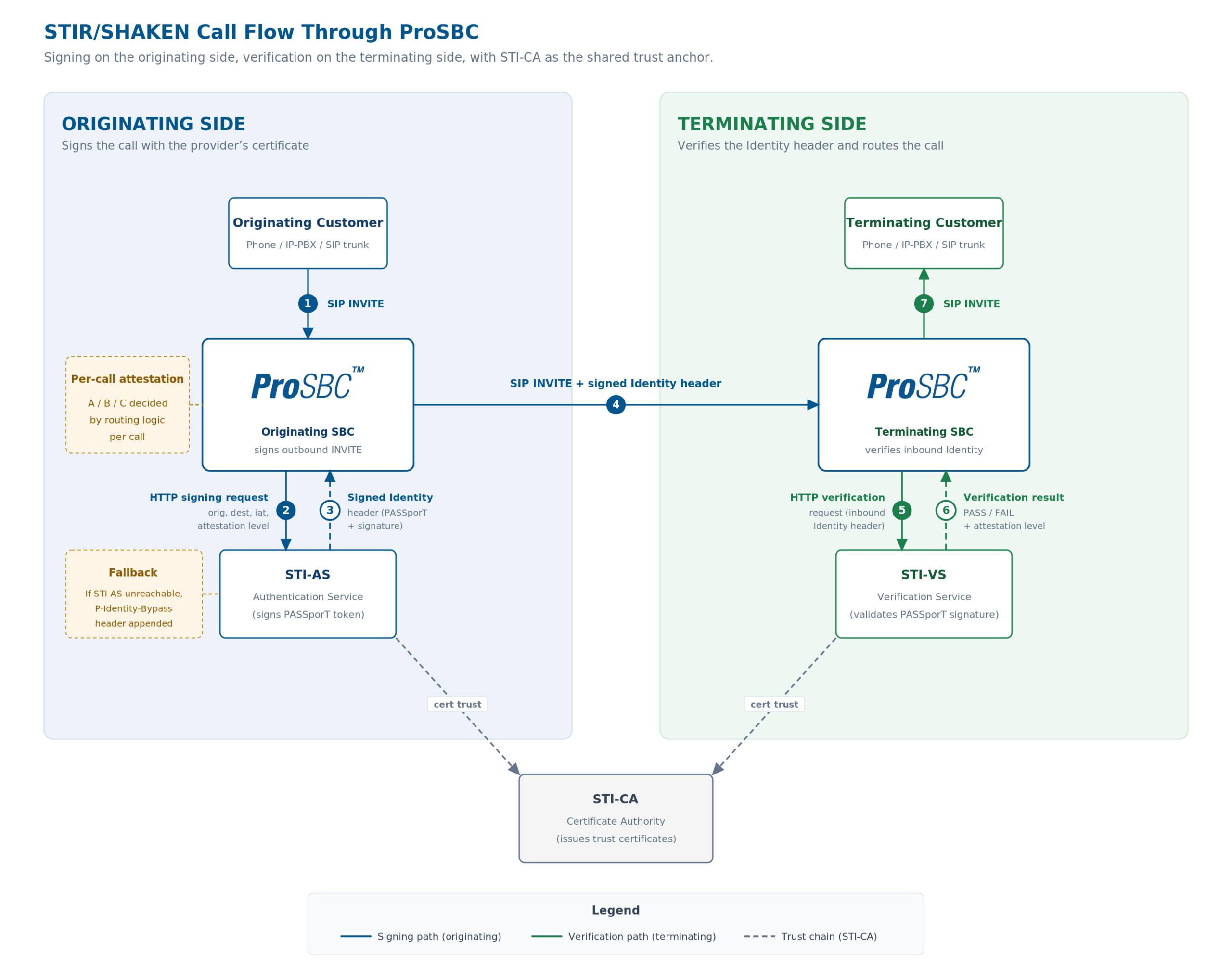
STIR/SHAKEN signing and verification flow through ProSBC. The originating SBC sends SIGNING requests to the STI-AS and injects the returned Identity header into the outbound INVITE. The terminating SBC sends VERIFICATION requests to the STI-VS and routes on the result. Primary and secondary signing URLs provide failover, and a P-Identity-Bypass header lets the call complete if the signing service is unreachable. Click to enlarge.
Why Attestation Control Belongs at the Routing Layer
Attestation is a per-call decision. It depends on what you know about the call source, and that knowledge lives in your routing logic.
Consider an ISP running a single SBC that handles three types of traffic: retail SIP trunking customers (you issued the numbers, you authenticate the subscriber), wholesale transit from a regional carrier (you know where it came from but cannot verify the caller), and gateway traffic from an international partner (untrusted source). The correct attestation level is A for the first, B for the second, and C for the third. All three pass through the same SBC.
An SBC that only supports a blanket attestation level per trunk forces you to choose one. Assign A to everything and you are making false attestation claims, which violates FCC rules. Assign C to everything and your retail customers’ calls get flagged as unverified, damaging their completion rates.
This is where configurable routing becomes a compliance requirement, not just a convenience. The routing engine evaluates each call against your business logic and assigns the attestation level dynamically. Retail customer on a trunk you provision? A-level. Wholesale transit where you know the originating carrier? B-level. Gateway traffic from an untrusted international peer? C-level.
The FCC’s own-certificate rule, effective September 18, 2025, reinforces this. Your organization must make the attestation-level decisions. A signing service can perform the technical act of signing, but it cannot assign attestation independently. (For a detailed breakdown of the own-certificate rule and what it requires, see our page on the FCC STIR/SHAKEN Own-Certificate Rule.)
If your SBC treats attestation as a static configuration rather than a routing decision, you will struggle to stay compliant as your traffic mix evolves.
For providers who need to move from C-level to A-level attestation with their own certificate, see our guide on STIR/SHAKEN A-Level Self-Attestation (coming soon).
Open Partner Model vs. Proprietary STIR/SHAKEN
Not all SBC vendors handle STIR/SHAKEN integration the same way. Some, including Ribbon and AudioCodes, offer proprietary STIR/SHAKEN implementations that constrain which signing service you can use. The integration is built into the SBC firmware, which simplifies initial setup but limits your options if you want to switch signing partners, add fraud scoring, or integrate additional compliance services.
ProSBC takes a different approach. Its configurable routing engine integrates with any HTTP or SIP-based signing service through Ruby API modules. TransNexus ClearIP, Neustar, or any other STI-AS that accepts standard HTTP signing or SIP INVITE requests: the integration is at the routing layer, not embedded in firmware.
How this works in practice: the StirShakenapi module sends an HTTP or SIP INVITE signing request to your configured signing service providers, carrying your authorization token and the call details (originating number, destination, timestamp, attestation level). The signing service returns a signed Identity header, and the SBC injects it into the outbound INVITE.
Three architectural advantages come from this approach:
Redundancy
ProSBC supports both a primary and secondary signing service providers. If the primary is unreachable, the request automatically fails over to the secondary. If both are down, a P-Identity-Bypass header is appended to the call, signaling to downstream providers that signing was unavailable for that specific call. The call still completes.
Partner Flexibility
Switching signing services means updating a provider (SIP NAP in ProSBC configuration) and authorization token in the routing configuration. No firmware update, no vendor engagement, no service window. If TransNexus raises prices or Neustar adds a feature you need, the migration is a configuration change.
Composability
Because the signing request is an HTTP or SIP call within the routing script, you can combine it with other API integrations in the same call flow. TransNexus ClearIP, for example, supports LCR (Least Cost Routing), fraud scoring, and STIR/SHAKEN signing in a single query. ProSBC’s routing engine can evaluate the fraud score, make a routing decision, and sign the call in one pass.
ProSBC’s STIR/SHAKEN Implementation
ProSBC supports three STIR/SHAKEN request types through its Ruby API modules:
Signing
The SBC sends a SIGNING request to the configured STI-AS. It populates the PASSporT claims from the SIP message: orig from the P-Asserted-Identity or From header, dest from the To header, and iat from the Date header. The signing service returns a signed Identity header containing the digital signature and attestation level, which the SBC injects into the outgoing INVITE.
Attestation
For deployments that separate the attestation decision from the signing operation, the SBC can send an ATTESTATION request. This allows the provider’s attestation logic to run independently of the signing service.
Verification
On the terminating side, the SBC sends a VERIFICATION request, passing the inbound Identity header to the STI-VS. The verification result informs routing decisions downstream.
Below is additional information that is configured by default in ProSBC:
Configurable timeout. Each HTTP or SIP query to the signing service has a configurable timeout. The default configuration is 10 seconds. This prevents signing latency from blocking call setup when the signing service is slow or unresponsive.
Primary and secondary providers (Network Access Points in ProSBC). Both signing and verification services support dual providers for automatic failover.
P-Identity-Bypass fallback. If the signing service is unreachable after retries on both providers, the SBC appends a P-Identity-Bypass header rather than blocking the call. The call completes, and the header provides transparency about why the Identity header is absent.
Domain-based routing. For networks handling both Mobile Origination (MO) and Mobile Termination (MT) traffic, the implementation supports domain-based routing to apply different STIR/SHAKEN behavior per call direction.
Validated partner integrations. ProSBC has documented integrations with TransNexus ClearIP (combined LCR, fraud scoring, and STIR/SHAKEN) and Neustar (authentication, verification, and 302 redirect processing). These are validated, production-tested integrations, not generic API claims.
Getting Started
If you are evaluating how your SBC handles STIR/SHAKEN, or deploying STIR/SHAKEN for the first time, start with the STIR/SHAKEN SBC Implementation Guide for the full step-by-step configuration walkthrough. ProSBC offers several paths to get started.
ProSBC Lab
ProSBC Lab is a free, permanent 3-session license for lab and testing use. It is self-serve and takes roughly 20 minutes to set up. You can configure STIR/SHAKEN signing and verification in a lab environment before committing to production.
30-Day Free Trial
The 30-day free ProSBC trial gives you 500 concurrent sessions for production evaluation. If your STIR/SHAKEN implementation needs testing at scale before going live, the trial covers it.
Managed Service
ProSBC Managed Service is available for providers who want TelcoBridges to handle STIR/SHAKEN configuration, monitoring, and ongoing compliance management. The managed service can be deployed on your own infrastructure (AWS, Azure, VMware, KVM, on-premises) or hosted by TelcoBridges. Your organization retains full access.
For providers already running an SBC with proprietary STIR/SHAKEN integration and looking for more flexibility, or for those deploying STIR/SHAKEN for the first time under regulatory pressure, the combination of configurable attestation control, open partner selection, and built-in redundancy is what makes this approach work.
Frequently Asked Questions
Test Your STIR/SHAKEN Configuration with ProSBC
Ready to see how a configurable SBC handles per-call attestation, open partner integration, and P-Identity-Bypass fallback? Start in a lab with ProSBC Lab, or evaluate at production scale with the 30-day free trial. Both paths let you configure STIR/SHAKEN signing and verification end-to-end with your preferred signing partner.