VoIP Security Threats and How SBCs Protect Your Voice Network
Voice networks carry far more than conversations. Every SIP message traversing the infrastructure contains authentication credentials, billing data, caller identity, and topology hints embedded in protocol headers. For an attacker, a compromised voice network is a high-value target, and many production deployments are still defended as if SIP traffic were generic UDP.
The numbers tell the same story. Vishing attacks surged 442% between H1 and H2 2024 as AI voice synthesis closed the gap on identity-based impersonation. Toll fraud continues to drain over USD 6 billion per year globally according to the Communications Fraud Control Association. Protocol-level exploits that enable remote takeover of VoIP phones via malformed SIP messages are documented regularly in the CVE database, with active campaigns targeting Grandstream, Cisco, and Yealink endpoints in the past 18 months alone.
Network firewalls alone do not stop any of these attacks effectively. They inspect packets at Layer 3 and Layer 4 and have no model of SIP, RTP, or the voice-specific attack patterns built on top of them. A Session Border Controller sits at the network edge with full visibility into SIP and RTP, which is what makes it the device that detects, mitigates, and blocks the seven attack classes covered in this article.

Why a Network Firewall Is Not Enough
Firewalls operate at Layer 3 and Layer 4: IP addresses, transport ports, and packet headers. To a firewall, VoIP traffic is just UDP on ports 5060 and 5061. The firewall cannot distinguish a legitimate SIP INVITE from a flood, detect toll fraud patterns in routing decisions, or identify spoofed caller identity in the From header.
SIP attacks live in the application layer. They are embedded in headers and message bodies that a network firewall never inspects. A SIP REGISTER flood can consist of perfectly valid SIP messages transported over UDP, TCP, or TLS, and the firewall passes every one through. An SBC sees the abnormal registration rate from one source and blocks it before it reaches the registrar. The deeper SIP DoS attack prevention guide walks through each flood type and the application-layer rate limiting that stops it.
Media handling creates the second gap. RTP streams use dynamically negotiated port ranges that often span thousands of UDP ports. Firewalls either open the full range (large attack surface) or rely on a SIP ALG to track media negotiation (well known for breaking call flows). An SBC anchors media on controlled ports as a B2BUA, so internal media paths are never exposed externally. The SBC security guide covers each defense layer with configuration patterns.
Firewall vs SBC at a Glance
| Capability | Traditional Firewall | Session Border Controller |
|---|---|---|
| SIP message inspection |  Sees UDP only Sees UDP only |
 Full SIP parsing Full SIP parsing |
| Media path control | Port range pinhole | Anchored media relay |
| Topology hiding | |
Native to B2BUA |
| Call-aware rate limiting | |
Per source, trunk, method |
| Toll fraud detection | |
Programmable routing plus scoring |
| Encryption termination | Pass-through only | TLS and SRTP per leg |
| Protocol normalization | |
SIP header manipulation engine |
| Caller identity verification | |
STIR/SHAKEN signing and verification |
Seven Critical VoIP Security Threats
The attacks below are the ones network engineers and security teams actually encounter in production voice environments. Each one exploits a specific weakness in VoIP infrastructure, and each one has a specific SBC defense.
1. Toll Fraud
An attacker compromises SIP credentials through brute-force registration, social engineering, or an open relay, then uses them to route international calls to premium-rate numbers the attacker controls. The attacker collects revenue from the premium-rate service. The carrier bills the victim, often for tens of thousands of dollars before the next invoice cycle closes.
Variants include International Revenue Sharing Fraud (IRSF), where the attacker has a revenue-sharing relationship with the premium-rate number provider; PBX hacking against misconfigured or unpatched IP-PBX systems; and wangiri (one-ring) schemes that auto-dial thousands of numbers and wait for callbacks to a premium-rate destination. Toll fraud unfolds in minutes. An attacker can generate thousands of dollars in fraudulent calls within an hour, while carrier bills arrive weeks later and chargebacks are difficult to obtain.
A properly configured SBC inspects every call before it routes. Programmable routing examines more than 100 parameters per call, including source IP, calling number, called number, destination country, time of day, and concurrent call count. Concurrent call limits per trunk prevent an attacker from running hundreds of simultaneous sessions. International destination blocking restricts calls to premium-rate ranges. Integration with fraud scoring services such as TransNexus ClearIP and SecureLogix evaluates each call’s risk score before it connects, blocking high-risk calls at the network edge before charges accrue.
2. SIP Flood Attacks (DoS and DDoS)
An attacker sends massive volumes of SIP INVITE, REGISTER, or OPTIONS messages to overwhelm the voice platform’s processing capacity. Legitimate calls cannot connect, existing registrations fail to refresh, and the network experiences a complete voice outage. Volumetric floods saturate bandwidth with raw packet volume. Protocol-specific floods target the SIP processing engine with malformed or computationally expensive messages. Distributed attacks generate traffic from thousands of source IPs simultaneously, making simple IP blocking ineffective.
SIP-aware rate limiting operates at multiple levels at the same time: per source IP, per trunk group, and per SIP message type. This granularity means the SBC can detect that a single IP is sending 500 REGISTER messages per second while allowing normal registration traffic from other sources to proceed unaffected. Protocol validation drops malformed SIP packets before they reach the call processing engine, neutralizing protocol-specific floods. Dynamic blacklisting automatically blocks offending sources when they exceed configured thresholds, with percentage-based greylisting for graduated response. SIP registration scanning protection is specifically designed to detect and block registration flood attacks, one of the most common VoIP DDoS vectors.
3. Eavesdropping and Call Interception
Unencrypted SIP signaling (UDP port 5060) and RTP media streams are readable by anyone with access to the network path between endpoints. The exposed content includes the full call audio, caller and callee identities, SIP credentials transmitted during registration, and DTMF tones that often carry passwords, credit card numbers, and PINs. Freely available packet capture tools can extract intelligible voice audio from unencrypted RTP streams in seconds.
The SBC enforces encryption on both the signaling and media planes. SIP over TLS on port 5061 encrypts all signaling traffic, preventing interception of call metadata, credentials, and routing information. SRTP encrypts the media stream, making captured audio unintelligible. The SBC also performs RTP-to-SRTP conversion: accepting unencrypted RTP from legacy endpoints that cannot encrypt natively and re-encrypting toward the destination. This means external connections can be secured immediately without replacing every internal endpoint. The SBC TLS and SRTP configuration guide walks through the deployment patterns.
4. Caller ID Spoofing and Robocalls
SIP’s design allows any value in the From header. There is no built-in authentication of caller identity. Attackers exploit this to forge caller ID, impersonating banks, government agencies, healthcare providers, or known contacts. AI voice synthesis has made these attacks dramatically more convincing, with attackers now able to clone a specific person’s voice from a few seconds of sample audio.
The scale is staggering. Billions of robocalls are placed every month in the United States alone. The FCC’s STIR/SHAKEN mandate exists specifically to address this problem by requiring cryptographic authentication of caller identity at the originating provider.
The SBC implements STIR/SHAKEN at the network edge. For originating calls, it integrates with an external signing service to create PASSporT tokens (cryptographic assertions of caller identity) and injects the Identity header into the SIP message. The SBC assigns attestation levels A (full authentication), B (partial), or C (gateway) based on how much the service provider knows about the caller. For terminating calls, the SBC validates incoming Identity headers by verifying the digital signature against the originating provider’s certificate. Integration with spam scoring services such as SecureLogix and YouMail provides real-time reputation checks on incoming caller IDs.
5. Topology Exposure and Network Reconnaissance
SIP messages naturally contain Via, Contact, and Record-Route headers that reveal internal IP addresses, server hostnames, network architecture, and software versions. Attackers use this information for reconnaissance: mapping internal topology before launching targeted attacks against specific servers or exploiting known vulnerabilities in identified software versions.
An SBC built on a Back-to-Back User Agent (B2BUA) architecture provides inherent topology hiding. A SIP proxy forwards messages and preserves header chains (including internal network details), while a B2BUA terminates the SIP session completely on one side and originates an entirely new session on the other. Every SIP header is reconstructed from scratch. Internal IP addresses, hostnames, and server names never appear in messages sent to external parties. Topology hiding is inherent to the B2BUA processing model because outbound SIP messages are reconstructed rather than forwarded transparently. Proper configuration is still required to avoid exposing information through optional or custom headers.
6. Registration Hijacking
An attacker registers their own device with the SIP registrar using stolen or brute-forced credentials. The registrar updates its binding table, and the legitimate user’s device stops receiving calls. The attacker’s device receives them instead. In more sophisticated attacks, the attacker registers with a higher priority, causing new calls to route to them while the legitimate device remains registered but unreachable.
SIP registration scanning protection detects abnormal registration patterns: rapid-fire attempts from a single source, attempts using sequential or dictionary-based credentials, or simultaneous registrations for the same user from different locations. Per-trunk registration rate limits prevent brute-force attempts from exceeding safe thresholds. Access control lists restrict which IP addresses and networks are permitted to register through each trunk group. RADIUS integration provides centralized credential verification and authorization, so registration attempts are authenticated against a trusted backend rather than accepted based on SIP-level credentials alone.
7. SIP Protocol Exploitation
Attackers craft malformed SIP messages designed to exploit parsing vulnerabilities in VoIP equipment: buffer overflows, header injection, SQL injection via SIP headers, or logic errors in SIP state machines. These attacks target the SIP processing engine itself, with the potential for remote code execution, service crashes, or unauthorized administrative access. Recent CVEs against Grandstream, Cisco, and Yealink endpoints demonstrate that these vulnerabilities are actively discovered and exploited in production.
The B2BUA architecture is again the critical defense. Because the SBC fully parses and reconstructs every SIP message, malformed input is either corrected through the SIP header manipulation engine, which normalizes non-standard messages, or dropped by protocol validation that rejects messages violating SIP standards. Properly configured B2BUA deployments prevent internal systems from seeing the original malformed SIP message directly; they receive only the SBC’s clean, validated reconstruction. A SIP proxy or firewall would pass the malformed message through to the target system.
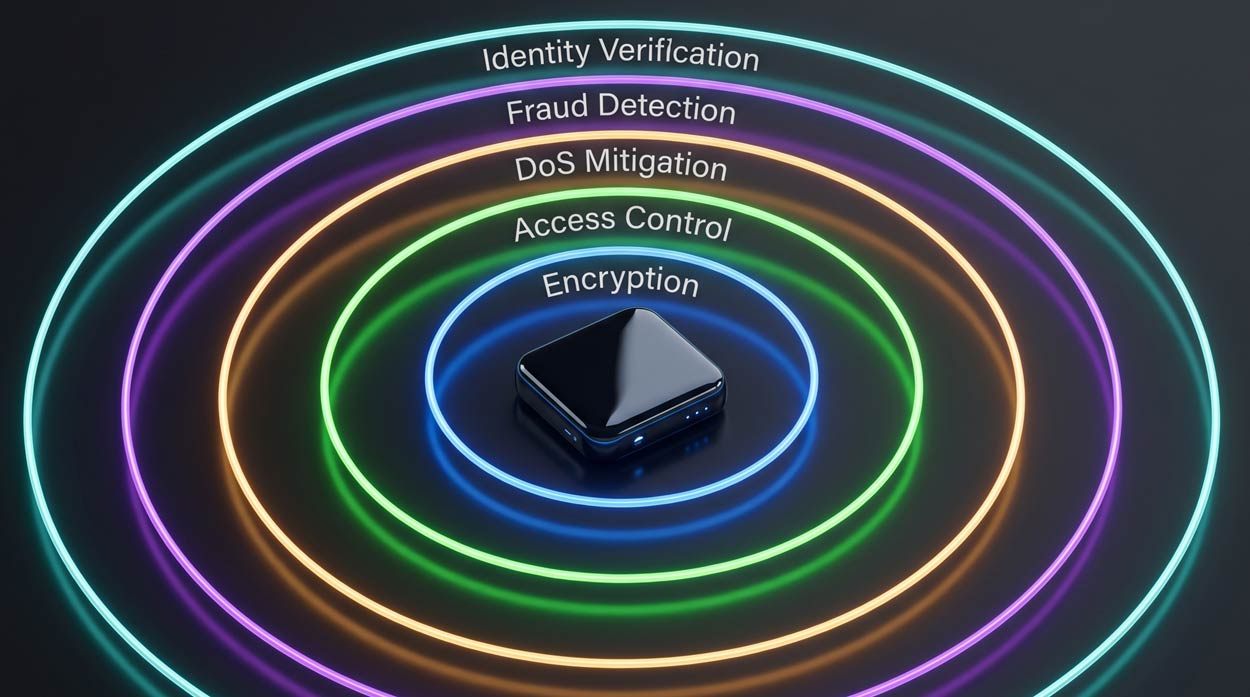
Defense in Depth: Five Layers of Protection
No single security mechanism stops all VoIP attacks. Toll fraud is a routing-layer problem. Eavesdropping is a transport-layer problem. Spoofing is an identity-layer problem. DoS is a capacity-layer problem. Protocol exploitation is a parsing-layer problem. Each attack vector requires its own defense, and each defense catches threats the others miss.
An effective SBC security posture operates as five concentric layers, each addressing a different attack surface rather than duplicating the one below it.
Layer 1 covers encryption through TLS for SIP signaling and SRTP for media. The layer prevents eavesdropping and credential theft so that even if an attacker gains network access, captured traffic is unintelligible.
Layer 2 covers access control through ACLs and IP blacklists. The layer restricts who can send traffic to your voice infrastructure, blocking known bad actors and unauthorized sources before they consume processing resources.
Layer 3 covers DoS and DDoS mitigation through SIP-aware rate limiting and dynamic blacklisting. The layer prevents volumetric and protocol-specific flood attacks from overwhelming call processing capacity.
Layer 4 covers fraud detection through programmable routing and per-call inspection. The layer evaluates every call in real time and blocks toll fraud, IRSF, and premium-rate abuse before charges are incurred.
Layer 5 covers identity verification through STIR/SHAKEN signing and verification, plus optional spam scoring integration. The layer authenticates caller identity and filters robocalls, addressing the spoofing and social-engineering attacks that bypass purely technical defenses.
The five layers are complementary, not redundant. An attacker who bypasses encryption (perhaps through a compromised internal endpoint) still faces access control. An attacker who passes access control using valid credentials still faces fraud detection. An attacker whose caller ID survives STIR/SHAKEN verification (a legitimate number used maliciously) can still be caught by behavioural fraud scoring. The SBC security guide covers each layer with deployment configuration examples.
What to Look for in an SBC Security Solution
When evaluating SBCs for voice network security, the capabilities below separate adequate solutions from comprehensive ones.
- Native TLS and SRTP support, including RTP-to-SRTP conversion for mixed environments, not just transparent pass-through.
- Per-trunk access control granularity so each carrier connection enforces its own security policies independently. A single global policy cannot account for the different trust levels of different peers.
- Programmable routing for custom fraud logic, because static route tables cannot detect sophisticated fraud patterns. Look for an SBC that lets you write custom inspection logic that executes before routing, with access to the full set of call parameters.
- STIR/SHAKEN signing and verification with the flexibility to integrate with your choice of signing service, not locked to a single vendor’s ecosystem.
- Third-party security service integration through the ability to query external fraud scoring, spam detection, and reputation services in real time during call setup.
- Built-in DoS and DDoS protection without requiring a separate appliance or additional licensing. DoS mitigation should be an inherent capability, not an add-on.
- Full B2BUA topology hiding that is architectural rather than configurable. Configurable topology hiding can be misconfigured; B2BUA-inherent topology hiding cannot be accidentally disabled.
- Real-time monitoring and alerting for visibility into active threats, blocked attacks, and traffic anomalies. Security without observability is security without awareness.
For deployments without dedicated SBC engineering capacity, a managed SBC service covers setup, day-two operations, and 24Ã7 support while preserving the same programmability for fraud logic and STIR/SHAKEN integration.
Where ProSBC Fits
ProSBC covers the SBC capabilities listed above in a software product that runs on AWS, Azure, VMware, KVM, Proxmox, or bare metal. The B2BUA architecture handles per-leg TLS and SRTP, full SIP normalization, per-NAP rate limiting and dynamic blacklisting with percentage-based greylisting, SIP registration scanning protection, and architectural topology hiding without configuration burden.
The Ruby routing API is where the fraud-detection layer lives. Validated integrations with TransNexus ClearIP, SecureLogix, and YouMail run as filters in the routing chain, querying each service during call setup and applying routing decisions based on risk score, attestation level, or spam reputation. STIR/SHAKEN signing and verification work through open partner integrations with either TransNexus ClearIP or Neustar, configured per call rather than as a single static attestation policy.
ProSBC scales to 60,000 sessions per server and supports up to 1,024 NAPs for multi-tenant deployments. Pricing starts at as low as USD 1.40 per session per year on subscription, with a 30-day free trial for commercial evaluation and a permanent ProSBC Lab license that provides three concurrent sessions for testing and integration work.
Frequently Asked Questions
What are the biggest VoIP security threats?
The seven most consequential threats are toll fraud (over USD 6 billion per year globally), SIP flood attacks (DoS and DDoS), eavesdropping on unencrypted signaling and media, caller ID spoofing now amplified by AI voice synthesis, topology exposure that enables reconnaissance, registration hijacking using stolen credentials, and SIP protocol exploitation targeting parsing vulnerabilities. Each requires its own layered defense.
How does an SBC protect against VoIP attacks?
An SBC provides defense in five concentric layers: encryption (TLS and SRTP), access control (ACLs and blacklists), DoS and DDoS mitigation (SIP-aware rate limiting per source, trunk, and message type), fraud detection (programmable routing with access to 100+ call parameters), and identity verification (STIR/SHAKEN signing and verification). Network firewalls cannot implement any of these because they have no model of SIP protocol semantics.
Is a firewall enough for VoIP security?
A network firewall operates only at the network and transport layers (IP addresses and UDP ports) and cannot inspect SIP application-layer traffic. It cannot distinguish a legitimate SIP INVITE from a flood, detect toll fraud patterns in call routing, identify spoofed caller identity in SIP headers, or handle dynamic RTP port ranges. An SBC parses every SIP message, validates it against protocol standards, and makes security decisions based on voice-specific context the firewall does not see.
Does STIR/SHAKEN stop all caller ID spoofing?
No. STIR/SHAKEN authenticates the originating provider’s relationship to the caller, but legitimate numbers used maliciously still pass A-level attestation. STIR/SHAKEN is most effective when paired with behavioural fraud scoring (TransNexus, SecureLogix, YouMail) and per-call routing logic that can react to mixed signals during setup.
Is RTP-to-SRTP conversion really necessary?
For any deployment that touches Microsoft Teams Direct Routing, WebRTC, HIPAA-regulated ePHI, or PCI DSS voice payment flows, yes. Many carriers still deliver unencrypted RTP, and many legacy endpoints cannot encrypt natively. RTP-to-SRTP conversion at the SBC lets external connections meet encryption requirements without replacing every internal endpoint at the same time.
Protect Your Voice Network with ProSBC
VoIP threats are not theoretical. Toll fraud, DDoS attacks, eavesdropping, and caller ID spoofing are active, ongoing threats that cost the telecommunications industry billions every year, and AI voice synthesis is making the identity-based attacks faster and cheaper to scale.
An SBC is the minimum viable security posture for any production voice network, the equivalent of a firewall for the data network but built for the protocols and attack patterns specific to voice. ProSBC ships with the full set of capabilities covered above: per-leg TLS and SRTP, full SIP normalization, programmable fraud detection, STIR/SHAKEN signing and verification, and B2BUA-inherent topology hiding, on commodity infrastructure with subscription pricing.
Prefer to evaluate on your own first? Start your 30-day free trial.