Scoring Every Call as It Happens with Real-Time Fraud Protection
Voice fraud does not announce itself. A fraudulent call looks like any other until the pattern behind it, an unusual destination, a suspicious volume, a number with a bad reputation, is measured against what a fraud service already knows.
Analyzing call records after calls have completed can tell an operator what fraud already happened, but it cannot prevent the charges. By the time the CDR is written, the toll fraud has already generated a bill. The only place to catch it before it costs anything is at the moment the call is being set up, and the device positioned to do that is the session border controller.
How Real-Time Fraud Protection Works
Real-time fraud protection is the inspection of incoming and outgoing call traffic to measure the risk of each call as it happens, by integrating the SBC with a fraud-scoring service. The SBC acts on the verdict, allowing, blocking, or flagging the call, before it connects and before fraud can generate a bill.
The protection comes from a division of labor. The SBC sees and controls the call, while a specialized fraud service holds the intelligence about what is risky. When a call arrives, the SBC inspects its details and queries the fraud service during call setup. The service returns a score or verdict based on reputation, destination, and behavioral patterns it tracks across the wider network, and the SBC acts on that answer. Because this happens inline, the decision is made before the call connects.
Where the specific problem is charges being run up on the network, the mechanics of stopping it are covered in the guide to real-time toll fraud prevention. This page is about the general capability of scoring every call as it happens, whatever fraud it is guarding against.
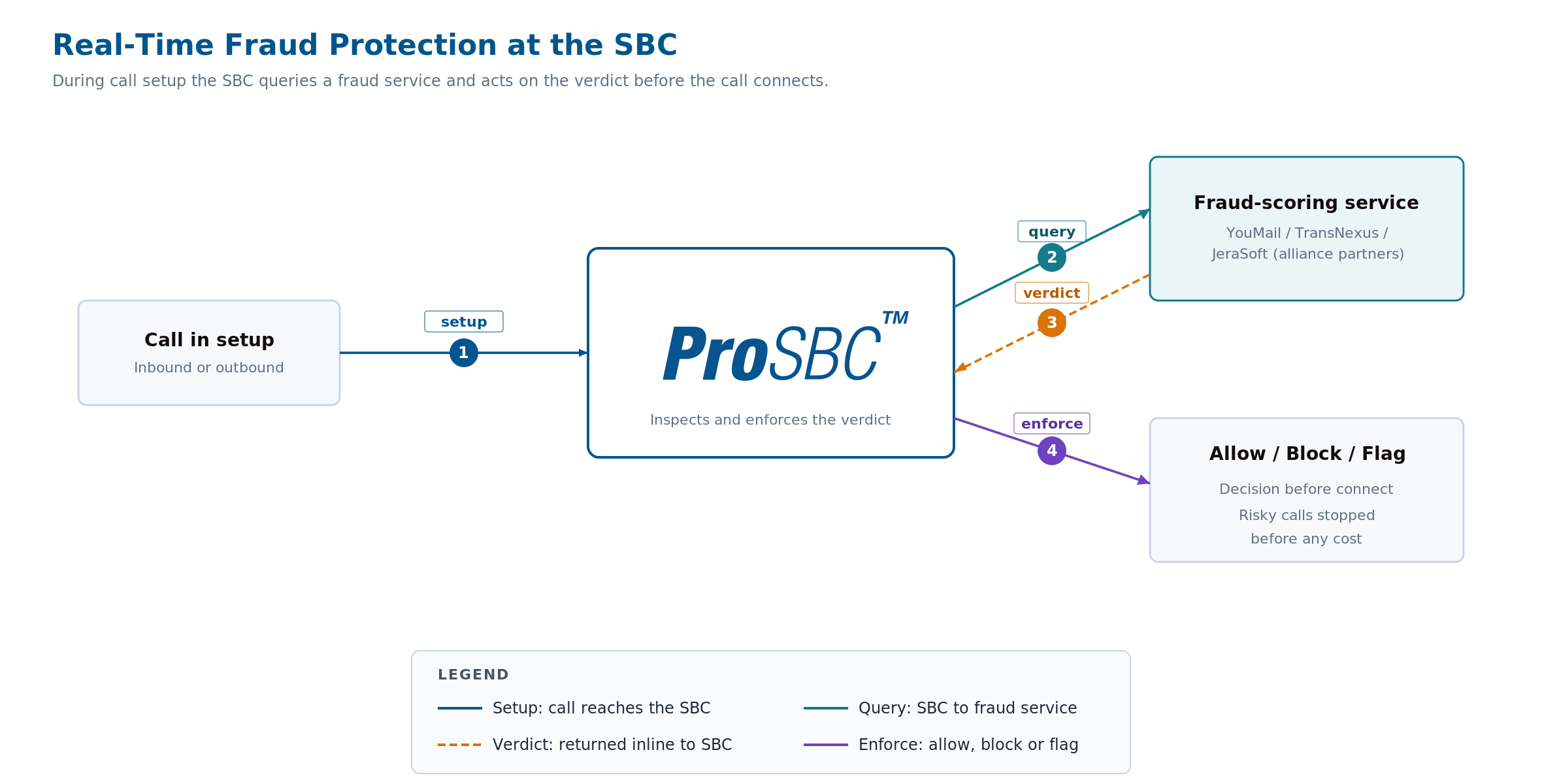
Real-time fraud protection: during call setup the SBC queries a fraud-scoring service, receives a risk verdict, and allows, blocks, or flags the call before it connects. Click to enlarge.
What the SBC Does for Fraud Protection
Inspecting Every Call
Because all inbound and outbound calls cross the SBC, it can inspect each one and measure its risk without anything slipping past. This complete coverage is what makes the SBC the right place for fraud scoring rather than a sampling tool that sees only some traffic.
Querying the Fraud Service Inline
During call setup, the SBC queries the fraud service via the SBC API and waits for its verdict before deciding, so the check is part of connecting the call. The integration also decides what to do when the service is slow or unreachable: fail open or fail closed, a policy decision the operator makes.
Acting on the Verdict
The SBC allows, blocks, or flags each call based on the score it gets back, enforcing the fraud policy at the boundary. This sits alongside the SBC’s other security work, so fraud scoring is one layer of a defended edge rather than a standalone bolt-on.
Validated Fraud Service Integrations
TelcoBridges maintains validated alliance partnerships with fraud services so an operator can pair the SBC with the fraud intelligence that best fits its network rather than being locked to one source. Current partners include:
TransNexus
ClearIP integration for fraud scoring, STIR/SHAKEN authentication, CNAM lookup, and LNP dips, all queried inline during call setup.
YouMail
Spam risk API integration that scores inbound calls against YouMail’s database of known robocall and spam sources.
JeraSoft
Billing and fraud-scoring integration for wholesale operators who need real-time rate validation and fraud detection alongside traffic management.
Deploy It Your Way
Self-Managed
Run ProSBC as software on your own infrastructure and configure the fraud-service integration directly. Full control over scoring policies, fail-open/fail-closed behavior, and routing rules.
Managed Service
Hand deployment and operation to TelcoBridges through the ProSBC managed service. The fraud-service integration is configured and maintained as part of the managed edge.
Fully Hosted
TelcoBridges hosts and manages the SBC entirely, including the fraud-service integration. The operator gets real-time scoring without building or maintaining the integration itself.
Frequently Asked Questions
What is real-time fraud protection?
It is the inspection of incoming and outgoing call traffic to measure the risk of each call as it is set up, by integrating the SBC with a fraud-scoring service. The SBC acts on the verdict, allowing, blocking, or flagging the call, before it connects and before fraud can generate a bill.
Why does the scoring have to happen in real time?
Analyzing call records after calls complete tells you what fraud already happened but cannot prevent the charges. A real-time check during call setup evaluates the call before it connects, so a high-risk call can be stopped before it costs anything.
Which fraud services does the SBC work with?
TelcoBridges maintains validated alliance partnerships with fraud services including YouMail, TransNexus, and JeraSoft, so an operator can pair the SBC with the fraud intelligence that best fits its network.
How is this different from toll fraud prevention?
They are closely related. Real-time fraud protection is the general capability of scoring every call as it happens against a fraud service. Toll fraud prevention is the specific application of it to stopping charges being run up on the network. The same SBC mechanism underlies both.
Score Every Call in Real Time with ProSBC
Talk to a solutions architect about deploying real-time fraud protection with ProSBC, or start evaluating on your own.
Prefer to evaluate on your own first? Start your 30-day free trial.