Is TLS 1.2 End of Life? (tl;dr no it’s not). What To Know for SIP-Over-TLS Deployments
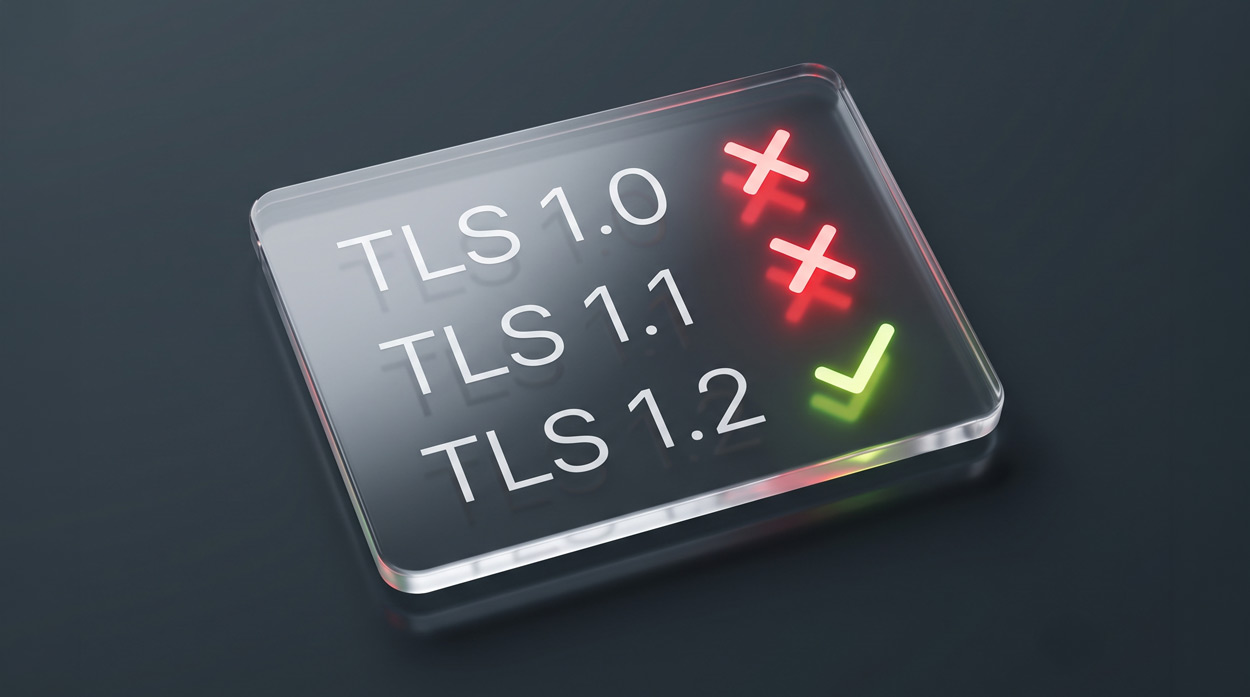
Most people searching “TLS 1.2 end of life” arrived after a vendor notice or an audit finding, and the headline is more alarming than the facts. Here is the short version: the Transport Layer Security (TLS) versions that are genuinely retired and insecure are 1.0 and 1.1, not 1.2. TLS 1.2 is still valid, still accepted under PCI-DSS, and has no published retirement date. What is changing is the floor. Major platforms keep raising their minimum accepted version, and when a carrier or cloud peer raises its floor, your SIP-over-TLS edge has to keep up or calls stop connecting.
In this article, we’ll separate what is actually deprecated from what is under pressure, explain why it matters for encrypted SIP, compare TLS 1.2 and 1.3 for telephony systems, and lay out a migration path you can run without a flag-day. If you operate an internet-facing Session Border Controller, this is particularly useful for deciding what to change first and what can wait.

What “TLS 1.2 End of Life” Actually Means (and What It Doesn’t)
The phrase conflates two different things. TLS 1.0 and TLS 1.1 were formally deprecated and moved to Historic status by RFC 8996 in 2021. Those are the versions that are truly end-of-life. They lack support for modern cryptographic algorithms, and standards bodies, browsers, and cloud platforms have spent years removing them.
TLS 1.2, defined in RFC 5246 back in 2008, sits in a different category. As of 2026 it is not formally deprecated by the IETF, nor have there been serious breaches against the protocol (as opposed to TLS 1.0 and 1.1, for which major security vulnerabilities have been identified since 2011). It remains the minimum version required by PCI-DSS, and there is no fixed sunset date attached to it. TLS 1.3, specified in RFC 8446 in 2018, is the preferred protocol going forward, but preferred is not the same as mandatory. The pressure on TLS 1.2 is anticipatory rather than scheduled: a rising industry baseline, not a published switch-off.
That distinction matters because it tells you where the real urgency is. If you are still accepting TLS 1.0 or 1.1 anywhere on an internet-facing SIP edge, that is the overdue problem. TLS 1.2 with strong cipher suites buys you time to plan, not a reason to panic.
The Deadlines That Are Actually Moving
The genuine deadlines come from compliance frameworks and platform vendors, not from a single TLS 1.2 obituary.
On the compliance side, PCI-DSS requires TLS 1.2 or higher and prohibits early TLS, meaning 1.0 and 1.1. NIST guidance in SP 800-52 Rev. 2 mandates support for TLS 1.2, expresses a preference for 1.3, and restricts weak cipher suites, yet it does not deprecate 1.2. So a voice deployment running TLS 1.2 with modern ciphers is compliant today under both regimes.
The faster-moving pressure comes from platform vendors raising their floors. In early 2026, Microsoft Azure Storage stopped accepting TLS 1.0 and 1.1, Cisco Meraki moved its cloud to TLS 1.2 and 1.3 only, and Microsoft began retiring legacy TLS for POP and IMAP connections in Exchange Online. The pattern repeats across the industry: a large platform sets a higher minimum, and every system that connects to it inherits that requirement.
For a SIP edge, the practical risk is not TLS 1.2 being switched off globally. It is a specific peer, a SIP trunk carrier, a Microsoft Teams Direct Routing connection, or a cloud voice platform, raising its minimum and refusing the older protocol or weak ciphers your edge still offers.
Why This Matters Specifically for SIP-Over-TLS
SIP-over-TLS protects the signalling channel that sets up, manages, and tears down calls, typically on port 5061. The version of TLS protecting that channel is not a cosmetic detail. When Session Description (SDES) is used to exchange media keys, the Secure Real-time Transport Protocol (SRTP) keys travel inside the SIP signalling, so the TLS version protecting your signalling is also protecting your media keys. For how that key exchange works, see What Is SRTP? and the SBC TLS and SRTP Configuration Guide.
A version or cipher mismatch does not produce a warning. It produces a TLS handshake failure at call setup, and the call simply never connects. When a partner raises its minimum, your first symptom is failed calls toward that peer, with no change on your side to explain it.
The security exposure is just as concrete. TLS 1.0 and 1.1, along with weak TLS 1.2 cipher suites that rely on CBC mode, SHA-1, RSA key transport, or any suite without forward secrecy, are the real attack surface on an internet-facing SIP edge. An attacker who can force a downgrade to a weak negotiation can attack the session far more easily than one facing a modern AEAD cipher. This is why disabling old versions and weak ciphers carries more security value than chasing the newest version number.
TLS 1.2 vs TLS 1.3 for Telephony Systems: What Changes
TLS 1.3 is a meaningful cleanup of the protocol. It removes RSA key transport, static Diffie-Hellman, CBC mode, RC4, SHA-1, and MD5, and it narrows the cipher list to five authenticated-encryption (AEAD) suites built on AES-GCM and ChaCha20-Poly1305, all of which provide forward secrecy. By stripping out the weak options, it also shrinks the negotiation surface that downgrade attacks have historically exploited.
The handshake is faster too, completing in a single round trip. For long-lived SIP-over-TLS connections between an SBC and a carrier, that speed gain is minor. At scale, where TLS connections are set up and torn down frequently, it adds up.
A word of honesty here: TLS 1.3 is not a magic shield. Research has shown that downgrade techniques can still target mixed environments, so correct configuration and disabling fallback to older versions still matter regardless of which version you run.
The practical reality for voice is that many carriers and PBXs still negotiate TLS 1.2 with strong ciphers, and that is acceptable today. The right target is a clear floor of TLS 1.2 with modern AEAD ciphers and forward secrecy, moving to TLS 1.3 wherever the peer supports it. A forced cutover to 1.3 across every trunk on the same day is neither required nor advisable.
A Migration Path for Your SIP-Over-TLS Edge
You can raise your TLS posture in stages without disrupting live calls. An SBC makes this practical because it terminates and re-originates each call leg separately, so the two sides of a call need not share a transport or a TLS version.
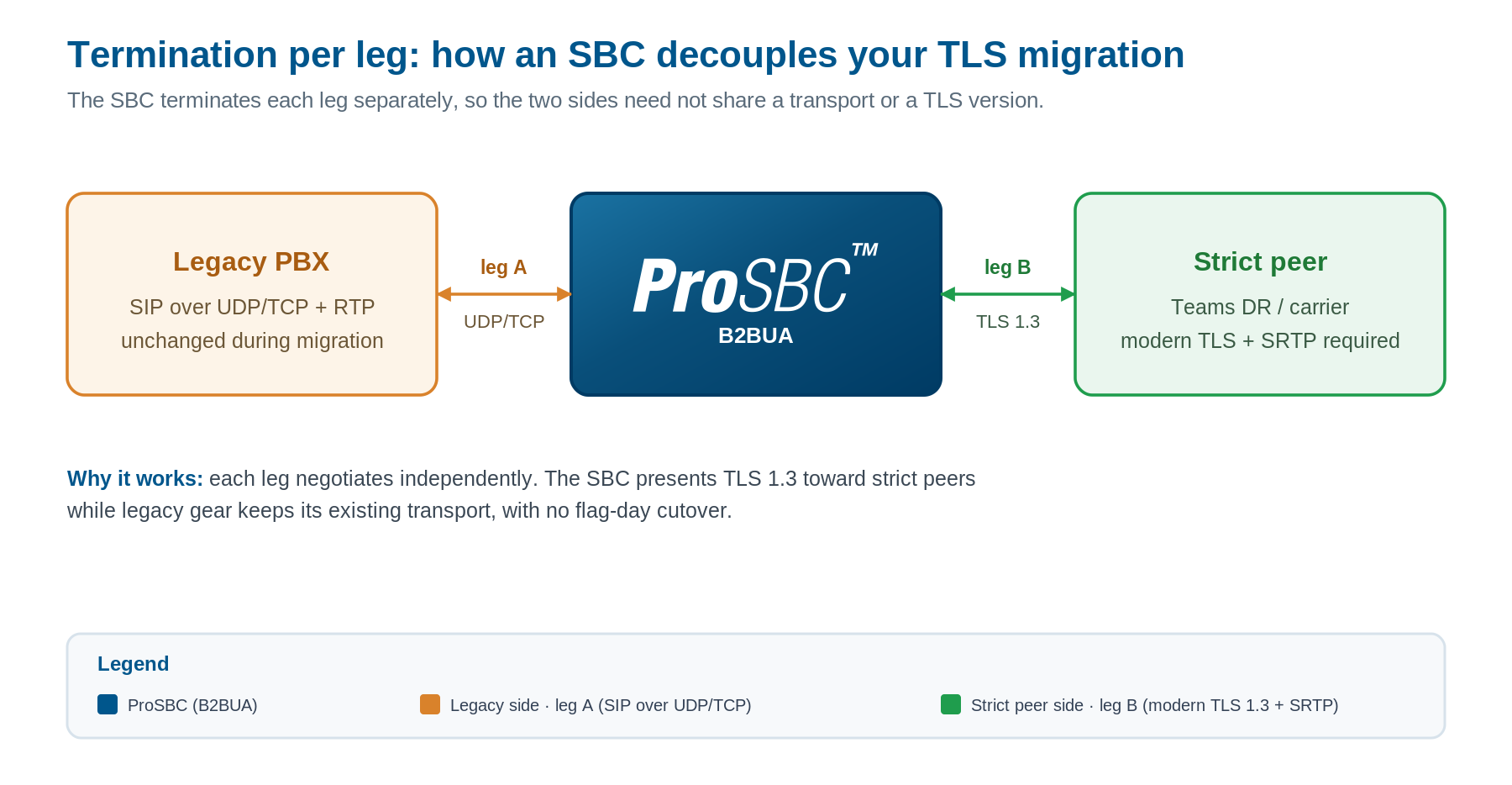
The SBC terminates and re-originates each leg separately, so you can present modern TLS toward a strict peer while legacy gear connects over its existing transport. Click to enlarge.
- Inventory covers which transport and TLS version each SIP peer actually negotiates today, drawn from the edge itself rather than from assumptions. Carriers, internal PBXs, Teams connections, and cloud platforms often differ.
- Set a floor by disabling TLS 1.0 and 1.1 and weak cipher suites first. This is the single change with real security value, and on most edges it is overdue.
- Decouple the sides using the SBC as the boundary. Present modern TLS toward a strict peer such as Teams or a carrier while a legacy internal PBX keeps its existing transport (older TLS where the SBC permits it, or plain UDP/TCP inside a trusted network), with no flag-day required. The SBC TLS and SRTP Configuration Guide covers the per-trunk setup, and SBC mTLS covers the mutual-authentication case that Teams and many carriers expect.
- Roll per trunk by changing one peer’s policy, validating the handshake with a packet capture, then moving to the next. Per-trunk changes keep the blast radius small.
- Monitor handshakes for failures after any peer raises its minimum. A sudden cluster of failures toward one carrier is usually the first sign that the partner moved its floor.
Frequently Asked Questions
Is TLS 1.2 deprecated?
No. TLS 1.0 and 1.1 are deprecated under RFC 8996; TLS 1.2 is still valid and remains the PCI-DSS minimum. The industry floor is rising, but 1.2 itself has no published retirement date.
Will my SIP trunks stop working when TLS 1.2 “ends”?
Not from a global switch. Calls toward a specific peer only fail if that peer raises its minimum above what your edge offers. The fix is to keep your floor current and decouple peers at the SBC so each side negotiates independently.
Do I need TLS 1.3 for SIP today?
Not strictly. TLS 1.2 with modern AEAD ciphers and forward secrecy is acceptable under PCI-DSS and NIST guidance. Plan to use TLS 1.3 where peers support it, and treat it as the destination rather than an emergency.
What is the single most urgent change?
Disabling TLS 1.0 and 1.1 and weak cipher suites on any internet-facing SIP edge. That is the genuine end-of-life work, and it delivers the most security per hour spent. The SBC security overview covers where this sits among the other edge defences.
Migrate Your TLS Posture Safely with ProSBC
The deadline that already passed applies to TLS 1.0 and 1.1; TLS 1.2 is under pressure from a rising floor, not retired; and TLS 1.3 is the destination you migrate toward rather than a switch you flip overnight. The durable fix is an edge that lets you set and change TLS posture per peer.
That is exactly the job a Session Border Controller does at the SIP edge. ProSBC operates as a full back-to-back user agent (B2BUA) that terminates and re-originates signalling and media on each leg, so you can raise your floor toward strict peers while legacy equipment keeps working. Its SIP-over-TLS implementation negotiates TLS assuming version 1.3 but downgrades automatically to 1.2 when necessary, so older versions can be selected when a SIP trunk is on a TLS 1.2 path. Peers that cannot negotiate TLS 1.3 can still connect thanks to ProSBC’s downgrade feature. ProSBC also supports SRTP, including SRTP relay and RTP-to-SRTP conversion, and it has been deployed in Microsoft Teams Direct Routing environments, which mandate TLS and SRTP. Subscription pricing is public and can be as low as $1.40 per session per year, and a free three-session ProSBC Lab is available if you want to test a TLS migration before touching production.
Prefer to evaluate on your own first? Start your 30-day free trial.