Interconnecting Service Provider Voice Networks with SBC Peering
When two service providers agree to exchange voice traffic, they do not simply plug their softswitches into each other. Each network has its own signaling conventions, its own security posture, and its own need to measure what crossed the boundary and bill for it.
A direct link exposes each network to the other’s problems and leaves neither side with control over the boundary. Two carrier networks rarely speak identical SIP, and without a mediation point, calls fail on signaling differences that neither core was built to reconcile. The interconnect needs a controlled point where security, interoperability, and settlement all happen.
How SBC Peering Works
SBC peering is the use of a session border controller to interconnect one service provider’s voice network with another’s, typically at the core of each network. It is the model behind wholesale VoIP interconnects, carrier-to-carrier trunk exchanges, and the connections a regional operator makes to reach the wider public network.
Each provider places an SBC at the core of its network, and the interconnect runs between them. A common arrangement has ProSBC on one end and another vendor’s session border controller on the other, which is one of the reasons interoperability matters so much at a peering point.
Peering is distinct from the access SBC role. An access SBC connects and protects an organization’s own users, whereas a peering SBC sits between two provider networks as equals. The traffic is carrier-to-carrier rather than user-to-carrier, and the concerns shift toward volume, routing economics, and settlement.
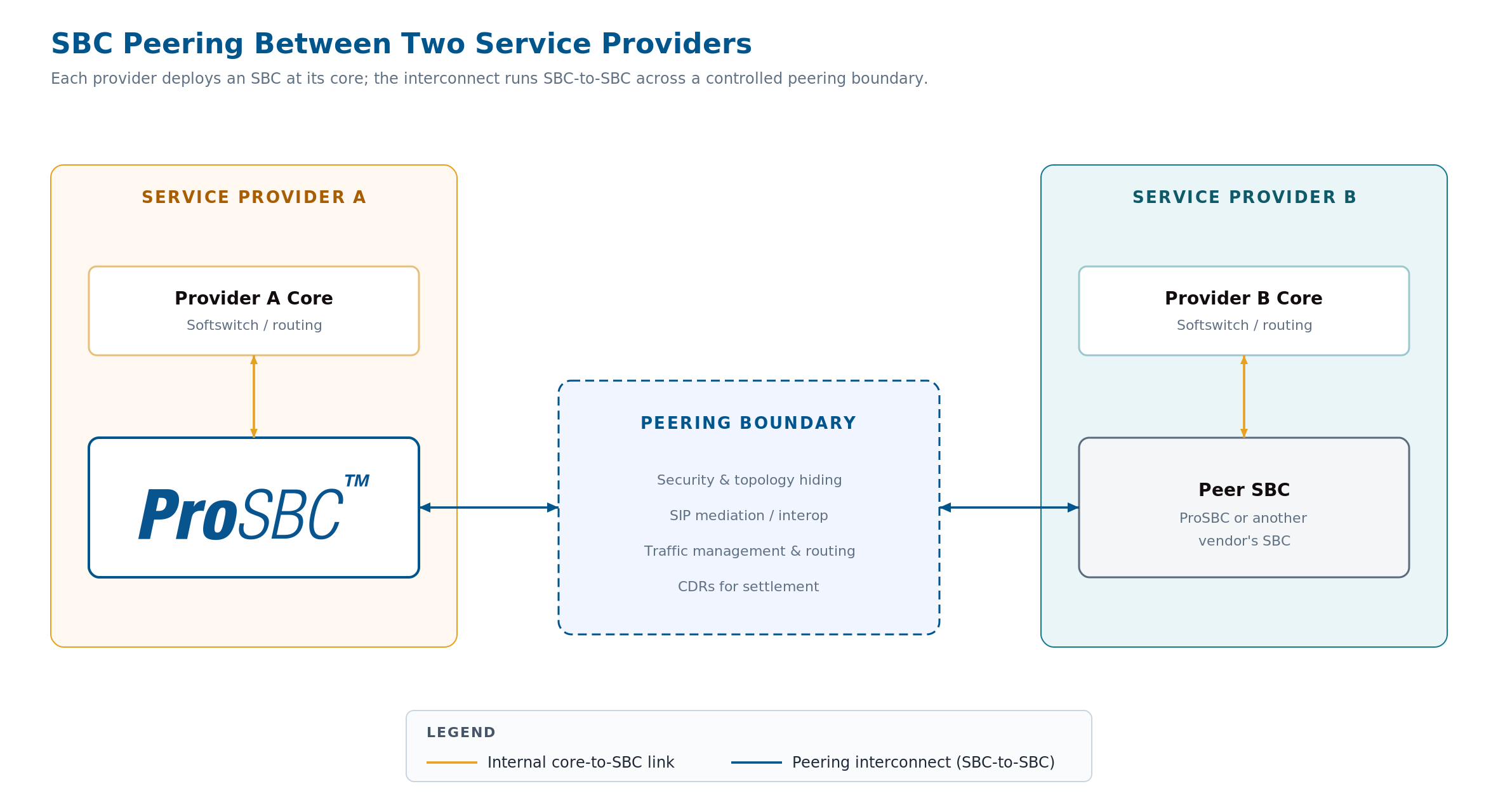
SBC peering: each provider deploys an SBC at its network core, and the interconnect runs SBC-to-SBC across the peering boundary. Click to enlarge.
What a Peering SBC Does
Traffic Management and Call Routing
The peering SBC directs traffic between the two networks and applies routing logic at the boundary. For a wholesale provider, this is where least-cost routing and capacity management matter most, because the margin on every minute depends on it. The SBC sends each call over the cheapest viable interconnect while honoring capacity limits and failover order.
Mediation and Interoperability
Two provider networks bring different signaling conventions, codecs, and numbering formats. The SBC’s SIP header manipulation normalizes the peer’s dialect into what the local core expects, allowing a ProSBC on one end to interconnect cleanly with a different vendor’s SBC on the other.
Billing and CDRs
Because peering is a commercial exchange, each provider needs a trusted record of the traffic. The SBC generates call detail records for every call crossing the boundary, giving each side its own basis for reconciliation and billing.
Security at the Interconnect
The SBC defends the boundary between the two networks. It hides internal topology so the peer sees only the SBC, absorbs signaling floods before they reach the core, and enforces access control on what the peer is allowed to send.
ProSBC for the Peering Interconnect
ProSBC is a carrier-grade, software-based session border controller built on more than 20 years of SIP deployment experience. For the peering use case, it delivers:
Deploy It Your Way
Self-Managed
Run ProSBC as software on your own core infrastructure. Full control over peering configuration, routing rules, and security policies.
Managed Service
Hand deployment and management to TelcoBridges through the ProSBC managed service. TelcoBridges engineers handle deployment, hardening, and ongoing operations while you keep full access.
Fully Hosted
TelcoBridges hosts and manages the SBC entirely. You connect your core and your peer to a managed interconnect point with no infrastructure to run.
Frequently Asked Questions
What is SBC peering?
SBC peering is the use of a session border controller to interconnect one service provider’s voice network with another’s, usually at the core of each network. It secures the boundary, mediates signaling differences, and produces the call detail records used to settle the traffic.
How is a peering SBC different from an access SBC?
A peering SBC sits between two service provider networks as equals and handles carrier-to-carrier traffic. An access SBC sits at the edge and connects an organization’s own users and phone system. The peering role emphasizes volume, routing economics, and settlement; the access role emphasizes user security and NAT traversal.
Why not just connect two softswitches directly?
A direct link exposes each network to the other’s signaling and security problems and leaves neither side with control over the boundary. An SBC gives each provider a defensible edge that inspects traffic, hides internal topology, mediates SIP differences, and records what crossed for billing.
Can a ProSBC peer with another vendor’s SBC?
Yes. A typical peering arrangement has ProSBC on one end and another vendor’s session border controller on the other. ProSBC’s SIP normalization reconciles the differences between the two, which is why interoperability is central to the peering use case.
Build Your Peering Interconnect on ProSBC
Talk to a solutions architect about deploying ProSBC at your peering boundary, or start evaluating on your own.
Prefer to evaluate on your own first? Start your 30-day free trial.