Neutral Tandem and Wholesale Voice Interconnect: A Voice Engineer’s Guide

Two carriers with no direct business relationship still complete calls between their networks every second of the day. Participants in the middle of the network make that possible, and most voice engineers configure trunks against them without ever hearing the layer named. That layer is wholesale voice interconnect, and “Tandem” is one of the names that defined it. In this article, we’ll walk you through what a tandem actually does, how neutral interconnect differs from direct peering, how the old TDM tandems gave way to IP and SIP, and where signaling control sits at the carrier border.
If you are an ISP or a transit operator, this is the part of the network that decides who you can reach and what it costs to get there. It is also where ProSBC has a documented home as a carrier and wholesale peering element, and where media gateways play a role to terminate calls in and out of the PSTN, which we come back to at the end.

What “Tandem” Means in the Voice Network
A tandem switch connects other switches. It does not serve subscribers directly. In the traditional telephone hierarchy, end offices (class-5 switches) terminate local lines, and tandem or toll switches (class-4) sit above them to pass traffic between end offices and between carriers. When a call leaves your network bound for somewhere you don’t directly connect to, it rides through a tandem.
The reason tandems exist is arithmetic. If every carrier had to build a direct connection to every other carrier, the number of links grows with the square of the number of networks. Ten carriers fully meshed need 45 connections; a hundred carriers need nearly 5,000. A tandem collapses that. Each carrier maintains one connection to the tandem, and the tandem reaches everyone else. You trade a direct path for a shared hub that buys you reach.
A Session Border Controller (SBC) can act as a tandem when deployed as the border element between two carrier networks that exchange traffic in IP only.
Neutral Tandem: the Company and the Category
Neutral Tandem is both a specific company and the name of a model it pioneered. The company launched its network in 2003 as the first independent, competitive tandem, a “network of networks” that interconnected carriers without being a retail competitor to any of them. Before that, carriers that wanted to exchange traffic indirectly leaned on the incumbent local exchange carriers’ access tandems, which meant handing traffic to a company they also competed with.
The “neutral” in the name is the whole point. An independent third party interconnects competing networks and has no retail subscriber business of its own, so no carrier is forced to route its traffic through a rival. That neutrality buys trust, transparent settlement, and single-hop reach to a large number of networks at once.
The company grew well beyond its origins. After acquiring the international carrier Tinet in 2010, Neutral Tandem rebranded as Inteliquent, and in December 2021 Sinch completed its acquisition of Inteliquent for roughly USD 1.14 billion, folding it into one of the largest independent voice providers in the United States. The platform that started as a TDM tandem now carries hundreds of billions of voice minutes a year over IP. That migration, from TDM tandem switching to SIP-based “neutral tandem voip,” is exactly the shift the rest of this guide tracks.
Wholesale Voice Interconnect: How Carriers Actually Connect
Wholesale voice interconnect is the carrier-to-carrier market that sits underneath every retail minute. A call you place to a far-off mobile number may cross three or four wholesale boundaries before it rings. Engineers connect to that market through three broad models.
Direct peering is a bilateral arrangement: two carriers agree to exchange traffic over a dedicated connection, usually because the volume between them justifies it. Tandem or transit is the hub model, where you connect once to an intermediary like Neutral Tandem and reach many destinations through it. Wholesale aggregation is buying termination from a wholesaler who fans your traffic out to a long list of destinations, often blending many underlying routes to hit a price.
Money and quality drive every routing decision in this market. Carriers publish rate decks, per-destination price lists that can run to tens of thousands of prefixes, and routing engines pick the cheapest acceptable path through least-cost routing (LCR). The catch is that cheapest and acceptable pull against each other. A bargain route to a given country may run through several intermediaries, degrade Answer-Seizure Ratio (ASR), strip or fake calling line identity, or add latency. Engineers watch ASR and Average Call Duration (ACD) as the working quality currency of a route, and they distinguish “clean” routes with intact CLI from “grey” routes that cut corners.
On the IP side, peers connect over a network-to-network interface using SIP, as defined in RFC 3261. That introduces practical concerns a TDM trunk never had: each peer reaches you over public signaling IP addresses that have to be whitelisted, and you cap exposure with per-supplier and per-customer channel and call-per-second limits so one peer cannot swamp the others or run up fraud on your account.
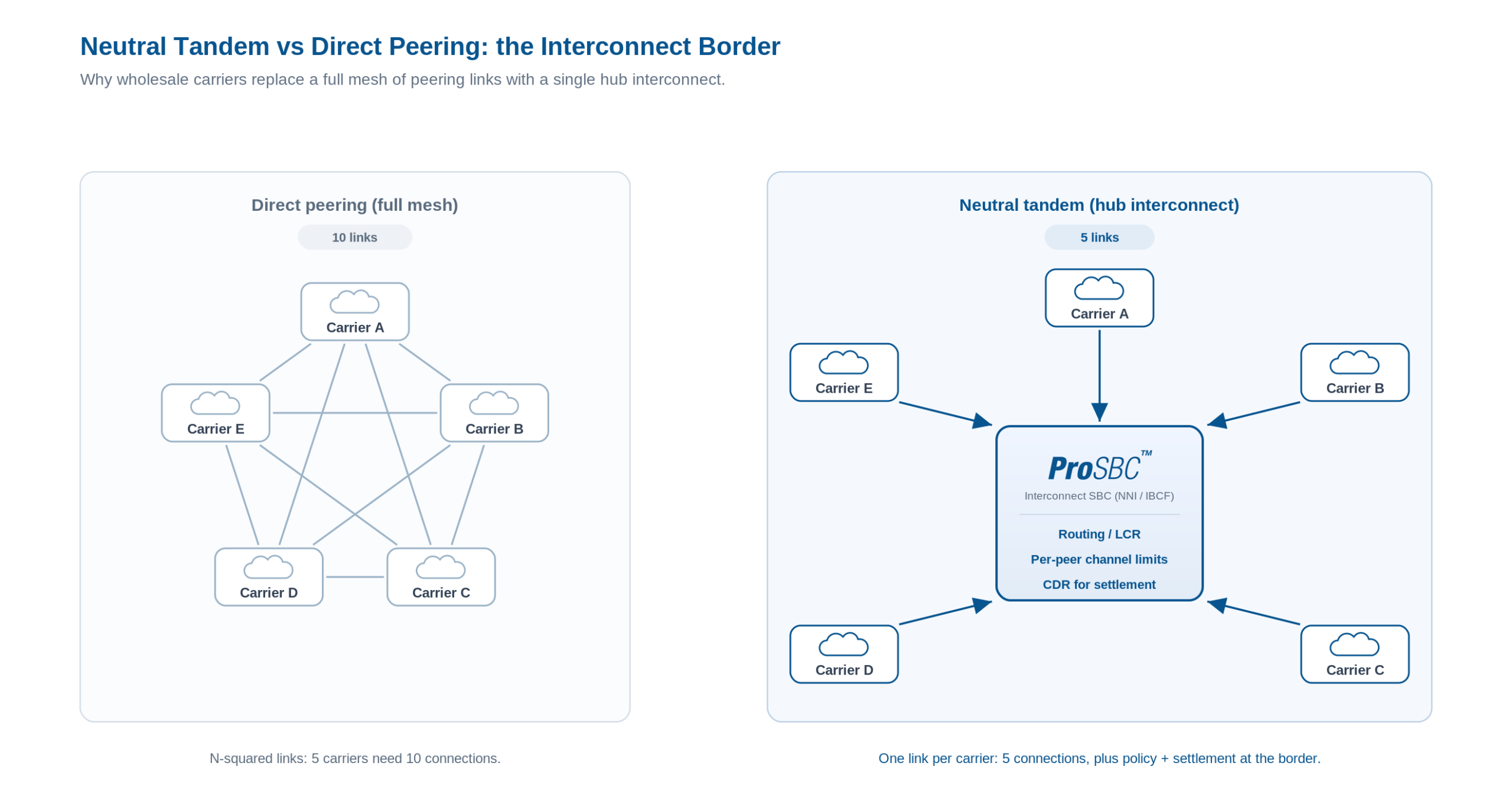
Direct peering meshes every carrier to every other carrier; a neutral tandem collapses that into one link per carrier, with routing, per-peer limits, and settlement records handled by the interconnect SBC at the border. Click to enlarge.
Where Signaling Control Lives at the Interconnect Border
In an IP interconnect, the SBC is the element that sits at the peering border between two carriers. In IP Multimedia Subsystem (IMS) terms, an SBC performing this carrier-to-carrier role is acting as the Interconnection Border Control Function (IBCF) at the network-to-network interface. Here the question is narrower than full IMS architecture: what does that border element do for a wholesale operator?
Several things that matter directly to interconnect. It enforces ingress and egress routing policy, deciding which peer a call leaves on based on rate decks, priority, and failover order. It applies per-peer channel and call-per-second limits so a single interconnect can’t exceed its commercial commitment. It normalizes SIP between carrier dialects, because no two networks format headers identically, and it provides topology hiding so competing carriers never see each other’s internal addressing. It generates Call Detail Records (CDRs) that you reconcile against each peer’s records when the monthly settlement arrives, which is where billing disputes are won or lost. And it screens inbound transit traffic for fraud and CLI problems before that traffic ever touches a downstream network.
The basic border mechanics here, Back-to-Back User Agent (B2BUA) behavior, topology hiding, and media anchoring, are the same primitives any SBC uses at a SIP trunk boundary. What changes at the wholesale border is the scale and the stakes: the peer on the other side is another carrier, the routing decisions are commercial, and the CDRs are money.
TDM Tandem to IP Interconnect: What Changed for Engineers
When interconnect ran on TDM, the work looked like provisioning SS7 trunk groups between tandem switches, identified by point codes, with fixed routes nailed up between fixed destinations. Capacity was physical. Routing was static. The signaling lived in a separate SS7 network, and moving it toward IP is the same SS7-to-SIGTRAN migration many carriers are still working through.
IP interconnect rewired all of that. You now manage SIP peers instead of point codes, routes driven by rate decks instead of nailed-up trunks, and codec negotiation across carrier boundaries instead of a single TDM encoding. A call can be offered to a primary peer, rejected on price or congestion, and route-advanced to a secondary peer in milliseconds. Media has to be anchored or steered deliberately rather than following the physical trunk.
The border element became more important in this world, not less. When every peer is reachable over the same IP fabric, the only thing standing between a clean interconnect and an open relay for fraud is the policy, security, and routing logic enforced at the SBC. That is why carriers that once thought of the tandem as plumbing now treat the interconnect border as one of the most security-sensitive and revenue-sensitive parts of the network.
Frequently Asked Questions
Is Neutral Tandem still a company?
The original Neutral Tandem rebranded as Inteliquent in 2010 and was acquired by Sinch in 2021, so the brand name is retired as a standalone company. The term still gets used loosely to mean the broader category of independent, carrier-neutral interconnection.
What is the difference between a tandem and an SBC?
A tandem switch aggregates and transits traffic between many networks. An SBC controls the border where two networks meet, applying routing policy, security, normalization, and CDR generation. A modern IP interconnect often uses an SBC to perform the border-control role that a TDM tandem handled implicitly, alongside whatever switching or routing function aggregates the traffic.
What does “neutral” mean in carrier-neutral interconnect?
It means the interconnect provider is an independent third party with no retail subscriber business competing against the carriers it connects. Carriers can exchange traffic through it without handing volume to a rival.
Do I still need a tandem provider if I can peer directly?
Direct peering makes sense where two carriers exchange enough traffic to justify a dedicated connection. A tandem or transit provider gives you reach to many networks through a single connection, which is cheaper and simpler than building direct links to everyone. Most operators use a mix of both.
Is wholesale voice interconnect the same as a SIP trunk?
No. A SIP trunk is usually a retail or enterprise service connecting a PBX or platform to a provider. Wholesale voice interconnect is carrier-to-carrier, where both sides are networks exchanging traffic in bulk under commercial agreements.
Bringing It Together
A tandem aggregates and transits voice traffic so carriers don’t have to mesh with each other directly. “Neutral tandem” named both the company that built the first independent version of that hub and the carrier-neutral model it created, a model that has since moved from TDM switching to SIP-based IP interconnect. Wholesale voice interconnect is the market that runs on top of it, governed by rate decks, least-cost routing, and the quality and trust of each route.
In the IP era, the border element where two carriers meet is where the signaling policy, security, and settlement data actually live. If you operate at that border, the SBC you choose is doing the heavy lifting of interconnect.
Run Your Interconnect Border on ProSBC
ProSBC is built for exactly this layer. The Peering SBC use case, service-provider-to-service-provider connectivity with SIP interoperability, traffic management, and billing, is one of its core deployment profiles. It scales to 60,000 sessions per server and up to 1,024 Network Access Points (NAPs), the per-peer trunk groups you use to model each carrier interconnect, with rule-based, priority-driven routing that maps cleanly onto least-cost routing and failover logic.
You get per-NAP channel and call-per-second limits, topology hiding between competing networks, SIP normalization across carrier dialects, and CDR output (text or RADIUS) to reconcile against every peer’s settlement records. ProSBC has been deployed as a carrier-scale NNI SBC, including a 10,000-session network-to-network deployment with high availability. Subscription pricing can go as low as $1.40 per session per year, and the permanently free three-session ProSBC Lab lets you model an interconnect before you commit.
Prefer to evaluate on your own first? Start your 30-day free trial.