FXS vs FXO: Analog Interfaces in a VoIP World
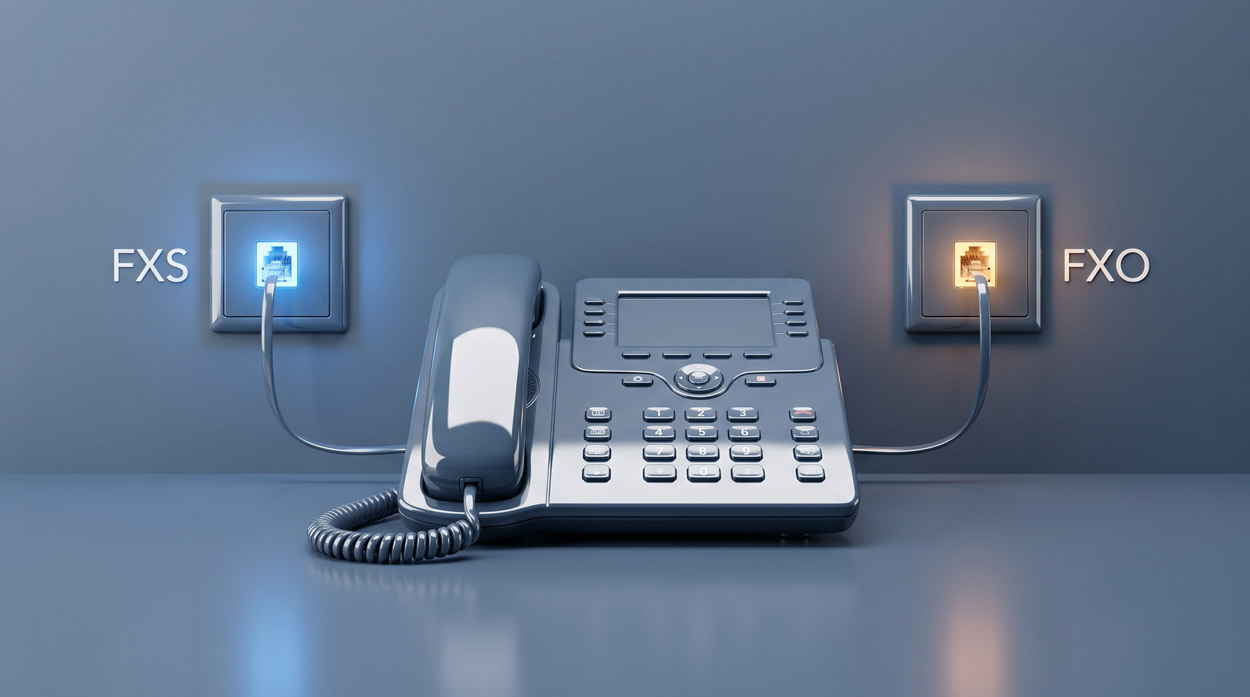
Two people can spend an afternoon arguing about which port is FXS and which is FXO, wire it backwards anyway, and end up with a phone that never rings. The two acronyms sit one letter apart, they show up on the same devices, and almost every wiring mistake in analog telephony traces back to confusing them. The good news is that the difference comes down to a single question you can answer in one sentence, and once it clicks, it stays clicked.
Here is the short version. FXS is the port that provides dial tone, so it is where a phone plugs in. FXO is the port that receives dial tone, so it is where a phone line plugs in. Everything else in this article is detail hanging off that one distinction, and it still matters in 2026 because analog fax machines, alarm panels, elevator phones, and legacy handsets have not gone away just because the network behind them is now IP.
We’ll cover what FXS and FXO actually do, how the analog signaling between them works, where each one lives in a real deployment, the mnemonic that keeps them straight, and how these decades-old copper interfaces connect to a modern SIP network. TelcoBridges has spent more than 20 years working the border between legacy telephony and IP voice, from TDM media gateways to the ProSBC software session border controller, so the point where analog meets SIP is familiar ground.

What FXS and FXO Actually Are
FXS and FXO are the two ends of an analog telephone line, and they are defined entirely by the voltage. One side supplies it, the other side consumes it. The name of each interface is a leftover from the telephone company’s own vocabulary, where a “foreign exchange” was a line delivered from an exchange other than the local one, but the historical detail matters far less than the working definition.
FXS is the interface on the dial-tone-providing side. It supplies the line voltage that powers an analog device, sends the ringing signal that makes a phone ring, and provides the dial tone you hear when you lift the handset. Think of an FXS port as standing in for the central office. Whatever plugs into it is a station: a phone, a fax machine, a modem, a cordless base, an alarm dialer.
FXO is the interface on the dial-tone-receiving side, and it behaves the way a telephone does. It draws current from the line to signal that it is off-hook, it detects the ringing voltage that arrives on an incoming call, and it hangs up by opening the loop. An FXO port is the side you connect toward a real phone line, whether that line comes from the PSTN or from an FXS port on another device.
Because the two interfaces are complementary, they always come in pairs on a working circuit. An FXS port on one end talks to an FXO port on the other, the same way the central office (FXS) talks to your home phone (FXO). Connect two FXS ports together and nothing has dial tone to consume; connect two FXO ports together and nothing is providing dial tone in the first place. That pairing rule is the practical heart of the whole topic.
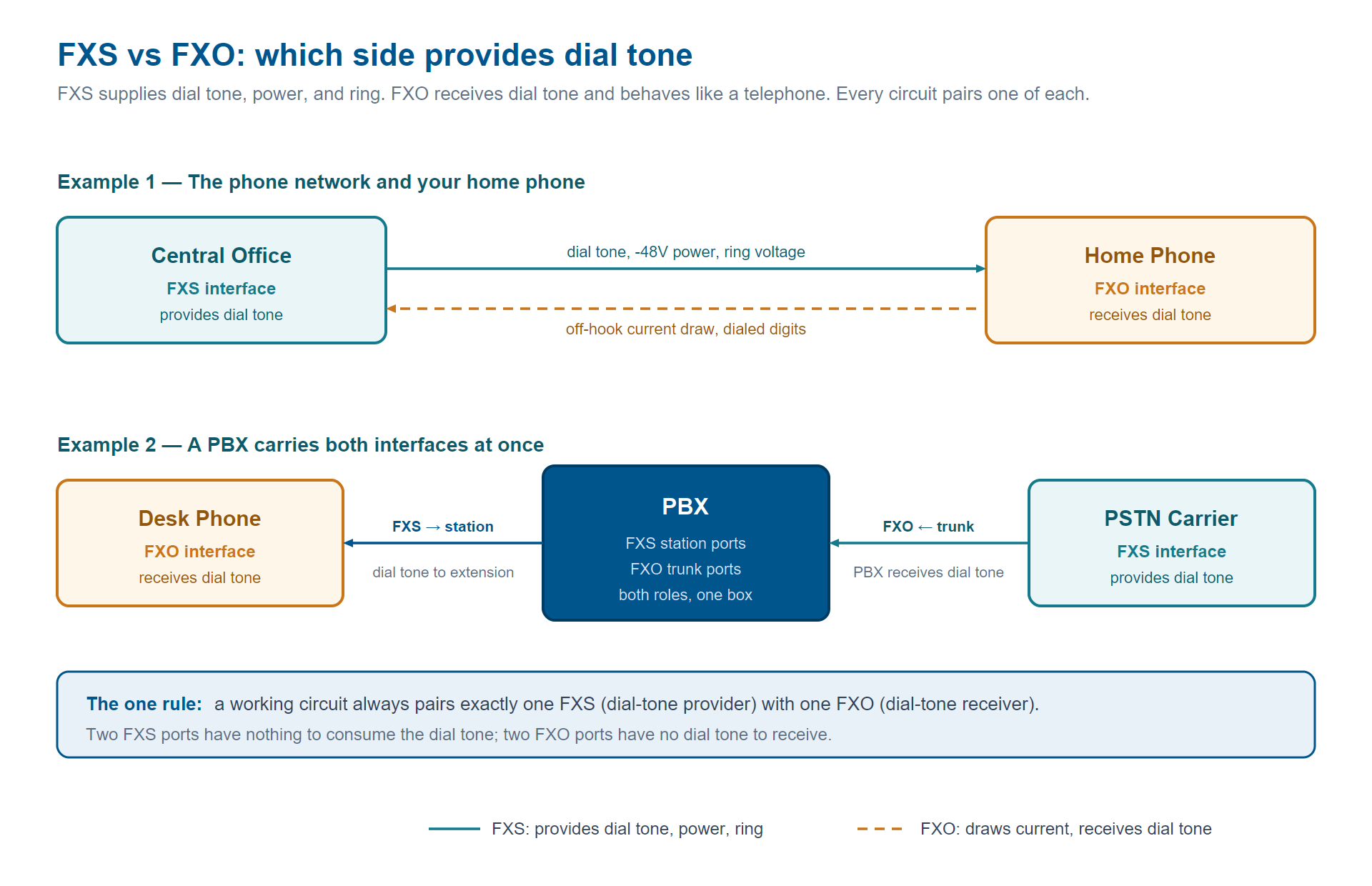
FXS provides dial tone, FXO receives it. The central office and PBX station ports are FXS; the phone and the PBX trunk port toward the PSTN are FXO. Every working analog circuit pairs one of each. Click to enlarge.
How the Signaling Between Them Works
The reason FXS and FXO are not interchangeable is that they play opposite roles in a small conversation of electrical signals. Understanding that conversation is what turns the acronyms from something to memorize into something you can reason about.
Battery and Off-Hook
The FXS side supplies roughly -48 volts DC on the line, the “battery” that has powered telephones since long before homes had reliable mains electricity. When the FXO device lifts off-hook, it completes the loop and draws current. The FXS side sees that current draw and knows the device wants to make or answer a call. This is why an analog phone keeps working during a power cut: the power it needs comes down the line from the telephony network, not from the home’s power.
Dial Tone and Digits
Once the FXS side detects off-hook, it plays dial tone back toward the FXO device. The device then sends the dialed digits, either as DTMF tones (the touch-tones you hear) or, on much older equipment, as pulse dialing. The FXS side collects those digits and routes the call. On a VoIP gateway this is the moment the analog world hands off to SIP, and the gateway translates the collected digits into a SIP INVITE.
Ringing and Answer
For an incoming call, the FXS side applies a ringing voltage, typically around 60-105 volts AC at 20 Hz in North America, that physically rings the bell or triggers the ringer on the FXO device. The FXO device answers by going off-hook, the FXS side removes the ring voltage and connects the audio path, and the call is up. Hang-up is signaled by the FXO device opening the loop, which the FXS side detects as loss of current.
Loop Start, Ground Start, and Glare
Most analog lines use loop start signaling, where going off-hook simply means completing the loop. It is simple and it is everywhere, but it has a weakness on trunk lines: if the central office sends a call down a line at the same instant a PBX tries to grab that line for an outbound call, both ends think they own the circuit. That collision is called glare, and on a busy PBX trunk it happens often enough to matter.
Ground start signaling solves this by having one side momentarily ground a wire to request the line before seizing it, so the two ends negotiate who goes first instead of racing. That is why PBX-to-PSTN trunks historically ran ground start while ordinary station lines ran loop start. When you configure an FXO or FXS port, matching the signaling type to the far end is as important as getting the port role right, because a loop-start port talking to a ground-start line will misbehave in ways that look random until you check the setting.
Where Each Interface Lives in a Real Deployment
The theory is tidy, but the reason people still wire these ports backwards is that the same device often has both kinds, and which one you need depends on what you are connecting to. A few concrete cases make the pattern clear.
Connecting an Analog Phone to a VoIP Network
You have an old analog handset or a legacy telephony system or a fax machine and you want it to work over SIP. The device expects dial tone, so it needs to plug into something that provides dial tone, which means an FXS port. An Analog Telephone Adapter or a gateway with FXS ports gives the phone its dial tone locally and turns the resulting call into SIP. This is the most common analog integration in a VoIP migration: keep the physical phones, put an FXS port in front of each one.
Connecting a VoIP Network to Analog PSTN Lines
Now flip it around. You have working copper lines from the local carrier and you want your IP phone system to place calls over them, maybe because those lines are cheaper, or because they need to stay up for emergency dialing when the internet is down. The carrier line already provides dial tone, so your equipment has to act like a phone and receive it, which means an FXO port. A gateway with FXO ports answers and seizes those PSTN lines on behalf of a local VoIP office network.
The PBX in the Middle
A traditional PBX shows both interfaces at once, which is exactly why it is such a useful mental model. The station ports where desk phones connect are FXS, because the PBX provides dial tone to its own extensions. The trunk ports facing the phone company are FXO, because toward the PSTN the PBX is just another subscriber receiving dial tone. Same box, opposite roles, and the direction of dial tone tells you which is which every time.
The Mnemonic That Keeps Them Straight
If you remember nothing else, remember where the hardware plugs in. An FXS port is where a Station plugs in, so it is where the phone goes. An FXO port is where the Office line plugs in, so it is where the phone line from the carrier goes. The last letter of each acronym names what connects to it: S for the station device, O for the office line.
Two more framings help when the plug-in test is ambiguous. The first is by behavior: FXS acts like the phone company, FXO acts like the phone. The second is by what each supplies: FXS supplies power, dial tone, and ring; FXO draws current like any handset. Whichever framing you reach for, they all resolve to the same one-sentence rule from the top of this article, which is why that rule is worth committing to memory over any table of pin-outs.
| Question | FXS | FXO |
|---|---|---|
| Provides dial tone? |  Yes, it is the source |
 No, it receives dial tone |
| Line Power | It supplies it | It consumes it |
| Behaves like | The central office | A telephone |
| You plug in | A station: phone, fax, modem | A line: PSTN or an FXS port |
| Typical location | ATA/gateway toward phones, PBX station ports | ATA/gateway toward PSTN, PBX trunk ports |
How Analog Interfaces Reach a Modern SIP Network
Analog ports and SIP do not speak the same language, so something has to sit between them and translate. That something is a gateway, and the shape of the deployment depends on which direction the analog traffic flows and how much of it there is.
For a handful of analog devices, an ATA with FXS ports is usually enough. It gives each phone its dial tone, converts the analog audio to an RTP media stream, and registers to a SIP server or PBX on the network side. For the reverse case, an FXO gateway seizes a few PSTN lines and presents them to the IP system as SIP trunks, which is a common way to keep a fallback path to the phone network for emergency calls.
At carrier and larger-enterprise scale, analog lines are rarely brought in one pair at a time. They are aggregated onto digital TDM trunks such as T1/E1 long before they reach the IP edge, and a media gateway terminates those trunks and converts the voice to SIP. This is the layer TelcoBridges works in. The Tmedia media gateways terminate T1/E1, DS3, and OC3/STM-1 circuits carrying SS7, ISDN PRI, and CAS signaling, and present clean SIP on the IP side, which is how legacy TDM voice, analog included once it has been digitized, crosses into a modern network at volume.
Once the call is SIP, it enters the same world every other IP call lives in, where a session border controller secures and normalizes it at the network edge. The SBC handles the encryption, topology hiding, and header normalization that the analog side never had to think about, and it does not care that the call started life on a copper pair. That separation of concerns, analog conversion at the gateway and SIP security at the SBC, is what lets a fax machine from 1995 sit on the same network as a Microsoft Teams user without either one knowing the other exists.
Frequently Asked Questions
Is FXS or FXO the port my analog phone plugs into?
FXS. Your phone needs dial tone, and FXS is the port that provides dial tone, power, and ringing. If you are connecting a handset, fax, or modem, you want to plug it into an FXS port.
What is the difference between FXS and FXO in one sentence?
FXS provides dial tone (it is where a phone plugs in), and FXO receives dial tone (it is where a phone line plugs in). Every working analog circuit pairs one FXS port with one FXO port.
Can I connect two FXS ports or two FXO ports together?
No. Two FXS ports would both try to provide dial tone with nothing to consume it, and two FXO ports would both wait for dial tone that never comes. A circuit needs exactly one dial-tone provider and one receiver, so it is always FXS to FXO.
Do I still need FXS and FXO ports if I am moving to VoIP?
Often yes, at least during the transition. Analog fax machines, alarm panels, elevator phones, and legacy handsets still exist, and FXS ports on an ATA or gateway let them keep working over SIP. FXO ports let a VoIP system reach any analog PSTN lines you keep for cost or emergency-dialing reasons.
Conclusion
FXS and FXO stop being confusing the moment you anchor them to dial tone. FXS provides it and is where an analog phone plugs in; FXO receives it and is where a line plugs in. From that single distinction, everything else follows: which port powers the phone, which one answers the carrier line, why a PBX carries both, and why you can never connect two of the same kind. The signaling underneath, the battery voltage, the ring, the loop-start-versus-ground-start choice, is just the mechanism that makes the roles work.
What has changed is not the analog interface but what sits behind it. The dial tone an FXS port provides now often originates from a SIP server, and the line an FXO port answers may be the last analog hop before a media gateway turns the whole thing into IP. If you are planning where analog fits in a network that is otherwise moving to SIP, the practical next step is to map each analog device to the port it needs, decide whether an ATA, an FXO gateway, or an aggregated TDM trunk is the right on-ramp for your volume, and treat the SIP side as a separate problem handled at the gateway and the SBC.
Bring Legacy Voice to IP with TelcoBridges
Analog and TDM voice do not disappear overnight, and the border where they meet a SIP network is exactly the ground TelcoBridges has worked for more than 20 years. The Tmedia media gateways terminate T1/E1, DS3, and OC3/STM-1 trunks carrying SS7, ISDN PRI, and CAS, and present clean SIP on the IP side, so aggregated legacy voice, including analog lines once they have been digitized, crosses into a modern network with carrier-grade availability.
On the IP side of that border, ProSBC is the software session border controller that secures and normalizes the SIP traffic: TLS and SRTP encryption, topology hiding, SIP header manipulation for multi-vendor interoperability, and DoS/DDoS protection at the edge. Whether you are retiring a PBX, consolidating analog trunks onto SIP, or connecting an older TDM footprint to a cloud voice platform, the gateway-plus-SBC pairing lets each layer do the job it is built for.
Download the free Voice Troubleshooting Runbook
A 22-page PDF reviewed by TelcoBridges technical support, with the first checks for the 9 most common voice symptoms, 14 SIP response codes explained, and 3 ways to capture a call trace.
By submitting this form, your information will be processed in accordance with our Privacy Policy.
Prefer to evaluate on your own first? Build your free lab.