SIP INVITE Message: Structure and Headers
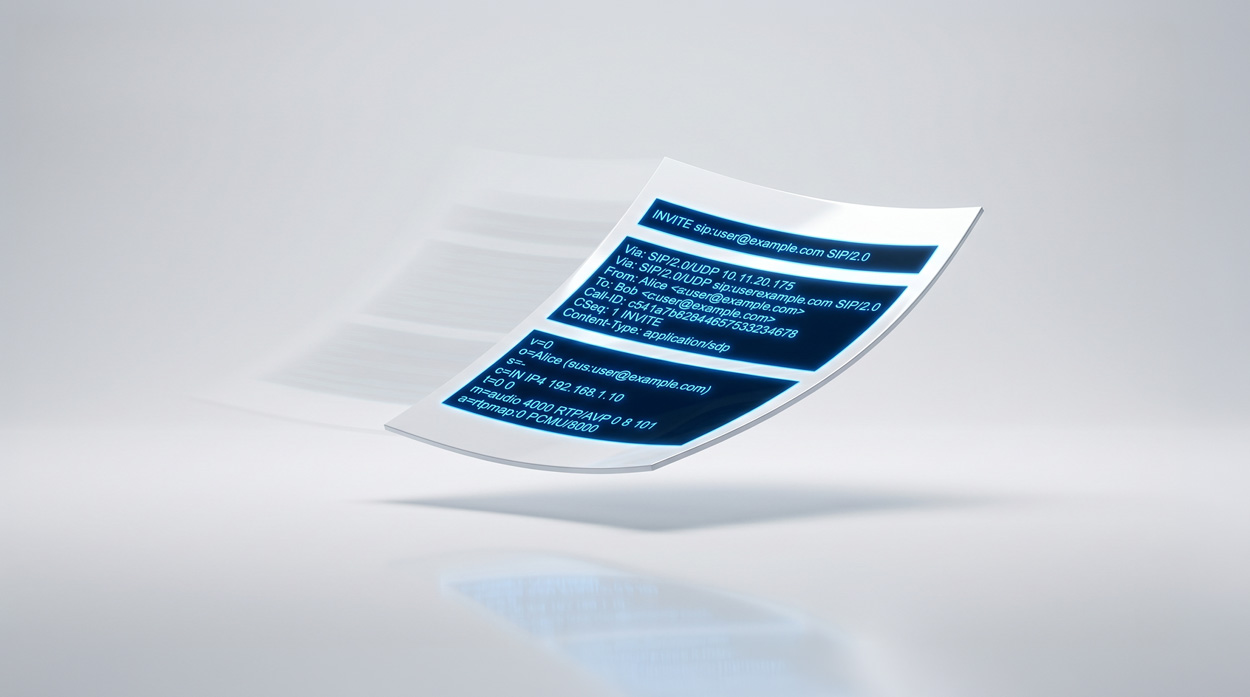
Every SIP call begins with an INVITE. It is the request a calling user agent sends to start a session, and it is also the message engineers spend the most time reading when something goes wrong. An INVITE carries the calling and called identities, the routing trail the call has taken so far, the codecs and transport parameters the caller is offering, and a long list of optional fields that influence everything from caller ID display to STIR/SHAKEN attestation.
This article is a structural reference for the INVITE itself. It walks through the three sections of the message, every mandatory header an INVITE must carry, the SDP body, and the optional headers that show up most often in production traces. For a broader overview of how SIP works as a protocol, see SIP signaling fundamentals.

METHOD Request-URI SIP-Version.Field-Name: value.z9hG4bK) that uniquely identifies a SIP transaction.sip:user@host or sips:user@host.The Three Sections of an INVITE
RFC 3261 defines a SIP message as three parts separated by carriage-return/line-feed sequences: a start line, a set of header fields, and an optional body. The start line of an INVITE is the request line. The headers carry routing, identity, and capability information. The body, if present, carries the SDP offer that describes the media the caller wants to negotiate.
The blank line between the last header and the body is structural. It is how a parser knows the headers have ended. A missing CRLF here is one of the more common reasons a malformed INVITE gets rejected by a strict SIP stack before it even reaches the routing logic.
The Request Line
The request line is a single line in the form METHOD Request-URI SIP-Version. For an INVITE it always begins with the literal word INVITE, followed by the Request-URI, followed by SIP/2.0.
The method tells the receiving stack what to do. INVITE means “establish a session.” Other methods that share most of the same header structure include ACK, BYE, CANCEL, OPTIONS, REGISTER, REFER, NOTIFY, SUBSCRIBE, UPDATE, INFO, MESSAGE, and PRACK. INVITE is the most common SIP method that creates a dialog. Other methods such as SUBSCRIBE can also establish dialogs depending on the extension in use.
The Request-URI indicates where the request is currently being sent. This is not necessarily the original destination. As the INVITE travels through proxies and SBCs, the Request-URI can be rewritten so the next hop knows where to forward. The To header represents the logical destination identity of the call and is normally preserved across transit, even when the Request-URI is rewritten for routing purposes. Confusing the Request-URI with the To header is one of the more common mistakes when reading a trace; the Request-URI answers “where is this going right now,” while the To header answers “who was this originally meant for.”
The SIP version has been SIP/2.0 since RFC 3261 was published in 2002. There is no SIP/3.0 in production.
The Mandatory Headers
RFC 3261 requires six headers on every SIP request: Via, Max-Forwards, To, From, Call-ID, and CSeq. INVITE requests almost always include Contact, because it provides the target for subsequent in-dialog requests such as BYE and re-INVITE. When the message carries a body, Content-Type and Content-Length become mandatory as well.
Via
The Via header records the network path the request has traveled. Every hop that forwards an INVITE adds a new Via at the top. Responses follow the Via chain in reverse order to return toward the sender. The branch parameter inside each Via uniquely identifies that transaction at that hop. RFC 3261 mandates that branch values begin with the magic cookie z9hG4bK.
Example: Via: SIP/2.0/UDP 198.51.100.10:5060;branch=z9hG4bK74bf9
Max-Forwards
A hop counter that prevents routing loops. Set to 70 by default; decremented at each hop; rejected with 483 Too Many Hops when it reaches zero.
To
The logical destination of the call, expressed as a URI. Not changed in transit. The answering UAS adds a To-tag in the 200 OK response, and that tag binds the dialog together on the callee’s side.
From
The caller’s claimed identity. Always carries a tag set by the calling UA. The From URI is what the caller claims to be, which is not the same as what an upstream provider has authenticated (that is P-Asserted-Identity).
Call-ID
A globally unique identifier for the entire dialog. Every request and response within the dialog carries the same Call-ID.
CSeq
Command Sequence: a number followed by a method name (e.g. CSeq: 314159 INVITE). Increments per new request within a dialog; reused for retransmissions.
Contact
Direct routing target for in-dialog requests such as BYE and re-INVITE, typically used together with any Route set established by Record-Route. Almost always contains the actual IP and port of the endpoint, which is why topology hiding at an SBC almost always involves rewriting Contact.
Content-Type and Content-Length
When the INVITE carries a body, both are mandatory. Content-Type is almost always application/sdp; Content-Length is the body size in bytes.
A Complete INVITE in Practice
INVITE sip:[email protected] SIP/2.0
Via: SIP/2.0/UDP 198.51.100.10:5060;branch=z9hG4bK74bf9
Max-Forwards: 70
To: "Bob" <sip:[email protected]>
From: "Alice" <sip:[email protected]>;tag=1928301774
Call-ID: [email protected]
CSeq: 314159 INVITE
Contact: <sip:[email protected]:5060>
P-Asserted-Identity: <sip:[email protected]>
Identity: eyJhbGciOiJFUzI1NiI...JSON-WEB-SIGNATURE
Allow: INVITE, ACK, CANCEL, BYE, OPTIONS, REFER, UPDATE
Content-Type: application/sdp
Content-Length: 156

v=0
o=alice 2890844526 2890844526 IN IP4 198.51.100.10
s=SIP Call
c=IN IP4 198.51.100.10
t=0 0
m=audio 49170 RTP/AVP 0 8 101
a=rtpmap:0 PCMU/8000
a=rtpmap:101 telephone-event/8000
The request line is on the first row, the mandatory and optional headers follow, the blank line marks the end of the header block, and the SDP offer fills the body. Values are illustrative; real-world INVITEs vary in field order and the exact set of optional headers, but every conforming INVITE carries the same mandatory fields and the same three-section structure.
The SDP Body
The body is almost always a Session Description Protocol (SDP) offer (RFC 8866, which obsoleted RFC 4566 in 2021). Key lines:
v=protocol version (always 0)o=origin: session ID + originator addresss=session namec=connection: IP where the originator expects to receive mediat=time (almost always0 0for real-time SIP)m=media line: type, port, transport, payload-type lista=attributes:rtpmap,fmtp,sendrecv/sendonly/recvonly/inactive,crypto(SDES),fingerprint(DTLS-SRTP)
SDP follows the offer/answer model (RFC 3264). The INVITE carries the offer; the 200 OK carries the answer. A deployment using SRTP with SDES keying must protect the signaling path with TLS, otherwise the master keys cross the network in clear text inside the a=crypto line.
Optional Headers That Matter in an INVITE
The INVITE carries more optional headers than any other SIP message because it is establishing the dialog, negotiating capabilities, and asserting identity all at once. The SIP headers complete reference covers every header field-by-field; here we focus on the ones that affect INVITE processing specifically.
Capability negotiation: Allow enumerates the methods the UA supports, Supported lists the extensions it understands, and Require lists the extensions the far side must support or the INVITE fails (commonly timer, 100rel, replaces). These three headers determine whether the dialog can be established at all.
Routing path: Route pre-sets the hops the INVITE traverses; Record-Route marks intermediaries that want to stay in-dialog for subsequent requests. A B2BUA SBC strips both and re-originates fresh routing on the outbound leg.
Caller identity: P-Asserted-Identity (RFC 3325) carries the carrier-asserted caller ID, P-Preferred-Identity is what the UA requests. The STIR/SHAKEN Identity header (RFC 8224) adds a signed PASSporT binding the caller’s number to a cryptographic identity. Privacy (RFC 3323) controls what gets concealed downstream.
Call forwarding history: Diversion and History-Info (RFC 4244) carry redirection history when a call has been forwarded. Two competing standards; vendors prefer different formats, and the SBC often normalizes between them.
Session lifecycle: Session-Expires and Min-SE (RFC 4028) set the refresh interval that prevents half-closed ghost sessions. User-Agent identifies the calling software, useful for trace correlation.
From INVITE to Dialog
An INVITE that reaches the destination triggers a sequence of responses: 100 Trying immediately, then one or more 18x provisional responses (180 Ringing, 183 Session Progress), then 200 OK with the To-tag set when the callee answers. The caller acknowledges with ACK, and the dialog is fully confirmed.
Re-INVITEs within an existing dialog reuse the same Call-ID, To-tag, and From-tag with a higher CSeq, modifying the session (codec change, hold, transfer). The provisional, success, and failure response codes that complete the INVITE transaction follow the same 1xx through 6xx pattern used everywhere else in SIP.
Where SBCs Touch the INVITE
A B2BUA Session Border Controller terminates the inbound INVITE and constructs a fresh outbound INVITE on the other leg. Every header on the outbound message is built from scratch, which means an SBC can strip proprietary fields, rewrite identity headers, normalize Diversion to History-Info (or vice versa), inject the STIR/SHAKEN Identity header from an external signing service, and rewrite Contact and Via to hide the originator’s internal topology. The mechanics of those rewrites are covered in SIP header manipulation; the architectural reason a proxy cannot do the same thing is covered in SIP proxy vs SBC.
Frequently Asked Questions
Why does an INVITE have both From and P-Asserted-Identity?
The From header carries the identity the caller claims. PAI carries the identity the upstream provider is willing to vouch for after authenticating the user.
What is the difference between the Request-URI and the To header?
The Request-URI is the address the request is currently aimed at (changes as proxies/SBCs forward it). The To header is the original logical destination (does not change in transit).
Can an INVITE have no body?
Yes. A “delayed offer” INVITE has no SDP. The callee responds with its SDP offer in the 200 OK; the caller’s ACK carries the answer. Uncommon in modern carrier deployments but still seen with some legacy click-to-call scenarios.
Why is Max-Forwards initialized to 70?
RFC 3261 convention. High enough to traverse any realistic SIP path, low enough that loops are detected and broken quickly.
What is the branch parameter in the Via header for?
Identifies a single SIP transaction at a single hop. Each hop inserts a fresh branch when it forwards. Compliant SIP/2.0 branches must begin with z9hG4bK.
ProSBC and the INVITE Message
Every interesting thing an SBC does to a call happens to the INVITE first. ProSBC is a full B2BUA: each INVITE is terminated on the inbound leg and re-originated from scratch on the outbound leg. That gives the routing engine complete control over the request line, every header, and the SDP body, independently on each side.
The Ruby routing API exposes more than 100 call parameters and supports filter stages that rewrite headers, query external systems, and inject the STIR/SHAKEN Identity header from a signing partner before the outbound INVITE is constructed. Header normalization is rule-based and scoped per Network Access Point.
For deployments exposed to the public internet, ProSBC also enforces the policy that protects the INVITE pipeline itself: SIP-aware rate limiting, INVITE flood protection, dynamic blacklisting, and topology hiding via Contact and Via rewriting on every outbound leg.
Prefer to evaluate on your own first? Start your 30-day free trial.