Giving Developers a Cloud SBC for Their Own Carriers with CPaaS Enablement
Developers building on a CPaaS platform reach a point where the convenience of a bundled communications API stops being worth its cost. They want their own carrier relationships, their own routing, and a bill that does not balloon with every minute of media passing through a cloud provider.
Getting there means connecting to local, international, and DID operators, each with its own SIP dialect. It means handling traffic routing across those carriers. And it means doing it in the cloud, alongside the application, without generating egress charges that scale with call volume. That is specialized voice-interconnect work that application developers were not built to do themselves.
How CPaaS Enablement Works
CPaaS enablement is the use of a cloud SBC to let application developers connect their own carriers to a CPaaS-style platform, with traffic management, SIP normalization, and media bypass so signaling and media are handled efficiently. The SBC turns a set of raw carrier connections into a clean, normalized interface the application can build on.
Because their applications are fully cloud-deployed, developers want the SBC in the same AWS or Azure environment rather than on separate infrastructure. A cloud-native SBC fits their stack and deploys alongside the application.
This use case is closely related to the broader pattern of connecting cloud platforms to carriers, covered in cloud communications trunking, and it complements the product view of how CPaaS and SBCs fit together, described on the CPaaS and SBCs solution page. What sets CPaaS enablement apart is its developer focus and its emphasis on cloud cost.
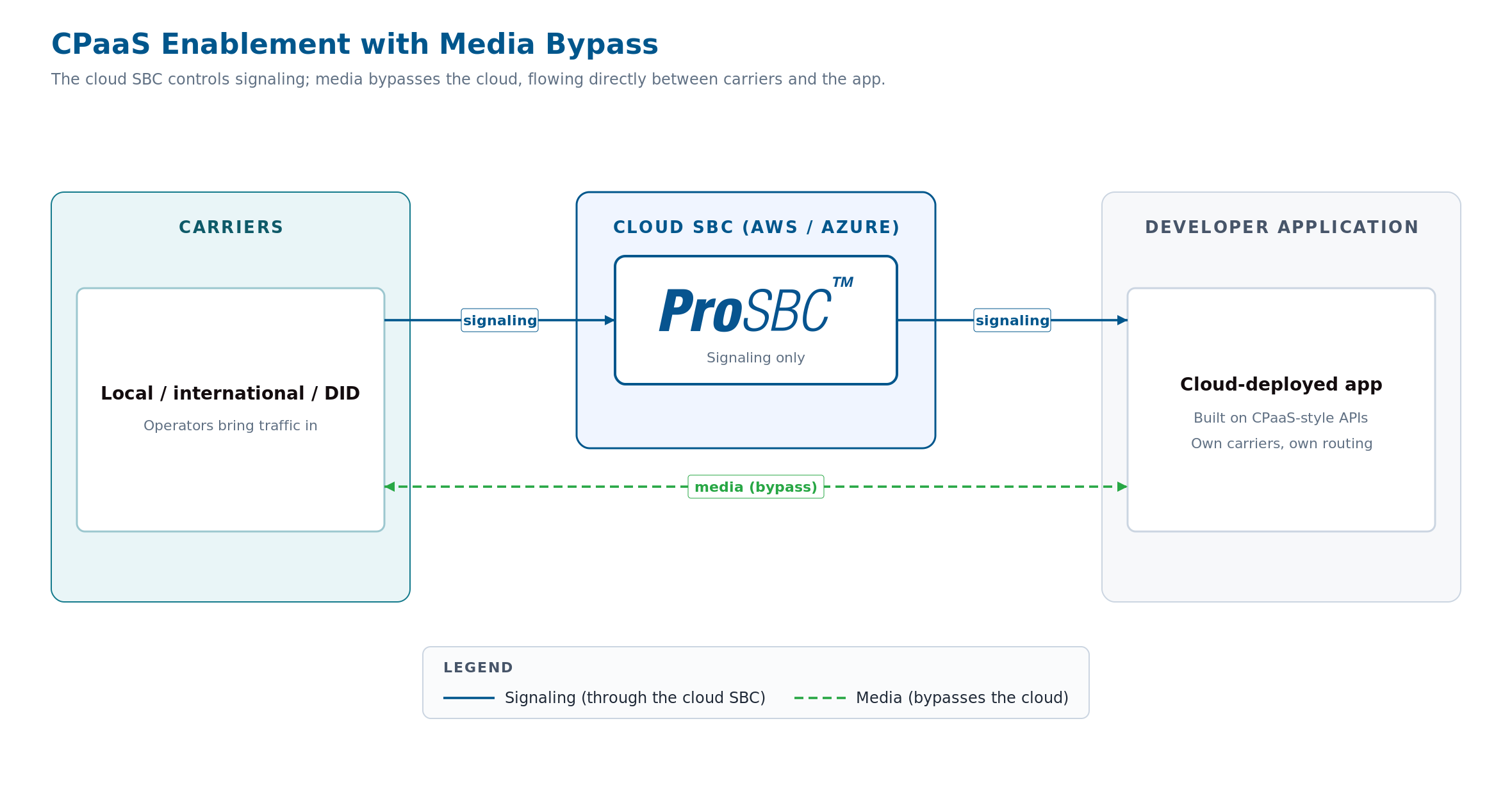
CPaaS enablement with media bypass: the cloud SBC handles signaling to and from carriers, while media flows directly between carriers and the application. Click to enlarge.
What the SBC Does for CPaaS Enablement
Carrier Connectivity and Routing
The SBC connects to the local, international, and DID operators the application needs, and manages traffic between them. Developers add carriers through the SBC rather than rebuilding their application for each one.
Interoperability and Normalization
Running as a Back-to-Back User Agent, the SBC normalizes each operator’s SIP into one consistent interface. The application sees a single clean connection no matter how many carriers sit behind it.
Media Bypass for Cost Control
The SBC handles signaling while letting media bypass the cloud, so voice audio flows directly between the carrier and the application without generating cloud egress charges. This is what makes a cloud SBC economical for high-volume developer applications.
Deploy It Your Way
Because the SBC is software, developers can run it in whatever model suits their team:
Self-Managed
Run ProSBC in your own AWS or Azure environment alongside the application. Full control over carrier onboarding, routing scripts, and media-bypass configuration.
Managed Service
Hand deployment and operation to TelcoBridges through the ProSBC managed service. Includes 1+1 HA, 24/7 support, and monitoring, while still getting media-bypass economics.
Fully Hosted
TelcoBridges hosts and manages the SBC entirely. The developer team points their carriers and application at a managed endpoint without operating voice infrastructure.
ProSBC for CPaaS Enablement
ProSBC is a carrier-grade, software-based session border controller built on more than 20 years of SIP deployment experience, and it is cloud-native. For the CPaaS enablement use case, it delivers:
Evaluate it with the free, permanent three-session ProSBC Lab, run a full 30-day trial, or start with the managed service.
Frequently Asked Questions
What is CPaaS enablement?
It is the use of a cloud SBC to let application developers connect their own carriers to a CPaaS-style platform, with traffic management, SIP normalization, and media bypass. It gives developers carrier control and better economics than a fully bundled communications API.
Why do developers want a cloud-based SBC specifically?
Their applications are fully cloud-deployed, so they want the SBC in the same AWS or Azure environment rather than on separate infrastructure. A cloud-native SBC fits their stack and deploys alongside the application.
What is media bypass and why does it matter?
Media bypass has the SBC manage only the signaling while media flows directly between the carrier and the application, bypassing the cloud instance. It matters because cloud providers charge for data egress, and routing voice media through a cloud SBC would generate charges that scale with call volume. Bypass avoids that.
How is CPaaS enablement different from cloud communications trunking?
They overlap. Cloud communications trunking is the general model of connecting a cloud platform to carriers. CPaaS enablement is the developer-focused case of it, where the customer is an application builder, the SBC is cloud-native, and media bypass for cost control is a central concern.
Build on Your Own Carriers with ProSBC
Talk to a solutions architect about connecting your application to its own carriers through ProSBC, or start evaluating on your own.
Prefer to evaluate on your own first? Start your 30-day free trial.