Moving Legacy Voice Networks to IP with TDM to SIP Migration
There are still thousands of central offices around the globe running on aging, end-of-life TDM switches. These systems are increasingly difficult to maintain and expensive to operate, and the vendors behind them have largely moved on. The operators who depend on them face a slow-motion deadline: the hardware will not last forever, and replacing it like-for-like is no longer an option.
The pressure is both practical and financial. Moving to IP-delivered services lets operators consolidate facilities and reduce operating costs, but it is not only a technical challenge. It is also a business-model change, from owning and running switching hardware to delivering services over a cloud platform. The migration has to preserve continuity for customers who neither know nor care what switch their calls run through, and it usually cannot happen all at once.
How an SBC Bridges the Migration
A migration of this kind is rarely a single cutover. The operator needs both worlds to coexist while traffic moves across in stages, and the session border controller is what makes that coexistence possible. It sits between the existing customer network and the cloud softswitch, terminating the legacy side and presenting a clean IP connection to the cloud, so neither end has to be rebuilt to accommodate the other.
Because it operates as a Back-to-Back User Agent, the SBC fully controls each call on both sides, normalizing the differences between the legacy environment and the cloud platform. The approach is deliberately general: the SBC sits between the customer network and the cloud regardless of which cloud softswitch the operator has chosen, so the migration is not tied to any single platform.
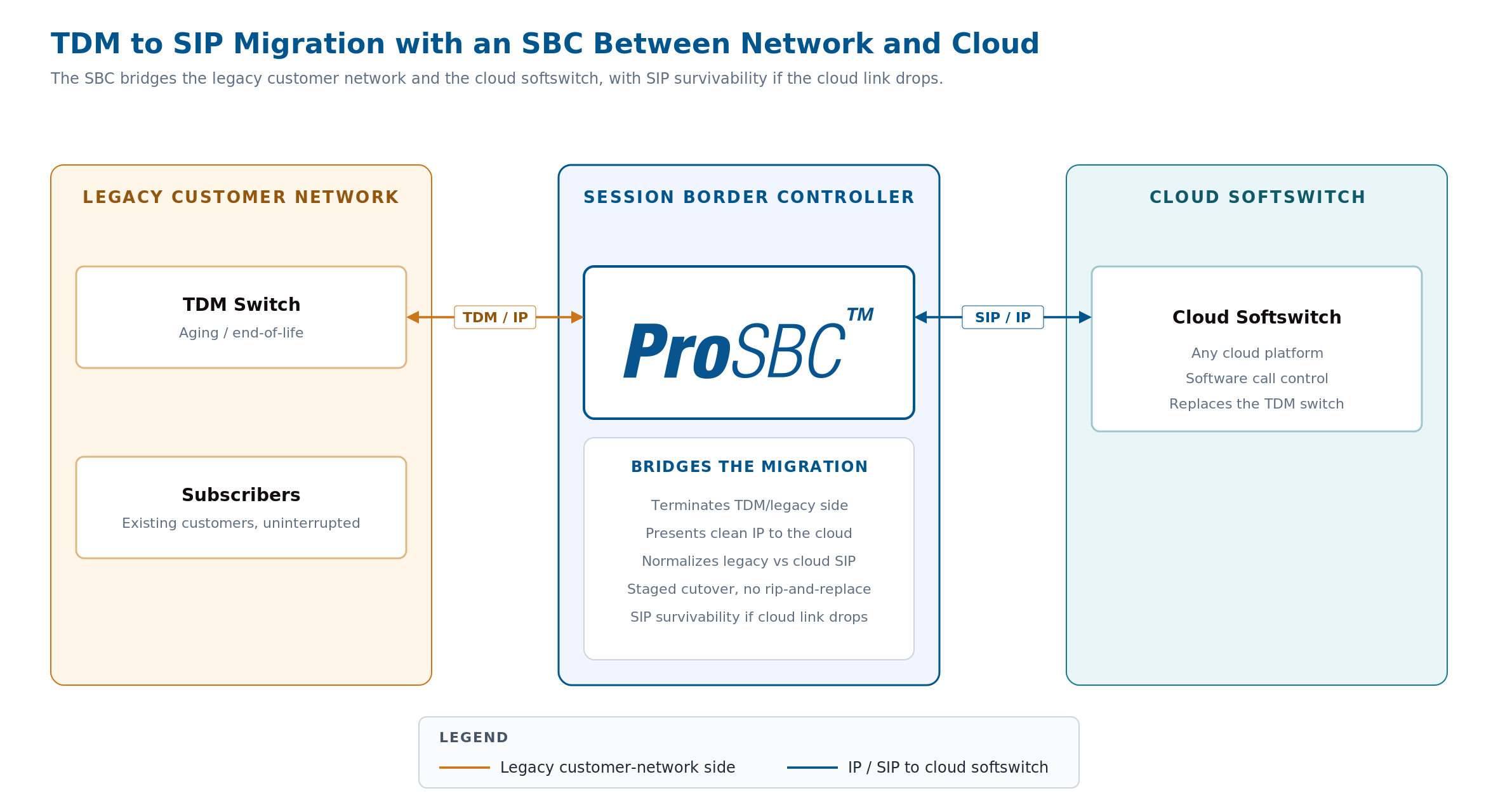
TDM to SIP migration: the ProSBC sits between the legacy customer network and the cloud softswitch, bridging the two during a staged migration. Click to enlarge.
What the SBC Does During and After Migration
Bridging Legacy and Cloud
The SBC connects the existing customer network to the cloud softswitch, letting the two coexist while traffic migrates in stages rather than in one risky cutover. It presents each side with the connection it expects.
Interoperability and Normalization
Migration inevitably surfaces mismatches between the old and new environments. The SBC’s SIP header manipulation reconciles them, so calls complete regardless of the differences between the legacy network and the cloud softswitch.
SIP Survivability
Local SIP survivability is available in ProSBC as Local Site Survivability. It keeps local calls working when the link to the cloud softswitch is lost, so an operator does not trade local resilience for cloud efficiency in the move to a cloud softswitch.
Ongoing Security and Control
Once migrated, voice runs over IP, which brings the same security needs as any IP voice network. The SBC continues to protect the connection, control routing, and give the operator visibility over traffic.
Deploy It Your Way
Operators migrating from TDM often have deep switching expertise but limited IP-voice experience, which makes the operating model an important choice:
Self-Managed
Run ProSBC as software on your own infrastructure. Full control over the migration pace, routing rules, and cloud softswitch integration.
Managed Service
Hand deployment and management to TelcoBridges through the ProSBC managed service, which suits operators who want the migration guided by SBC specialists. Includes 1+1 HA, 24/7 support, and monitoring.
Fully Hosted
TelcoBridges hosts and manages the SBC entirely during and after the transition. The operator connects its legacy network and cloud platform to a managed bridge.
Frequently Asked Questions
What is TDM to SIP migration?
It is the process of moving voice services off legacy digital TDM switches onto IP-based infrastructure, usually a cloud softswitch, while keeping existing customers in service. An SBC sits between the legacy network and the cloud to bridge the two during a staged migration.
Why do operators migrate away from TDM?
Legacy TDM switches are aging and end-of-life, increasingly expensive and difficult to maintain. Migrating to IP-delivered services lets operators consolidate facilities and reduce operating costs while keeping their customers.
What is SIP survivability and why does it matter here?
SIP survivability keeps local calls working when the connection to the cloud softswitch is lost. It matters because moving call control to the cloud introduces a dependency a local switch never had. ProSBC delivers local SIP survivability through its Local Site Survivability feature.
Does the SBC work with any cloud softswitch?
Yes. The SBC sits between the customer network and the cloud regardless of which cloud softswitch the operator has chosen, and its normalization reconciles the differences. The migration approach is general rather than tied to any single platform.
Migrate from TDM to the Cloud with ProSBC
Talk to a solutions architect about bridging your legacy network to a cloud softswitch with ProSBC, or start evaluating on your own.
Prefer to evaluate on your own first? Start your 30-day free trial.