SIP Trunk Pricing: Cost, Plans, and How to Compare Providers
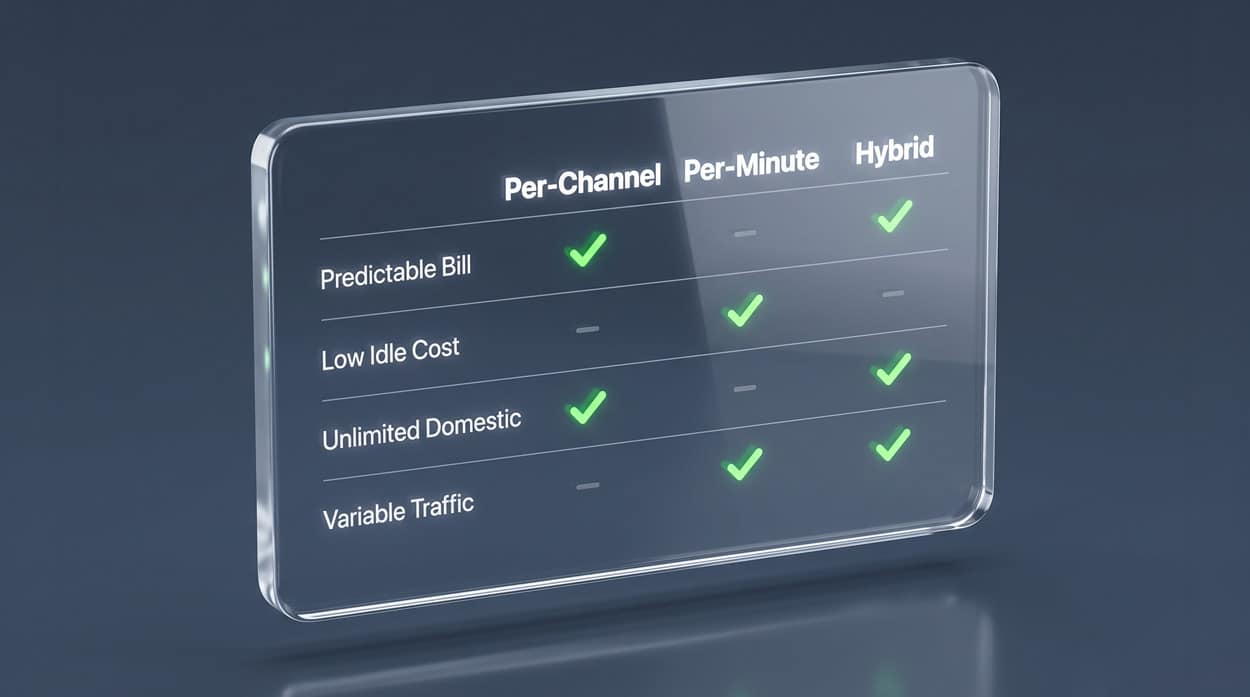
Two SIP trunk quotes almost never line up cleanly. One provider quotes a flat per-channel price, another quotes per-minute with a low headline rate, a third bundles unlimited domestic calling with a per-DID charge on top. The sticker numbers look wildly different, and yet the real cost of carrying the same call volume can land within a few dollars of each other once you account for how each plan actually meters usage. The trick to a fair SIP trunking pricing comparison is knowing which meter each provider is running, and what that meter does to your bill when your traffic changes.
In this article, we’ll walk you through how SIP trunk pricing is actually structured, the three main pricing models and when each one wins, the hidden charges that turn a cheap headline rate into an expensive bill, realistic price ranges you can sanity-check a quote against, and a straightforward method for comparing providers on total cost rather than on the number at the top of the page. If you’re an MSP, an ISP, or an IT lead sizing a first SIP deployment, this is the part of the buying process where a little structure saves real money.

How SIP Trunk Pricing Is Structured
Every SIP trunk bill is assembled from the same handful of components. Providers differ in which components they emphasize and which they bury, but the underlying meters are consistent, and once you can name them you can read any quote.
The first component is capacity, which covers how many calls you can run at once. This is priced either per channel (a flat monthly fee for each concurrent session) or absorbed into a per-minute plan with no hard channel cap. Capacity is the single biggest driver of a predictable bill, because it maps directly to your busy-hour call volume rather than to your total minutes.
The second component is usage, the actual minutes carried. On a metered plan this is the dominant line item, drawn from a rate deck that prices each call by destination. On a flat-rate plan, usage is either included up to a cap or genuinely unlimited for domestic calling, with international always billed separately.
The third component is numbers, the DIDs you rent for inbound calls. These are small recurring charges per number, typically a few tens of cents to just over a dollar each per month, plus one-time setup or porting fees when you move existing numbers in. A business with 200 employees who each need a direct line will see this add up in a way a headline per-channel rate never shows.
The fourth component covers add-ons and compliance: emergency calling (E911) fees, regulatory recovery charges, toll-free surcharges, and increasingly the cost of maintaining call authentication under the FCC’s STIR/SHAKEN framework. These are the line items that make the final invoice larger than the quote, and they are where careless comparison shopping goes wrong.
The Three SIP Trunk Pricing Models
Most providers structure their SIP trunk plans around one of three models. None is cheapest in the abstract; each wins for a particular traffic shape.
Per-channel (flat-rate) pricing
A per-channel plan charges a fixed monthly fee for each concurrent channel, commonly in the range of $15 to $30 per channel, often with unlimited domestic calling folded in. You size the plan to your busy-hour concurrency and your bill barely moves month to month. This is the model of choice for businesses with steady, predictable calling: a professional office, a clinic, a branch network where the number of simultaneous calls is stable and most traffic is domestic. The tradeoff is that you pay for peak capacity whether or not you use it every hour, so a trunk sized for a seasonal peak sits partly idle the rest of the year.
Per-minute (metered) pricing
A metered plan charges by the minute against a rate deck, with domestic termination often landing somewhere around $0.005 to $0.02 per minute and international varying enormously by destination. There is usually no fixed channel fee, so a line that carries almost no traffic costs almost nothing. This model wins for low-volume or highly variable calling: a disaster-recovery trunk that only carries traffic during an outage, an outbound campaign that runs in bursts, a business whose call volume swings hard by season. The risk is that heavy or unexpected volume, or a toll-fraud event, produces a bill with no ceiling.
Hybrid and bundled plans
Most commercial plans in practice are hybrids. A provider bundles a block of channels with a bucket of included minutes, charges per-minute overage above the bucket, and adds DIDs and compliance fees on top. Bundled per-seat plans (a flat price per user that includes a channel allocation and a phone number) are common in the hosted PBX and unified communications market because they map cleanly to headcount. The hybrid model smooths the extremes of the other two, but it also makes direct comparison harder, because two hybrid quotes rarely bundle the same things.
The Hidden Costs That Change the Real Price
The headline rate is the part of SIP trunk pricing designed to be compared. The rest of the bill is where the real differences live, and it is worth pulling each of these into the open before you sign.
Setup and porting fees apply when you move existing numbers to a new provider. Number porting is often free in small quantities and per-number above a threshold, and a large port can carry a meaningful one-time cost, so factor it into the first-year total rather than the monthly rate. Our guide to number porting for ISPs and carriers covers the operational side of moving numbers without dropped service.
Regulatory and compliance charges cover E911 fees, federal and state regulatory recovery, and toll-free database dips. These are usually small per-line amounts, but they are mandatory and they scale with your DID count. STIR/SHAKEN compliance in particular has become a real operating cost for voice providers rather than a one-time setup: maintaining your own attestation certificate and Robocall Mitigation Database registration is now an annual obligation, covered in depth in our piece on FCC STIR/SHAKEN compliance for small VoIP providers.
Overage and burst charges are the sting on flat-rate plans that let you exceed your channel count for a fee. A trunk that bursts gracefully is convenient, but the burst rate is often several times the base per-channel price, so a few busy days can erase the savings of a lean base plan.
Toll fraud exposure is the cost nobody quotes and everybody eventually pays attention to. A compromised PBX or a stolen SIP credential can dial premium-rate international destinations for hours before anyone notices, and on a metered plan the resulting minutes are real money you owe. This is not a line item on the quote, but it belongs in any honest total-cost calculation, and it is the single strongest argument for putting real fraud controls at the network edge rather than trusting the provider’s after-the-fact alerts.
Realistic SIP Trunk Price Ranges
Concrete numbers are more useful than adjectives, so here are the ranges you can use to sanity-check a quote. Treat these as general market figures for comparison, not a guaranteed price from any specific provider.
| Component | Typical range | Notes |
|---|---|---|
| Per-channel (flat-rate) | $15–$30 / channel / month | Often includes unlimited domestic calling |
| Per-minute domestic (US) | $0.005–$0.02 / minute | Inbound and outbound may differ |
| DID (phone number) | $0.25–$1.50 / number / month | Plus one-time porting on transfer |
| Toll-free number | $1–$3 / number / month | Inbound minutes usually billed separately |
| E911 / regulatory | $1–$3 / line / month | Mandatory, scales with DID count |
These figures give you an anchor for any SIP trunking price you are handed. A useful gut check: a mid-size business running 20 concurrent channels on a flat-rate plan with unlimited domestic calling and 100 DIDs typically lands somewhere in the low hundreds to several hundred dollars a month all-in, once numbers and compliance fees are added. If a quote is dramatically below that, look for what has been unbundled and priced separately; if it is dramatically above, look for capacity or bundled features you are not using.
How to Compare SIP Trunk Providers on Total Cost
Comparing SIP trunk pricing fairly means normalizing every quote to the same call profile, then adding up the whole bill rather than the one rate that is easiest to compare. Here is a method that holds up.
-
Pull your real traffic profile. Get 90 days of call records and find your busy-hour concurrent calls, your total monthly minutes split by domestic and international, and your DID count. Size to the 95th-percentile peak, not the absolute maximum, so one anomalous spike does not inflate every quote.
-
Model each quote against that exact profile. Apply each provider’s channel fees, per-minute rates, and bundle rules to your numbers. A low per-minute rate on high volume can beat a flat plan, or lose to it, and you only find out by running your own minutes through both.
-
Add every recurring charge. DIDs, toll-free, E911, regulatory recovery, and any monthly platform or portal fee go into the monthly total. These are the line items that separate the real winner from the cheapest headline.
-
Add first-year one-time costs. Porting fees, setup charges, and any hardware or SBC cost belong in the first-year comparison, amortized so a provider with a high setup fee does not look artificially cheap.
-
Price the risk and the exit. Check the overage rate, the contract term, the early-termination penalty, and whether the plan lets you burst or hard-caps you. A plan with no fraud ceiling and a punishing exit clause can cost more than a slightly pricier plan that protects you on both.
The provider comparison that matters is the all-in total against your own traffic, plus the terms that govern what happens when things go wrong. A slightly higher monthly rate with graceful bursting, real fraud controls, and a clean exit is often the cheaper choice over a two-year horizon. The same total-cost discipline applies to the SBC that sits alongside the trunk, which our hardware SBC vs software SBC total cost of ownership breakdown works through in detail.
Where the SBC Fits in SIP Trunk Pricing
One cost that sits alongside the trunk itself, rather than inside the carrier’s quote, is the Session Border Controller. If you take trunks from more than one provider (for failover, for least-cost routing, or simply to avoid single-carrier lock-in), the SBC is the piece that sits at your edge and makes multiple trunks behave like one coherent voice network. It handles the security, the SIP normalization between carriers that speak slightly different dialects, and the routing logic that sends each call down the cheapest acceptable path.
The SBC is also where the toll-fraud ceiling actually lives. Carrier alerts tell you about fraud after the minutes are spent; per-call fraud scoring and dynamic blacklisting at the edge stop the calls before they cost you anything. When you are pricing SIP trunks, the SBC is the line item that turns an uncapped metered risk into a controlled one, which is why it belongs in the total-cost picture even though no trunk provider will quote it for you. If you are weighing the SBC choice itself, our SBC buyer’s guide walks through sizing, deployment, and pricing step by step.
Frequently Asked Questions
How much does a SIP trunk cost per month?
It depends on the pricing model and your call volume. Flat-rate per-channel plans commonly run $15 to $30 per channel per month, often with unlimited domestic calling. Metered plans charge per minute (roughly $0.005 to $0.02 for US domestic) with no fixed channel fee. A mid-size business with 20 channels and 100 numbers typically lands in the low hundreds to several hundred dollars a month once DIDs and compliance fees are included.
Is per-minute or per-channel SIP trunk pricing cheaper?
Neither is cheaper in the abstract. Per-channel wins for steady, predictable, mostly-domestic calling because the bill is flat and includes unlimited minutes. Per-minute wins for low-volume or highly variable traffic, such as a disaster-recovery trunk or a bursty outbound campaign, because you pay almost nothing when the line is idle. Run your own minutes through both models to see which fits your traffic.
What hidden costs should I watch for in SIP trunk pricing?
The main ones are setup and number-porting fees, mandatory E911 and regulatory recovery charges that scale with your DID count, overage or burst rates on flat plans that can be several times the base rate, and toll-fraud exposure on metered plans where a compromised system can run up real minutes. STIR/SHAKEN compliance has also become an ongoing annual cost for voice providers rather than a one-time setup.
How do I compare SIP trunk providers fairly?
Normalize every quote to your own traffic profile. Pull 90 days of call records for your busy-hour concurrency and monthly minutes, model each provider’s rates against those exact numbers, add every recurring charge (DIDs, toll-free, E911, regulatory), fold in first-year one-time costs like porting, and price the risk (overage rate, contract term, fraud ceiling, exit penalty). Compare the all-in total, not the headline rate.
Do I need an SBC on top of my SIP trunk?
For a single trunk feeding a single well-secured system, not always. The moment you take trunks from more than one provider, face the public internet, or need real fraud protection, an SBC becomes the piece that secures, normalizes, and routes across those trunks and enforces the toll-fraud ceiling that the carrier’s after-the-fact alerts cannot. It is a separate cost from the trunk but belongs in the total-cost picture.
Conclusion
SIP trunk pricing looks confusing because providers meter the same service in different ways, but the confusion dissolves once you separate capacity from usage from numbers from compliance, and once you run each quote against your own real traffic instead of comparing headline rates. Pick the model that matches your traffic shape, add up everything the invoice will actually contain, and price the risk of overage, fraud, and exit alongside the monthly number. The cheapest quote on paper is rarely the cheapest bill at the end of the year.
The piece that ties multiple trunks together, protects your margin from fraud, and gives you the routing control to chase the best per-minute rate on every call is the Session Border Controller at your edge. When you are ready to price that piece, TelcoBridges publishes its SBC pricing openly, so you can slot a real number into your total-cost model instead of waiting on a quote.
How ProSBC Helps You Control SIP Trunk Cost and Risk
Once you are running trunks from more than one provider to chase the best rate or protect against a single-carrier outage, ProSBC is the edge that makes them work as one network. It routes each call down the cheapest acceptable path with rule-based least-cost routing, normalizes the SIP differences between carriers so a multi-vendor setup behaves predictably, and enforces the fraud ceiling that turns an uncapped metered bill into a controlled one through per-call scoring, dynamic blacklisting, and integrations with fraud partners such as TransNexus and YouMail.
ProSBC uses a per-session annual subscription with published, volume-tiered rates you can read straight off the pricing page and drop into your total-cost model, it deploys on AWS, Azure, VMware, KVM, or bare metal, and a permanently free ProSBC Lab license lets you validate the routing and security before you commit to a plan.
Prefer to evaluate on your own first? Start your 30-day free trial.