Low-Cost SIP Trunk Providers: Cutting Cost Without Losing Quality
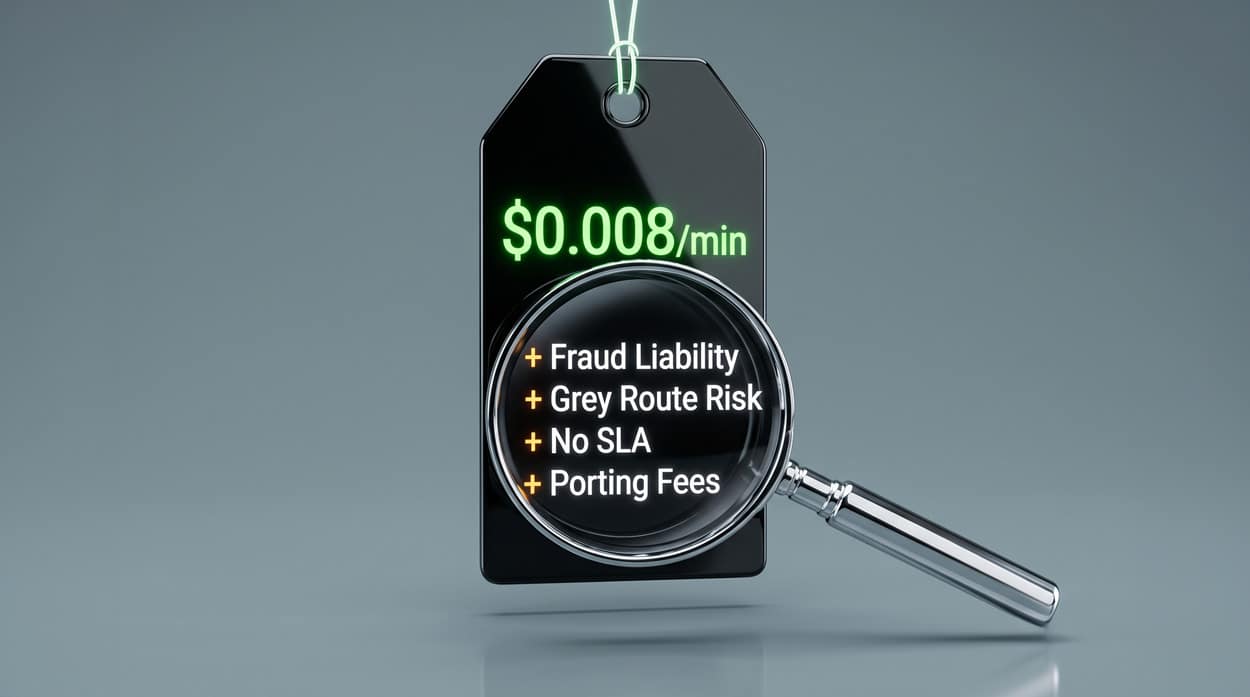
Everyone shopping for a SIP trunk starts in the same place: the price sheet. A lower per-channel rate or a cheaper per-minute number feels like an easy win, and sometimes it is. The trouble is that the cheapest quote and the cheapest outcome are rarely the same thing. Once you add in the calls that don’t connect, the fraud you end up liable for, and the hours lost when a single carrier goes dark, a low-cost trunk can quietly become the expensive one.
So the real question isn’t who has the lowest rate. It’s who gives you the lowest total cost for the quality you actually need. In this article, we’ll walk through what drives SIP trunk pricing, why the cheapest provider often costs more than it looks, how to evaluate a low-cost provider without getting burned, and the one architectural decision that lets you chase cheap rates and stay reliable at the same time.

What Actually Drives SIP Trunk Cost
Before comparing providers, it helps to know what you’re actually paying for. SIP trunk pricing comes down to a few variables, and the headline number on a landing page usually hides most of them.
The first is the pricing model. Concurrent-channel pricing charges a flat rate per simultaneous call path, which is predictable and tends to win for steady, high-volume traffic. Metered per-minute pricing charges for what you use, which suits bursty or low-volume calling but gets unpredictable fast when a campaign spikes. Committed or wholesale pricing trades a monthly minimum for a lower unit rate, and it only pays off if your volume is genuinely reliable.
The second is where your calls actually go. Domestic termination is cheap and competitive almost everywhere. International destinations vary enormously, and this is where low cost and low quality most often travel together. A provider quoting a rock-bottom international rate is frequently buying the cheapest termination route it can find, which is a different product from a premium route to the same country.
The rest is the fine print that decides your real bill. DID and number fees cover the numbers you rent, and one-time setup charges, minimum contract length, porting fees, and the fraud-liability terms all move the total. Two providers can quote the same per-minute rate and still cost very different amounts once you read how each one handles number ranges and what happens after a fraud event. SIP itself, as defined in RFC 3261, is just the signaling protocol underneath all of this; the pricing lives entirely in the commercial terms wrapped around it. For a sense of how a published per-session model compares, the ProSBC pricing page lays the numbers out in the open.
Why the Cheapest SIP Trunk Can Cost More
Here’s the part the price sheet won’t tell you. A cheap rate is often subsidized by something you’ll pay for later.
Route quality is the most common trade-off. To hit an aggressive price, some providers send traffic over least-cost or grey routes that hop through multiple wholesalers before termination. The signaling still works, so the trunk looks fine in a demo. In production you see it as a lower answer-seizure ratio, longer post-dial delay while the call threads through extra hops, degraded audio, and fax that simply refuses to complete. You didn’t save money; you moved the cost from your invoice to your call quality, and your customers noticed before you did.
Fraud liability turns a small saving into a five-figure problem. International revenue share fraud and Wangiri (one-ring) fraud generate real toll charges, and cheaper carriers frequently push that liability onto the customer in their terms. One compromised PBX or one leaked SIP credential over a weekend can run up a bill that erases a year of savings. The rate was low; the exposure was not. Scoring calls with real-time toll fraud detection at your own edge is the reliable way to cap that.
Then there’s what you don’t get. A bargain trunk often comes with a thin service-level agreement or none at all, no built-in redundancy, and a support queue rather than an engineer. When something breaks at 2 a.m., the difference between a provider you can reach and one you can’t is worth more than the few cents per minute you saved. The honest way to read a cheap quote is to ask what was removed to reach that price, because something almost always was.
How to Evaluate a Low-Cost Provider Without Getting Burned
You can buy cheap and buy well at the same time. It just takes looking past the rate at a handful of things that separate a genuinely good-value provider from a false economy.
- Route quality, in writing. Ask for typical ASR and ACD on your actual destinations, and whether they offer a premium route option. A provider confident in its quality will share the numbers.
- Fraud terms. Read exactly who is liable when fraud happens, whether spend caps or velocity limits are available, and what monitoring they provide. This clause matters more than the per-minute rate.
- Redundancy and SLA. Look for a real uptime commitment and geographic redundancy on the carrier side, not a marketing “99.9%” with no remedy attached.
- Number coverage and porting. Confirm DID availability in the regions you serve and that porting your existing numbers is straightforward, documented, and not buried in fees.
- Contract flexibility. Short terms and the ability to test with real traffic before committing are signs of a provider that expects to earn the renewal.
The single most useful step is to run test traffic before you sign. A trial across your real destinations tells you more in a week than any quote tells you in a quarter. Measuring quality once traffic flows is its own discipline, and our guide to VoIP monitoring best practices covers the metrics worth watching. The table below is a simple way to frame the comparison.
| Evaluation criterion | Cheapest-rate trunk | Reliable low-cost trunk |
|---|---|---|
| Route quality (ASR/ACD) | Opaque, often grey routes | Disclosed, premium option |
| Fraud liability | Pushed to customer | Shared, caps and monitoring |
| Redundancy | Single path | Geographic redundancy, real SLA |
| Support | Ticket queue | Reachable engineers |
| Contract | Long lock-in | Short terms, test traffic allowed |
Using Multiple Low-Cost Carriers Safely
Here’s the move that changes the whole equation: don’t marry one carrier at all.
The instinct is to find the single cheapest reliable provider and route everything through it. The problem is that you’ve now tied your quality, your uptime, and your rates to one company’s good behavior. A better pattern is to connect several low-cost trunks and put a Session Border Controller (SBC) at your edge to manage them. The SBC becomes the layer where you enforce the reliability the cheap carriers don’t guarantee.
An SBC sitting between your network and multiple carriers does a few things that directly turn cheap into cheap-and-dependable. It routes least-cost across your trunks and fails over automatically when a route degrades or a carrier drops, so no single provider is a single point of failure. It normalizes SIP between carriers that each implement the protocol a little differently, which is what makes multi-carrier setups practical instead of a constant firefight. It scores calls for fraud in real time and can block or divert a suspicious pattern before the toll charges accrue, which caps the exposure that cheap carriers hand you. On top of that it encrypts signaling and media with TLS and SRTP, hides your internal topology from the carrier side, and produces its own call detail records, so you can reconcile every carrier’s invoice against your own numbers rather than taking their billing on faith.
That last point is the whole argument in one sentence. You keep the cheap rates on the carrier side, and you keep the reliability, security, and billing control at your own edge where you actually govern them. It’s the practical difference between hoping a low-cost provider behaves and building a setup where it doesn’t have to. For a deeper look at what that edge layer does on a trunk, our guide on how an SBC secures and normalizes SIP trunking walks through the mechanics, and if you’re weighing the edge itself, the SBC buyer’s guide lays out the evaluation.
Frequently Asked Questions
What is the cheapest SIP trunk pricing model?
It depends on your traffic. Metered per-minute pricing is cheapest for low or unpredictable volume because you only pay for what you use. Concurrent-channel pricing wins for steady, high-volume calling because the flat per-channel rate works out lower than metered minutes at scale. Committed wholesale pricing beats both on unit rate, but only if your volume reliably meets the monthly minimum. Match the model to your actual call pattern rather than chasing the lowest advertised number.
Are cheap SIP trunk providers reliable?
Some are, many aren’t, and the rate alone won’t tell you which. A low price funded by grey routes, thin SLAs, or customer-carried fraud liability is a false economy. A low price from a provider that discloses route quality, offers redundancy, and shares fraud terms can be genuinely good value. Verify the things behind the rate before you judge reliability.
How do I switch SIP trunk providers without downtime?
Run the new provider in parallel with the old one before cutting over. Connect both to your edge, send test traffic across your real destinations, then migrate number ranges or trunk groups gradually with the ability to roll back. An SBC in front of both trunks makes this straightforward because you control routing centrally and can shift traffic one segment at a time instead of flipping everything at once.
Does a cheap SIP trunk increase fraud risk?
It can increase your exposure, mostly through the contract terms rather than the technology. Cheaper carriers more often push toll-fraud liability onto the customer, so a single compromised endpoint can generate charges you’re on the hook for. The rate doesn’t create the fraud; the liability clause decides who pays for it. Scoring calls for fraud at your own edge is the reliable way to cap that risk regardless of which carrier you use.
Can I use more than one SIP trunk provider at once?
Yes, and for cost and resilience it’s often the smartest setup. Connecting multiple carriers behind an SBC lets you route least-cost, fail over automatically when one degrades, and negotiate from a stronger position because no single provider owns your traffic. The SBC handles the SIP differences between carriers so the multi-carrier setup stays manageable.
Conclusion
The lowest total cost combines three things: a competitive rate, quality you can actually verify, and an edge that keeps a cheap carrier’s shortcuts from becoming your problem. Chase the rate, but read what’s behind it, test before you commit, and don’t hand any single provider control over your uptime, your fraud exposure, or your billing. Do that, and low cost and reliable stop being a trade-off. If you’re weighing providers now, the next practical step is deciding where to enforce that reliability, and for most operators the answer is the edge.
Deploy Low-Cost, Multi-Carrier SIP Trunking with ProSBC
If your plan is to use cheaper carriers without inheriting their risk, that’s exactly what a Session Border Controller like ProSBC is for. ProSBC connects multiple SIP trunks behind a single edge, routes least-cost with automatic failover across up to 1,024 trunk groups, and scores calls for fraud in real time through open integrations with partners like TransNexus ClearIP, SecureLogix, and YouMail. TLS and SRTP secure your signaling and media, topology hiding keeps your network private, and per-carrier call detail records let you reconcile every invoice against your own data.
Pricing is published rather than quote-only, so you can compare before you talk to anyone. Published subscription rates start from around $1.40 per session per server per year for the base license (from the current ProSBC brochure; the live pricing page shows the current per-session tiers, and pricing may change), which is unusual in a market where most SBC vendors keep the number behind a sales quote. You can validate the whole approach before spending anything: a permanent, free three-session ProSBC Lab license installs self-serve in about twenty minutes, and a 30-day free trial covers a full production evaluation. Want the broader picture first? The SIP trunking overview and the ProSBC use cases are good next reads.
Prefer to evaluate on your own first? Start your 30-day free trial.