Connecting One Phone System to Many Carriers with Enterprise SIP Trunking
Most enterprises do not buy their phone service from a single carrier. They source toll-free numbers from one operator, inbound DID ranges from another, and international termination from a third, then expect all of it to arrive at one IP-PBX as if it were a single service.
That multi-carrier model is where enterprise SIP trunking stops being a single connection and becomes an integration problem. Each carrier terminates on its own trunk, each expects its own flavor of SIP, and each has to be routed to and failed over from independently. The enterprise needs one place where all of those trunks come together, get reconciled, and present a single clean interface to the IP-PBX.
How an SBC Solves Multi-Carrier Trunking
A session border controller sits at the trunking edge, between the carriers and the phone system. It fully terminates each carrier’s call as a Back-to-Back User Agent and re-originates a clean one toward the IP-PBX, giving it authority over every header and media parameter on both legs. The phone system sees one well-behaved connection regardless of how many carriers sit behind the SBC.
Many enterprises deliberately adopt this bring-your-own-carrier approach because it gives them leverage on price and resilience against any single carrier failing. Running multiple carriers is a deliberate strategy: rates for toll-free, local DID, and international termination rarely all come from the same operator at the best price, and a business that depends on a single carrier has a single point of failure for every call.
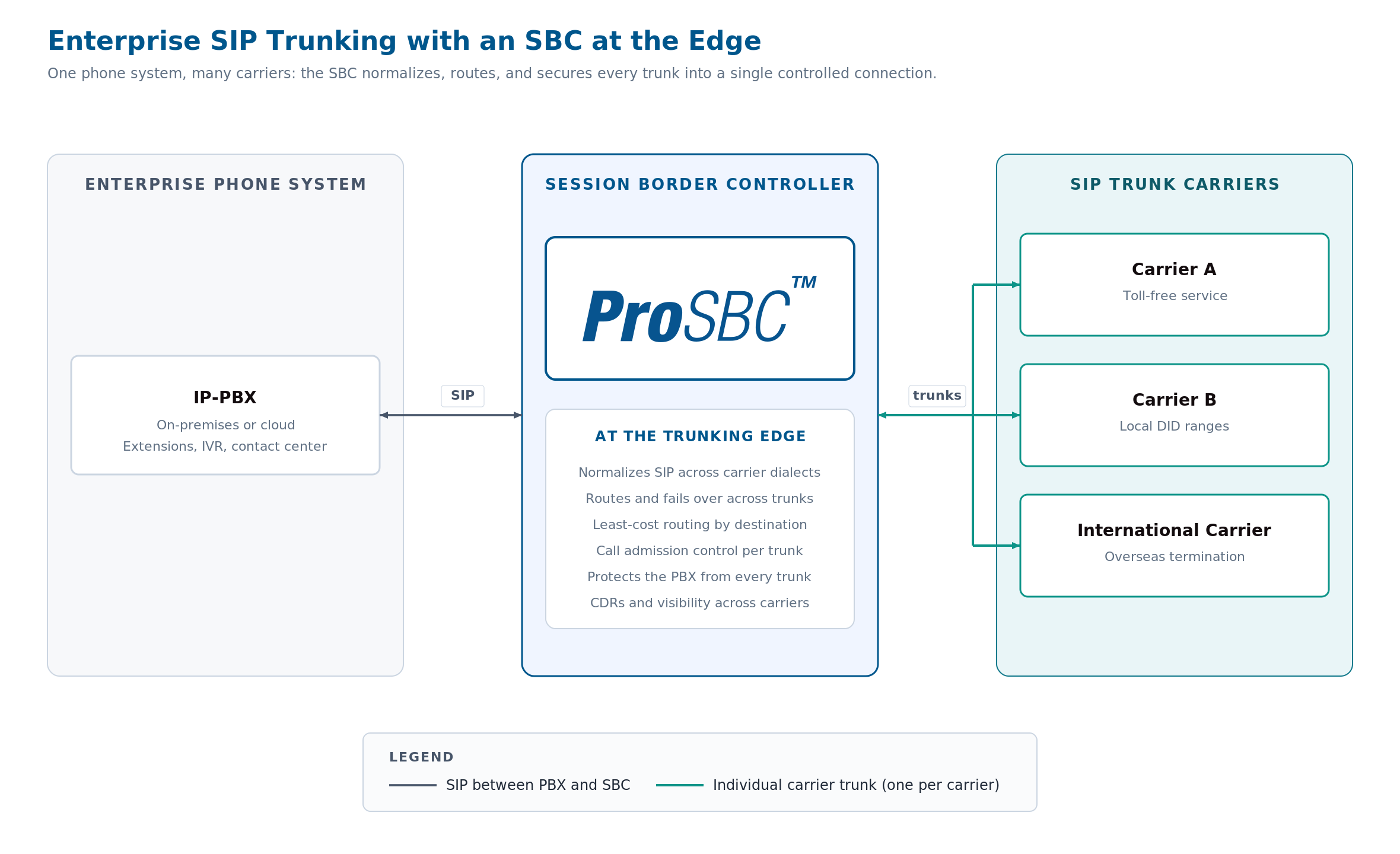
Enterprise SIP trunking: the IP-PBX connects to a single ProSBC, which terminates trunks from several carriers, normalizing SIP and routing calls across operators. Click to enlarge.
What the SBC Does at the Trunking Edge
Interoperability and SIP Normalization
No two carriers implement SIP identically. The SBC’s SIP header manipulation engine rewrites each carrier’s dialect into the single format the IP-PBX expects. The difference between this and a device that merely forwards messages is what makes a full B2BUA SBC required rather than a SIP proxy.
Routing, Least-Cost Routing, and Failover
With several carriers available, every outbound call raises a question of which trunk to use. The SBC directs calls by destination, cost, or capacity, and advances to the next carrier automatically when the first is full or unavailable. Failover is governed by route ordering together with Reason Cause Mapping based on SIP response codes.
Protecting the Phone System
Every carrier trunk is a path into the enterprise. The SBC inspects and controls what each carrier can send, applying access control, call admission limits, and topology hiding so the IP-PBX is never directly exposed. Call admission control caps concurrent sessions per trunk to prevent a traffic spike from overwhelming the phone system.
One Point of Visibility and Control
Routing all carriers through one SBC gives the enterprise a single point that produces call detail records across every trunk, scores call quality with MOS scoring, and captures SIP traces for troubleshooting, regardless of which carrier a call used.
ProSBC for Multi-Carrier Trunking
ProSBC is built for exactly this multi-carrier picture. For the enterprise SIP trunking use case, it delivers:
Deploy It Your Way
Self-Managed
Run ProSBC as software on your own infrastructure. Full control over carrier onboarding, routing rules, and security policies.
Managed Service
Hand day-to-day operation to TelcoBridges through the ProSBC managed service. TelcoBridges engineers handle deployment, hardening, and ongoing management while the enterprise keeps full access.
Fully Hosted
TelcoBridges hosts and manages the SBC entirely. The enterprise points its carriers and phone system at a managed endpoint with no infrastructure to run.
Frequently Asked Questions
What is enterprise SIP trunking?
Enterprise SIP trunking is the delivery of business phone service over IP, from one or more carriers into an organization’s own phone system, using SIP trunks instead of legacy PRI or analog lines. In most enterprises it involves several carriers at once for toll-free, DID, and international service.
What is the difference between single-carrier and multi-carrier SIP trunking?
Single-carrier trunking connects the phone system to one operator, so there is little to reconcile. Multi-carrier trunking connects several operators at once, which adds the need to normalize each carrier’s SIP, route and fail over calls between them, and secure each trunk. That coordination is the job an SBC performs at the edge.
Does enterprise SIP trunking require an SBC?
A single trunk from a cooperative carrier can sometimes connect directly, but as soon as an enterprise runs multiple carriers, exposes its phone system to the internet, or needs routing, failover, and security across trunks, an SBC becomes the practical requirement.
How does an SBC fail over between carriers?
The SBC uses a routing engine to order the available carriers for each call and to move to the next carrier when one is full or unavailable. On ProSBC this is configured with route ordering and Reason Cause Mapping, which decide how the SBC reacts to each carrier’s SIP responses and when it advances a call to the next trunk.
Can one SBC handle many carriers?
Yes. Each carrier is configured as its own trunk group with independent settings, and a single ProSBC server supports up to 1,024 of them alongside up to 60,000 concurrent sessions.
Connect Your Carriers with ProSBC
Talk to a solutions architect about consolidating your carrier trunks through ProSBC, or start evaluating on your own.
Prefer to evaluate on your own first? Start your 30-day free trial.