BYOC Explained: Bring Your Own Carrier for Teams Direct Routing, Contact Centers, and CPaaS
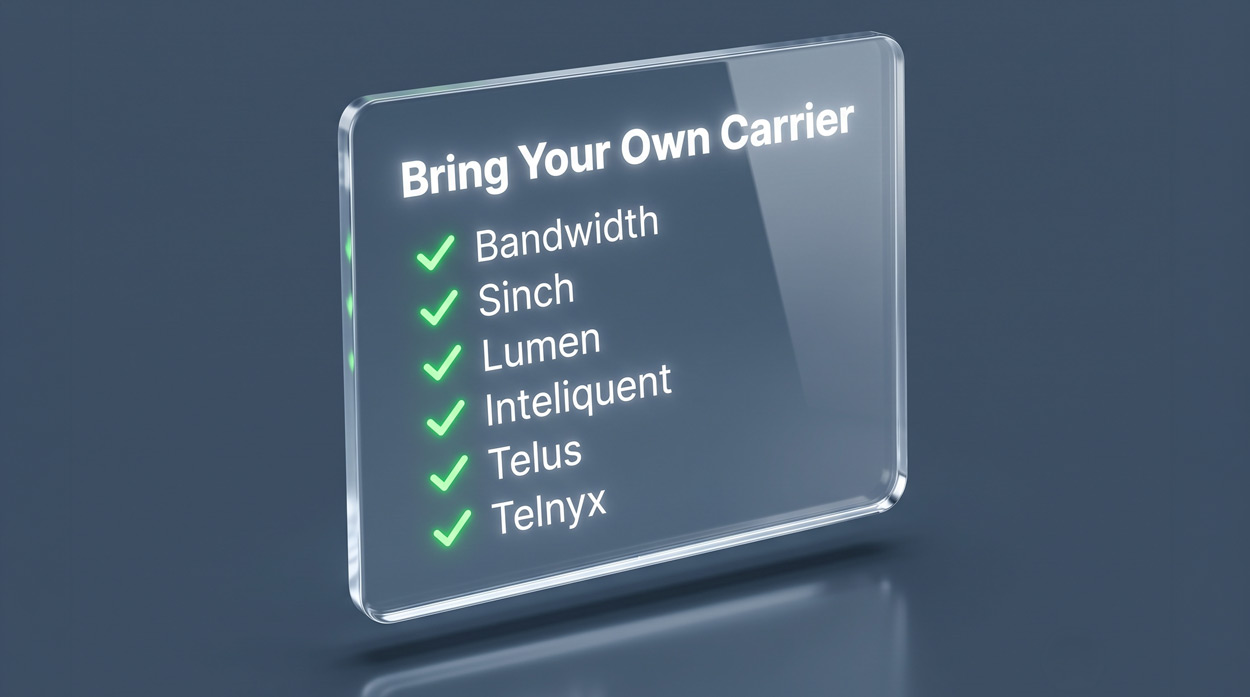
Most cloud voice platforms will happily sell you the phone numbers and minutes that go with them. BYOC is the alternative: you keep your own carrier and connect it to the platform yourself. The model shows up under different names across Microsoft Teams, contact center platforms, and CPaaS providers, but the underlying idea is identical, and so is the piece of infrastructure that makes it work.
Here is what we will cover: what BYOC means, why organizations choose it over bundled telephony, and how a Session Border Controller (SBC) sits at the center of every BYOC deployment. From there we look at how the model applies to the three buyer segments that search for it most: Teams Direct Routing, cloud contact centers, and CPaaS platforms. For the deep mechanics of any one of those, we link out to a dedicated guide rather than repeating it here.

What Does BYOC Mean?
BYOC stands for Bring Your Own Carrier. It is a deployment model in which an organization connects its own carrier, or SIP trunk provider, to a cloud voice platform, instead of buying the bundled telephony that the platform vendor sells. The platform still delivers the application: the Teams calling experience, the contact center agent desktop, or the CPaaS API. The actual carriage of the call, the phone numbers, and the per-minute economics stay with a carrier the customer chooses.
The contrast that defines BYOC is with bundled telephony. When you buy Microsoft Calling Plans, for example, Microsoft is both your application vendor and your carrier, and you pay Microsoft for the minutes. Under BYOC you split those roles: Microsoft remains the application, but the minutes run over a SIP trunk from a carrier you already work with. The same split applies on a contact center platform or a CPaaS, where the vendor offers a bundled telephony option and a BYOC option side by side.
Organizations choose BYOC for four recurring reasons. Cost is the first, because wholesale carrier rates are usually well below bundled per-minute pricing at any real volume. Carrier control is the second, since keeping your own provider means keeping negotiated rates, geographic coverage the platform may not offer, and the ability to add a second carrier for redundancy or least-cost routing. Number portability is the third, because the numbers you already own stay with your carrier rather than being reissued by the platform. Compliance is the fourth, since recording, lawful interception, and data residency are often easier to satisfy when the voice path runs through infrastructure you control.
Why the SBC Is What Makes BYOC Possible
BYOC sounds like a contractual choice, but it is an engineering one. A cloud platform and a PSTN carrier rarely speak the same dialect of SIP, almost never agree on encryption, and have no reason to trust each other’s network. Something has to sit between them, terminate each side independently, and translate. That something is the SBC, and it is the single component every BYOC deployment has in common regardless of which platform sits upstream.
The SBC terminates the customer’s carrier-side SIP trunk on one leg and presents a clean, normalized SIP interface to the cloud platform on the other. Because it operates as a B2BUA rather than a pass-through proxy, it has full control over both legs at once, which is what the following functions require.
SIP normalization
Carriers and platforms disagree on header formats, identity fields, and codec offers. The SBC applies SIP header manipulation per leg so each side receives the dialect it expects, which is the difference between a BYOC trunk that works and one that produces one-way audio and failed transfers.
The encryption boundary
Cloud platforms increasingly require TLS for signaling and SRTP for media, while many carriers still deliver unencrypted RTP. The SBC is the point where the two meet, converting between them transparently so neither side has to change.
Security at the edge
A BYOC interconnect is exposed to the public internet, which makes it a target. SBC security functions such as DoS and DDoS mitigation, dynamic blacklisting, and SIP registration scanning protection keep the carrier trunk from becoming an attack vector into the cloud platform.
Topology hiding and routing
The SBC conceals each side’s internal addressing from the other and applies configurable routing across carriers for failover, least-cost routing, and geographic distribution. Where caller authentication is mandated, it is also the natural point to handle STIR/SHAKEN signing and verification.
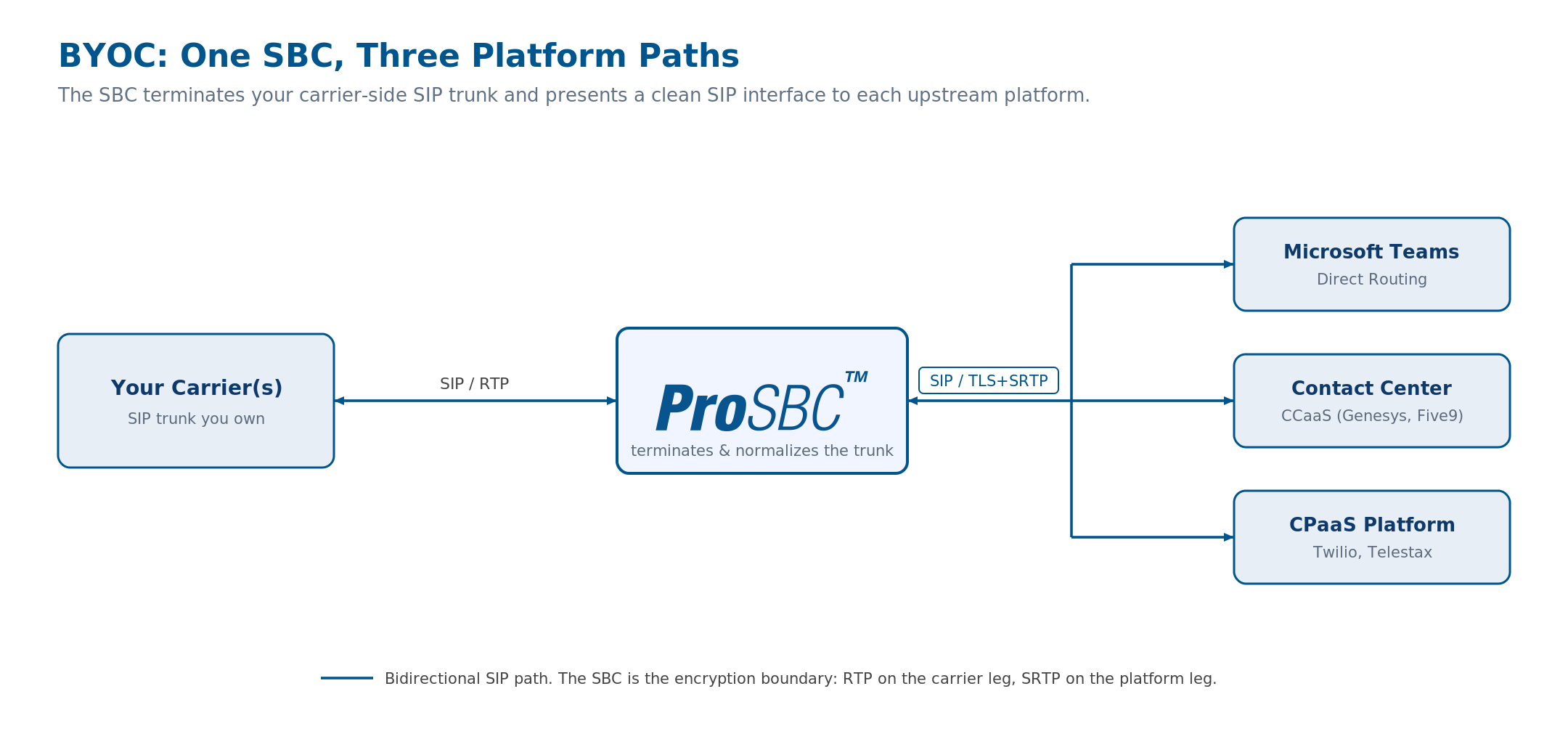
In every BYOC deployment, the SBC terminates the customer’s carrier-side SIP trunk and presents a clean SIP interface to the upstream platform, whether that is Microsoft Teams, a cloud contact center, or a CPaaS. Click to enlarge.
BYOC for Microsoft Teams Direct Routing
On Microsoft Teams, BYOC has a product name: Teams Direct Routing. It is the path that connects Teams Phone to any PSTN carrier through a customer-managed SBC, and it is one of three ways to give Teams users a phone number. Microsoft Calling Plans is the bundled option, where Microsoft is the carrier. Operator Connect is the managed-carrier option, where an approved operator owns the SBC. Direct Routing is the BYOC option, where you bring your own carrier and your own SBC.
The reasons to choose Direct Routing are the BYOC reasons applied to Teams: existing SIP trunk contracts at rates you do not want to replace, geographic coverage that Calling Plans and Operator Connect do not reach, and the control needed for recording, compliance, or multi-tenant service delivery. If you are weighing the managed path against the BYOC path, the Operator Connect versus Direct Routing comparison covers the trade-off in detail, and the guide to connecting Teams to the PSTN covers the licensing.
What matters for BYOC specifically is that Teams imposes strict requirements on the SBC, including TLS for signaling, SRTP for media, a registered FQDN, and a SIP OPTIONS heartbeat. The SBC is what satisfies all of them on the Teams leg while speaking ordinary carrier SIP on the trunk leg. ProSBC supports Teams Direct Routing and handles that translation as a standard B2BUA function.
BYOC for Contact Centers (CCaaS)
Cloud contact center platforms follow the same pattern. Genesys Cloud, Five9, NICE CXone, and Talkdesk all offer bundled telephony, and all support a BYOC model where the customer keeps its own carriers and interconnects through an SBC. For a contact center, the BYOC argument is usually sharpest, because call volume is high enough that the gap between wholesale carrier rates and bundled per-minute pricing becomes a large line item, and because keeping existing numbers and carrier relationships removes risk from a cloud migration.
Under contact center BYOC, the SBC sits between the SIP trunk providers and the CCaaS platform, handling the interconnection, multi-carrier normalization, topology hiding, and the security posture that a high-value, internet-facing contact center demands. The economics, session sizing, regulatory details such as PCI DSS isolation, and platform-specific notes are covered in the dedicated guide to the SBC for contact centers. The short version is that BYOC is what lets a contact center move to the cloud without surrendering its carrier layer.
BYOC for CPaaS
CPaaS platforms expose voice and messaging through developer APIs, and they sell carriage as a bundled convenience: you buy numbers and minutes from the same vendor whose API you call. That convenience is exactly why CPaaS BYOC exists. Once an application reaches meaningful volume, or once a regulated workload needs traffic to stay on a specific carrier, the bundled minutes stop being the cheapest or the most compliant option.
BYOC on a CPaaS lets the platform keep doing what it is good at, the application logic and the API, while the actual calls route over a carrier the customer controls. The SBC is again the interconnect: it terminates the customer’s carrier trunk, normalizes SIP toward the platform, anchors and secures the media, and balances traffic across carriers. TelcoBridges has built this pattern with CPaaS and SaaS voice platforms including Twilio, Telestax, and Aircall, and it is described on the CPaaS and SBCs solution page.
The reason BYOC fits CPaaS so naturally is that CPaaS buyers are already comfortable assembling their own stack. Bringing their own carrier is one more component they would rather own than rent, and the cloud-native SBC is what lets them own it without running physical hardware.
BYOC vs Bundled Telephony: The Trade-Offs
BYOC is not automatically the right answer. It trades a small amount of added setup for a large amount of control, and whether that trade is worth it depends on volume, coverage needs, and compliance obligations. The table below compares the two models on the dimensions that usually decide it.
| Dimension | BYOC (Bring Your Own Carrier) | Bundled telephony |
|---|---|---|
| Carrier choice |  Any carrier, multiple carriers Any carrier, multiple carriers |
 Platform vendor only Platform vendor only |
| Per-minute cost at volume | Wholesale carrier rates |
Bundled, typically higher |
| Number portability | Keep existing numbers |
Often reissued by vendor |
| Geographic coverage | Wherever your carriers reach |
Limited to vendor footprint |
| Compliance and recording control | Enforced at your SBC |
Depends on vendor features |
| Setup effort | Requires an SBC and configuration | Turnkey from the vendor |
| SBC required | Yes, self-hosted or managed | None |
The pattern across the table is consistent: bundled telephony wins on simplicity, and BYOC wins on everything that compounds with scale. Organizations with low volume and no special coverage or compliance needs often start bundled. Those with real traffic, existing carrier contracts, or regulated workloads almost always end up on BYOC, and the SBC is the one-time investment that unlocks it. If you do not want to run that SBC yourself, a managed SBC service provides the same BYOC capability without the operational burden.
Frequently Asked Questions
What does BYOC mean?
BYOC stands for Bring Your Own Carrier. It is a deployment model where you connect your own SIP trunk provider to a cloud voice platform instead of buying the platform vendor’s bundled telephony. You keep your carrier, your phone numbers, and your negotiated rates, while the platform delivers only the application.
Do I need an SBC for BYOC?
Yes. The SBC is what terminates your carrier-side SIP trunk and presents a clean, secure SIP interface to the cloud platform. It handles the SIP normalization, the encryption boundary between unencrypted carrier RTP and the platform’s mandatory SRTP, topology hiding, and security. Without an SBC there is no safe, reliable way to interconnect your carrier with the platform.
Is Teams Direct Routing the same as BYOC?
Effectively yes. Direct Routing is Microsoft’s name for the BYOC path on Teams Phone. It connects Teams to any carrier through a customer-managed SBC, in contrast to Microsoft Calling Plans, which is bundled telephony, and Operator Connect, where an approved operator manages the carrier and SBC for you.
Is BYOC cheaper than bundled calling plans?
At meaningful volume, usually. BYOC lets you run calls over wholesale carrier rates, which are typically well below bundled per-minute pricing, and the SBC is a one-time investment rather than a per-minute charge. At very low volume the simplicity of bundled telephony can outweigh the savings, so the break-even depends on your call volume and coverage needs.
Can I use BYOC with Five9, Genesys, or other contact center platforms?
Yes. Genesys Cloud, Five9, NICE CXone, and Talkdesk all support a BYOC model where you interconnect your own carriers through an SBC. The SBC sits between your SIP trunk providers and the CCaaS platform, handling interconnection, multi-carrier normalization, and security.
Conclusion
BYOC is one idea wearing three names. Whether it is called Direct Routing on Teams, BYOC on a contact center platform, or carrier passthrough on a CPaaS, the model is the same: keep your own carrier, let the platform handle the application, and connect the two through an SBC. The SBC carries this entire picture. It is the component that terminates the carrier trunk, normalizes SIP, draws the encryption boundary, hides topology, and secures the edge, and it is what turns a contractual preference for your own carrier into a working voice path.
If carrier control, cost at scale, number portability, or compliance matter to you, BYOC is almost always the right model, and the SBC is the one decision that makes all three platform paths possible.
Enable BYOC with ProSBC
ProSBC is a carrier-grade, software-based Session Border Controller built for exactly the BYOC interconnect this page describes. It terminates your carrier-side SIP trunk and presents a clean, normalized SIP interface to the upstream platform, operating as a full B2BUA with independent TLS and SRTP configuration per leg, so it satisfies a cloud platform’s encryption requirements without asking your carrier to change anything.
The same instance covers all three BYOC paths. It supports Microsoft Teams Direct Routing, interconnects cloud contact center platforms such as Genesys Cloud, Five9, NICE CXone, and Talkdesk, and provides the carrier passthrough that CPaaS platforms rely on. Configurable routing across carriers, topology hiding, DoS and DDoS protection, and open STIR/SHAKEN partner integration are included, and ProSBC scales to 60,000 sessions per server starting from $1.25 per session per server per year.
You can test the full BYOC interconnect for free with ProSBC Lab, a permanent three-session license, or evaluate at production scale with the 30-day trial.
Prefer to evaluate on your own first? Start your 30-day free trial.