Cloud Voice Deployments and the SBC: Architecture for Multi-Cloud, Hybrid, and SaaS Voice

Cloud platforms have absorbed most enterprise workloads, but voice remains the exception that proves the rule. Email, CRM, and collaboration moved to SaaS with minimal friction because they tolerate latency, run over HTTPS, and never touch the public telephone network. Voice is different. It runs on SIP, demands sub-150ms round-trip latency, and every call that reaches a phone number must cross a carrier interconnect governed by decades of telecom regulation and vendor-specific SIP implementations.
The Session Border Controller is the component that bridges that gap. Whether your voice platform runs entirely in the cloud, spans multiple cloud providers, or straddles on-premises infrastructure and a public cloud, the SBC sits at the boundary where SIP trunks meet cloud services. It terminates carrier connections on one side and cloud platform connections on the other, handling encryption translation, SIP normalization, and security enforcement that neither the carrier nor the cloud platform provides on its own.
This article covers why cloud voice still requires an SBC at the network edge, how the three dominant deployment patterns work, and what happens at the carrier interconnect boundary for CPaaS, UCaaS, and hybrid architectures.

Why Cloud Voice Still Needs a Physical Edge
Cloud voice platforms handle call control, user management, and increasingly sophisticated features like AI voice agents and real-time transcription. What they do not handle is the carrier handoff. Every call that originates from or terminates on the public telephone network must cross a SIP trunk boundary where the cloud platform meets a telecom carrier, and that boundary is where the problems concentrate.
Carriers deliver SIP traffic with vendor-specific header implementations, varying encryption support, and transport requirements that differ from trunk to trunk. One carrier may send SIP over UDP with no encryption; another may require TLS 1.2 with mutual certificate authentication. The cloud platform on the other side has its own requirements. Microsoft Teams Direct Routing mandates TLS and SRTP on every connection. Genesys Cloud expects specific SIP header formats for its BYOC trunk interface. Twilio’s Elastic SIP Trunking has its own normalization requirements.
The SBC resolves this mismatch by operating as a B2BUA that fully terminates SIP on one side and re-originates it on the other. Each side gets the encryption, headers, codecs, and transport it expects, negotiated independently. Without an SBC, every carrier-to-platform combination requires custom integration work that the cloud platform vendor will not perform and the carrier has no incentive to support.
Beyond protocol translation, the SBC provides the security perimeter that cloud platforms assume exists but do not implement themselves. SIP-layer DoS protection, dynamic blacklisting, SIP registration scanning defense, and toll fraud prevention all execute at the SBC before traffic reaches the cloud application. Exposing a cloud voice platform directly to carrier SIP traffic without an SBC is the voice equivalent of placing a web application on the public internet without a firewall.
Three Deployment Patterns for Cloud SBCs
Cloud SBC deployments fall into three architectural patterns. The right choice depends on where your voice workloads run, where your carriers connect, and how much on-premises infrastructure you intend to maintain.
Pure Cloud
In a pure cloud deployment, the SBC runs as a virtual machine alongside the voice application in the same cloud provider. This is the simplest pattern: the SBC instance deploys on AWS, Azure, VMware, or KVM/Proxmox, carrier SIP trunks terminate on the SBC’s public interface, and the voice platform connects to the SBC over the cloud provider’s internal network. Latency between SBC and application is minimal because both sit in the same data center or availability zone.
Pure cloud works well for organizations that have fully migrated to a cloud voice platform and have no remaining on-premises telephony equipment. It eliminates hardware SBC appliances entirely, replacing capital expenditure with a subscription model that scales with actual session count.
Multi-Cloud
Multi-cloud deployments place SBC instances across two or more cloud providers or regions. An MSP delivering multi-tenant Teams Direct Routing might run their primary SBC on Azure for lowest latency to Microsoft 365, with a standby instance on AWS for carrier diversity and geographic redundancy. A contact center operator running Genesys Cloud BYOC might place SBC instances in both US-East and EU-West to comply with data residency requirements while maintaining failover capability.
The SBC is particularly suited to multi-cloud because it operates as a self-contained network function. Each instance connects to its local carriers and cloud platform endpoints independently, with routing rules that can direct traffic between instances based on load, availability, or policy. ProSBC’s support for AWS, Azure, VMware, KVM/Proxmox, and bare metal means the same software and configuration patterns apply regardless of which cloud hosts a given instance.
Hybrid On-Premises + Cloud
Hybrid is the most common pattern in practice, because most organizations do not migrate all voice workloads to the cloud at once. A typical hybrid deployment keeps an on-premises PBX (Avaya, Cisco, or FreeSWITCH) for internal extensions while routing external calls through a cloud-hosted SBC that connects to both the legacy PBX and a cloud UCaaS platform. The SBC handles SIP normalization between the legacy PBX’s SIP dialect and the cloud platform’s requirements, encrypts traffic that crosses the public internet, and provides a single management point for carrier connections that serve both environments.
Hybrid deployments also serve as the migration path from on-premises to full cloud. The SBC’s NAP-based architecture lets operators migrate trunk groups one at a time, moving carrier connections from the on-premises leg to the cloud leg progressively. At any point, rolling back a single trunk group is a routing change, not a re-architecture.
CPaaS and UCaaS Carrier Interconnect
The SBC’s role becomes most visible at the carrier interconnect boundary for CPaaS and UCaaS platforms. These platforms abstract voice into APIs and managed services, but the abstraction breaks down at the PSTN boundary where real SIP trunks carry real calls to real phone numbers.
UCaaS: Teams, Zoom, RingCentral
UCaaS platforms present the cleanest SBC integration pattern because the platform vendor defines the SIP requirements explicitly. Microsoft Teams requires TLS with a certificate from a trusted CA, SRTP for all media, SIP OPTIONS heartbeat monitoring, and specific SIP header formatting. The SBC terminates the carrier’s SIP trunk on one side (often unencrypted UDP) and presents Teams-compliant TLS/SRTP on the other. ProSBC supports Teams Direct Routing and has been successfully deployed in Teams DR environments across MSP, ISP, and enterprise networks.
For MSPs serving multiple customers, the SBC enables multi-tenant Teams voice delivery from a single instance. Each customer’s Microsoft 365 tenant connects through a dedicated NAP with its own subdomain FQDN, TLS certificate, and routing rules, while sharing the underlying carrier connections and SBC infrastructure.
CPaaS: Twilio, Telestax, Cloudoni
CPaaS carrier interconnect works differently because the SBC sits between the CPaaS platform and the organization’s own carriers in a BYOC model. Instead of using the CPaaS provider’s bundled telephony (and paying per-minute rates at scale), the organization brings its own SIP trunks and uses the SBC to normalize traffic between its carriers and the CPaaS platform’s SIP endpoint.
This pattern is increasingly common among organizations building AI voice agents, automated outbound dialers, and programmable IVR systems. The CPaaS platform provides the application logic, but the SBC provides carrier routing, security, STIR/SHAKEN signing, and cost control. Aircall, for example, uses ProSBC on AWS to normalize international SIP provider traffic for over 50,000 users, leveraging the SBC’s SIP header manipulation engine and RESTful API to manage carrier diversity across multiple countries.
Contact Center BYOC
Cloud contact center platforms (Genesys Cloud, Five9, NICE CXone, Talkdesk) all support BYOC models where the customer supplies their own SIP trunks through an SBC. The SBC handles the same carrier normalization and encryption translation as in the UCaaS case, with additional requirements for high session density, low-latency media handling, and integration with fraud prevention systems that score calls during setup.
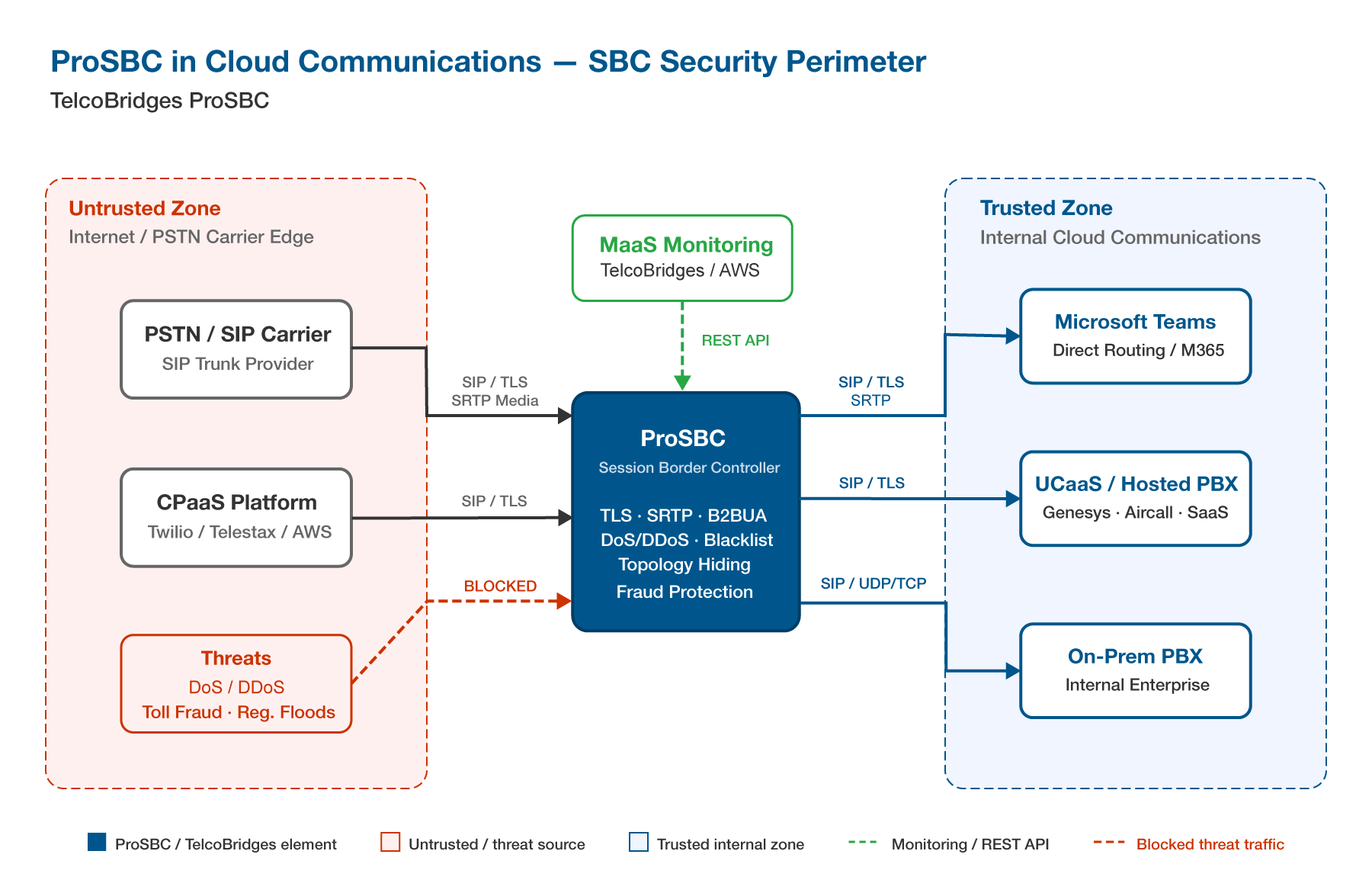
ProSBC security perimeter in a cloud communications deployment. Click to enlarge.
Security at the Cloud Voice Edge
Moving voice to the cloud does not eliminate the attack surface; it moves it. The SBC becomes the security perimeter between the public internet (where carrier SIP traffic arrives) and the cloud environment (where voice applications run). A full treatment of SBC security capabilities is available in the dedicated SBC security guide, but the cloud-specific concerns deserve focused attention.
Encryption bridging is the most fundamental security function. Cloud platforms mandate TLS and SRTP, while many carriers still deliver traffic over unencrypted UDP. The SBC terminates unencrypted SIP/RTP on the carrier side and re-originates encrypted TLS/SRTP on the cloud side. ProSBC negotiates TLS 1.3 exclusively with no fallback to older versions, ensuring that the encrypted leg meets the strongest available standard. Peers that cannot negotiate TLS 1.3 connect over UDP or TCP legs instead, where the SBC still provides signaling-layer inspection and media anchoring.
Topology hiding takes on additional importance in cloud environments. Container orchestrators, load balancers, and cloud networking layers introduce internal IP addresses that must never leak into SIP headers crossing the public internet. The SBC’s B2BUA architecture replaces all internal addresses with the SBC’s own public-facing IP, making the cloud infrastructure architecturally invisible to external parties.
SIP-layer attack prevention protects the cloud application from threats that network firewalls cannot address. SIP flood attacks, registration scanning, and malformed SIP message exploits all target the application layer. The SBC inspects SIP traffic at the protocol level, applying rate limiting per method, per source, and per trunk group, with dynamic blacklisting that automatically blocks sources exceeding configured thresholds.
High Availability and Failover Across Cloud Regions
Voice tolerates downtime poorly. A web application that returns a 503 for thirty seconds causes inconvenience; a voice platform that drops calls for thirty seconds causes operational disruption and, for service providers, SLA violations with financial penalties. High availability in cloud SBC deployments operates at two levels: instance-level and region-level.
Instance-level HA uses a 1+1 pair where a standby SBC instance monitors the primary and takes over its IP address and active sessions if the primary fails. ProSBC’s 1+1 HA runs on standard virtual machines without requiring specialized cloud networking, making it deployable on AWS, Azure, VMware, or KVM without modification. The standby instance maintains configuration synchronization with the primary, so failover requires no manual intervention.
Region-level redundancy protects against cloud availability zone or region failures by placing SBC instances in geographically separate locations. Carrier-side DNS SRV records or SIP OPTIONS-based health monitoring direct traffic to the available instance. For organizations with strict uptime requirements, active-active deployments across regions distribute traffic continuously, with each instance handling a portion of the call load and absorbing the other’s traffic during a failure.
Cloud SBC deployments also benefit from the Monitoring as a Service (MaaS) layer, which provides real-time dashboards, threshold-based alerting, and historical trend analysis across all SBC instances regardless of where they are hosted. MaaS detects degradation patterns (rising jitter on a specific carrier trunk, registration count anomalies, session capacity approaching limits) before they become outages, giving operations teams time to respond before failover is needed.
Frequently Asked Questions
Can I run an SBC in the cloud without any on-premises equipment?
Yes. A pure cloud SBC deployment runs entirely on a cloud provider (AWS, Azure, or a private cloud on VMware or KVM). Carrier SIP trunks terminate on the SBC’s public IP address, and the voice platform connects over the cloud provider’s internal network. No on-premises hardware is required. This is the standard deployment model for organizations that have fully migrated their voice infrastructure to the cloud.
How many concurrent sessions can a cloud SBC handle?
ProSBC supports up to 60,000 concurrent sessions and 350,000 endpoint registrations per server instance. Actual capacity depends on the underlying cloud instance size and workload profile (encryption, header manipulation complexity, and whether hardware transcoding is attached). For most cloud deployments, a single instance handles well beyond typical enterprise and MSP traffic volumes.
Does the SBC support Microsoft Teams Direct Routing in a cloud deployment?
ProSBC supports Microsoft Teams Direct Routing and has been successfully deployed in Teams DR environments. The SBC handles the TLS, SRTP, SIP OPTIONS heartbeat, and header normalization that Teams requires. It is important to note that ProSBC is not Microsoft-certified (it does not appear on Microsoft’s certified SBC list), but it delivers the full technical requirements for Teams DR interoperability.
What is the difference between BYOC and using a CPaaS provider’s bundled telephony?
Bundled telephony means the CPaaS provider (Twilio, for example) supplies both the API platform and the SIP trunks, charging per-minute rates for PSTN access. BYOC means you supply your own SIP trunks through your own SBC, connecting them to the CPaaS platform’s SIP endpoint. BYOC gives you control over carrier selection, negotiated rates, routing logic, and STIR/SHAKEN compliance, which becomes economically significant at scale.
How does the SBC handle STIR/SHAKEN in a cloud deployment?
The SBC integrates with external STIR/SHAKEN signing services (TransNexus ClearIP or Neustar) over SIP. When an outbound call reaches the SBC, a routing script queries the signing service, receives the Identity header with the PASSporT token, and injects it into the outgoing SIP INVITE. The signing service integration works identically whether the SBC is deployed on-premises or in the cloud. ProSBC supports primary and secondary signing service URLs for redundancy.
Can I start with a small cloud deployment and scale later?
ProSBC uses transparent per-session subscription pricing. You can start with a 500-session license and scale up as traffic grows, without changing hardware or redeploying. The ProSBC Lab provides a permanently free 3-session license for testing and proof-of-concept work, and a 30-day free trial with 500 sessions is available for production evaluation.
Conclusion
Voice may be the last major workload to move to the cloud, but the migration is well underway. What distinguishes successful cloud voice deployments from troubled ones is how the carrier boundary is handled. The SBC provides the protocol translation, encryption bridging, security enforcement, and high availability that cloud voice platforms require but do not implement natively.
Whether you are deploying a pure cloud architecture on a single provider, spanning multiple clouds for redundancy and compliance, or maintaining a hybrid environment during a gradual migration, the SBC operates as the consistent control point at every carrier interconnect. Its B2BUA architecture ensures that each side of the connection gets the exact SIP behavior, encryption, and routing it requires, without requiring either side to adapt to the other.
For organizations evaluating their cloud voice architecture, the SBC is not an optional component to add after problems surface. It is the foundational layer that makes carrier interconnection, multi-vendor interoperability, and voice security function correctly from the start.
Architect Your Cloud Voice Edge with ProSBC
ProSBC deploys on AWS, Azure, VMware, KVM/Proxmox, and bare metal, scaling from lab testing to 60,000 concurrent sessions per instance. Its B2BUA architecture provides full SIP termination and re-origination on every leg, with TLS 1.3 signaling encryption, SRTP media encryption, and independent configuration per trunk group through up to 1,024 NAPs. Whether you are connecting carrier SIP trunks to Microsoft Teams, integrating a CPaaS platform via BYOC, or bridging on-premises PBXs to a cloud UCaaS environment, ProSBC provides the carrier interconnect, security perimeter, and high availability that cloud voice demands.
For organizations that prefer a fully managed approach, the ProSBC Managed Service includes 1+1 HA, 24×7 support, setup, integration, and monitoring on the platform of your choice.
Prefer to evaluate on your own first? Start your 30-day free trial.