What Is SIP? Session Initiation Protocol Explained for Voice Network Engineers
Every IP voice call you have ever placed, every Microsoft Teams Direct Routing deployment, and every SIP trunk that replaced an old PRI circuit rests on the same protocol. Yet most explanations of “what is SIP” are written for application developers building click-to-call buttons or business leaders, not for the engineer who has to route, secure, and troubleshoot the calls in production. This is the version for that engineer.
SIP, the Session Initiation Protocol, is the signaling protocol that sets up, modifies, and tears down real-time communication sessions over IP networks. It is the language two phones, two carriers, or a phone and a cloud platform use to agree on a call before any audio flows. In this article, we’ll walk you through what SIP stands for, where it came from, where it sits relative to the actual media, how SIP addresses users, the parts of a SIP network, and how the SIP phones and SIP providers you deal with every day fit into the picture.

What Does SIP Stand For? Session Initiation Protocol Defined
SIP stands for Session Initiation Protocol. It is an application-layer, text-based, request and response protocol standardized by the IETF in RFC 3261. If you have ever read an HTTP exchange, SIP will look familiar: requests have methods and headers, responses have numeric status codes, and the whole conversation is human-readable plain text. That design was deliberate, because the people who wrote SIP modeled it on HTTP and SMTP rather than on traditional telephony signaling.
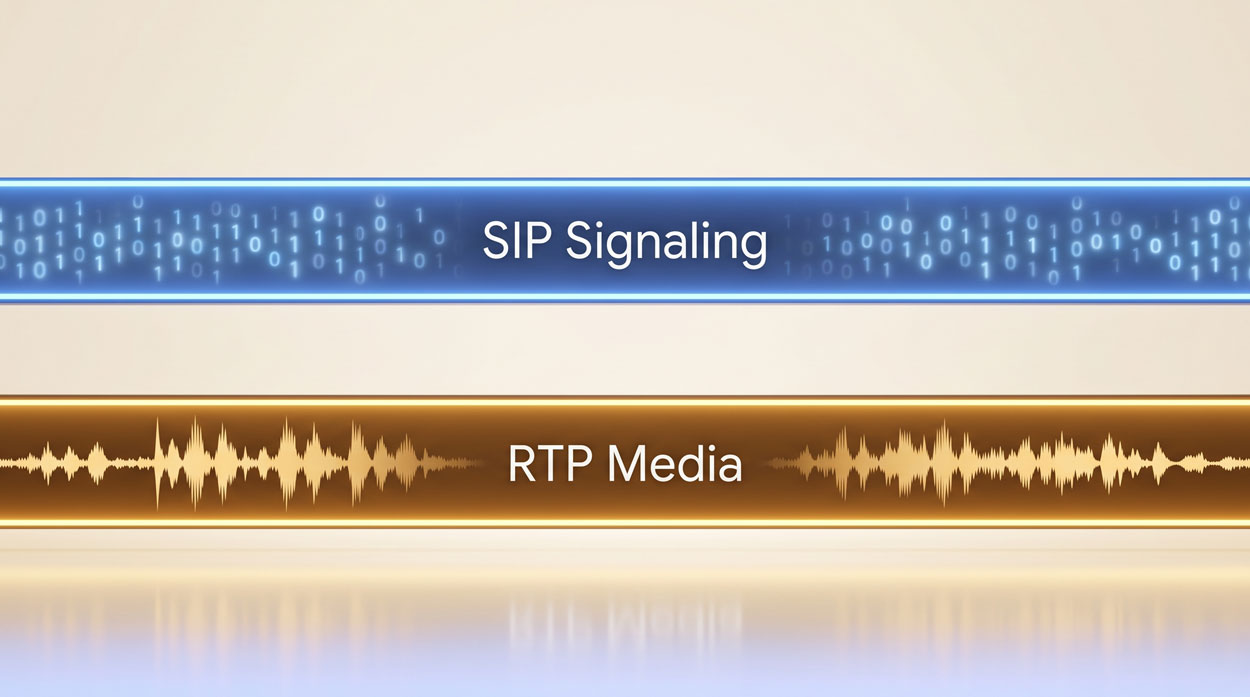
The single most useful thing to understand up front is what SIP does not do. SIP negotiates the session; it does not carry the voice. The audio travels in a separate media stream over the Real-time Transport Protocol (RTP), and the details of that media stream are described by the Session Description Protocol (SDP) carried inside the SIP messages. SIP is the control plane, and RTP is the media plane. Hold onto that distinction, because it explains almost everything else about how voice networks are built.
Two short examples show what these messages look like on the wire. A REGISTER binds a user to the device they are currently using:
REGISTER sip:registrar.biloxi.com SIP/2.0
Via: SIP/2.0/UDP bobspc.biloxi.com:5060;branch=z9hG4bKnashds7
Max-Forwards: 70
To: Bob <sip:[email protected]>
From: Bob <sip:[email protected]>;tag=456248
Call-ID: 843817637684230@998sdasdh09
CSeq: 1826 REGISTER
Contact: <sip:[email protected]>
Expires: 7200
Content-Length: 0
An INVITE starts a session and proposes media via SDP:
INVITE sip:[email protected] SIP/2.0
Via: SIP/2.0/UDP pc33.atlanta.com;branch=z9hG4bKnashds8
Max-Forwards: 70
To: Bob <sip:[email protected]>
From: Alice <sip:[email protected]>;tag=1928301774
Call-ID: a84b4c76e66710
CSeq: 314159 INVITE
Contact: <sip:[email protected]>
Content-Type: application/sdp
Content-Length: 142
A SIP session is driven by a small set of request methods. You do not need the full call sequence to understand the protocol, just the vocabulary:
| Method | What it does |
|---|---|
| INVITE | Starts a session and proposes media (codecs, IP, ports) via SDP |
| ACK | Confirms the final response to an INVITE |
| BYE | Ends an established session |
| REGISTER | Binds a user’s address to their current device location |
| OPTIONS | Queries the capabilities of another endpoint |
| SUBSCRIBE / NOTIFY | Requests and delivers event notifications (presence, message-waiting) |
| CANCEL | Aborts a request that has not yet completed |
Responses mirror HTTP and fall into six numeric classes: 1xx provisional, 2xx positive, and 3xx–6xx negative responses. For how these messages actually sequence a live call, see our walkthrough of the SIP call flow, and for what each status class means in practice, see the guide to SIP response codes. Here, the point is simply that SIP is a compact request and response language with a handful of verbs.
A Short History of SIP, and Why It Replaced H.323
SIP arrived as an IETF draft in the late 1990s, reaching its first published form as RFC 2543 in 1999 and its current definition as RFC 3261 in 2002. At the time, the dominant standard for multimedia over IP was H.323, a comprehensive ITU specification borrowed from the world of video conferencing.
H.323 worked, but it was heavy. It used binary encoding that you could not read off the wire, it carried a large stack of sub-protocols, and extending it was slow. SIP went the other way. Because it was text-based and human-readable, an engineer could troubleshoot it by eye. Because it borrowed HTTP’s request and response model, it was simple to implement and easy to extend with new headers and methods. Because it used internet-style addressing, it fit naturally into a world that was already running on DNS and IP. Those properties, readability, extensibility, and internet-native design, are why the SIP protocol became the default for VoIP and why H.323 faded to legacy status.
That long arc is worth respecting when you build voice infrastructure. TelcoBridges has more than 20 years of SIP deployment experience behind its products, and the recurring lesson across that time is that SIP’s flexibility is also its complication: the same extensibility that helped it win means no two vendors implement it identically.
Where SIP Sits in the Stack: Signaling, SDP, and Media
Three protocols do the work of a single voice call, and keeping them straight is the foundation for everything else.
SIP is the signaling. It locates the far end, rings it, negotiates the call, and tears it down. SDP, the Session Description Protocol defined in RFC 4566, rides inside SIP message bodies and describes the proposed media: which codecs each side supports, and the IP addresses and ports where audio should be sent. RTP, the Real-time Transport Protocol defined in RFC 3550, is the stream that actually carries the digitized voice once both sides agree.
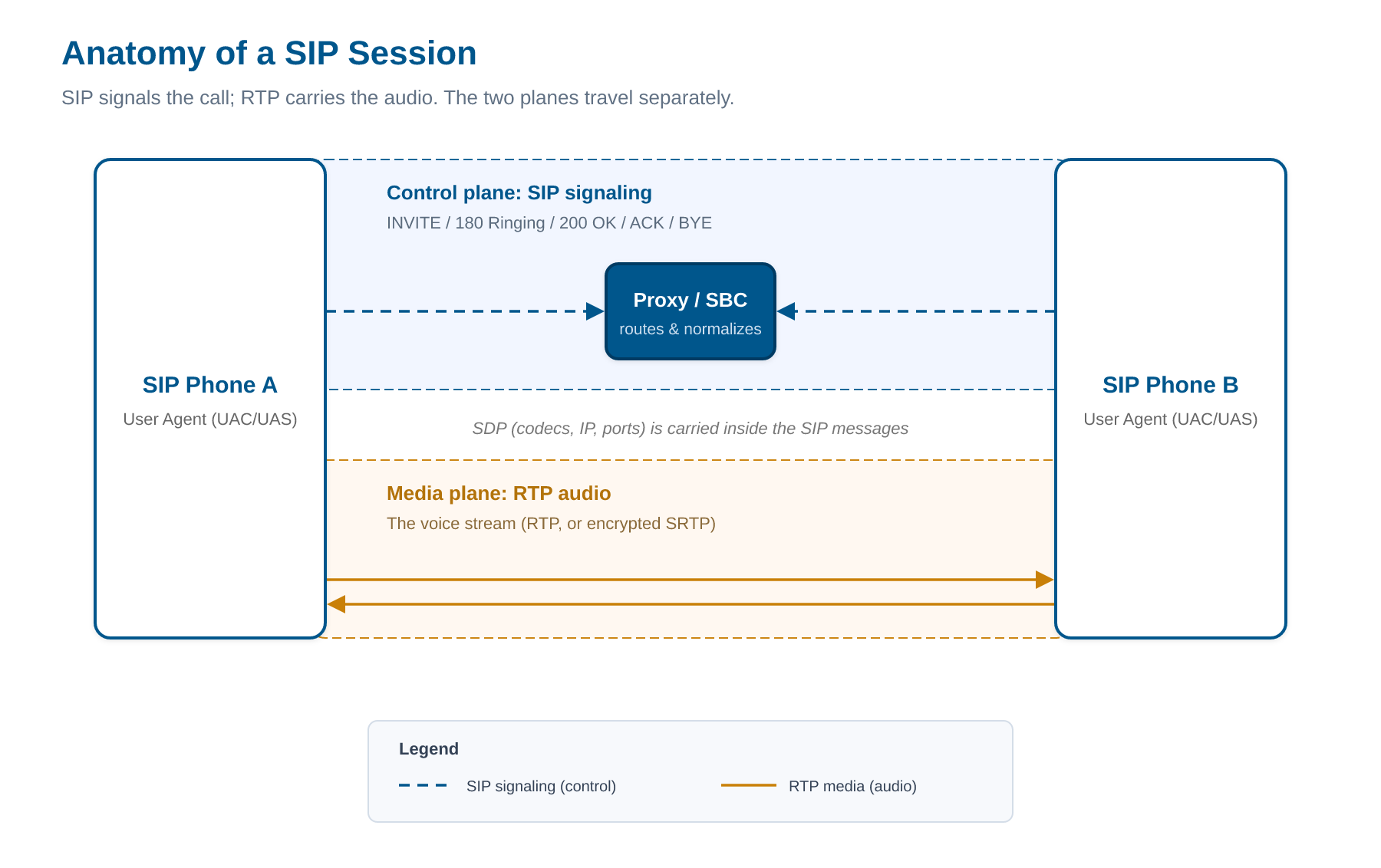
The control plane (SIP signaling) and the media plane (RTP audio) travel as separate streams. Click to enlarge.
SIP runs over UDP or TCP, conventionally on port 5060, and over TLS for encrypted signaling on port 5061. The media runs as RTP, or as its encrypted form SRTP. Because signaling and media are separate, an intermediary can read, route, and rewrite the SIP without ever touching the audio, which is exactly what proxies and Session Border Controllers exist to do. The mechanics of that separation, including the back-to-back user agent model, are covered in our deep dive on SIP signaling fundamentals.
How SIP Identifies Users: SIP URIs and Addresses
SIP borrows its addressing scheme from email, which is why a SIP address looks like one. A SIP URI takes the form sip:[email protected], where the part before the @ identifies the user and the part after identifies the domain or host responsible for them. The secure variant, sips:[email protected], signals that the request should travel over TLS.
That address is logical, not physical. sip:[email protected] says who you are trying to reach, not which device or IP they happen to be using right now. The mapping from a logical address to a real location is handled by registration: a device sends a REGISTER request to a registrar, binding the user’s address-of-record to the device’s current contact address. When someone later calls that URI, the network looks up the binding and routes the call to wherever the user registered. This is the mechanism that lets you keep one phone number while moving between a desk phone, a laptop, and a mobile app.
DNS also plays an important role in identifying users, because DNS resolution is what turns the domain in a SIP URI into the IP address a request is actually sent to.
The Parts of a SIP Network
A working SIP deployment is a handful of cooperating roles. You rarely build all of them yourself, but you need to recognize each one when you read a network diagram or a trace.
User agents are the endpoints. The side that sends a request is acting as a User Agent Client (UAC); the side that answers is the User Agent Server (UAS). A single device switches between both roles every time a request is sent or received.
SIP phones and softphones are the most common user agents you will meet. A SIP phone is a hardware desk phone that speaks SIP natively, while a softphone runs the same logic as a software client on a computer or mobile device. Both register to a PBX or provider and then place and receive calls as ordinary SIP user agents.
Registrars and location services track where each user currently is, using the REGISTER mechanism described above.
SIP proxies route requests toward their destination without terminating the session, forwarding messages and consulting routing logic along the way. For a focused explanation, see what a SIP proxy is.
Session Border Controllers (SBCs) sit at the border between networks, for example between your network and a carrier’s. An SBC is the control point that secures, routes, and normalizes SIP as it crosses that boundary, which is why it is central to multi-vendor voice.
SIP in Practice: SIP Trunks, SIP Providers, and SIP Phones
In real deployments, SIP shows up in three places engineers ask about constantly.
A SIP trunk is a virtual connection that carries SIP calls between your phone system and a provider, replacing the physical PRI or PSTN circuits of the TDM era. One trunk can carry many simultaneous calls, scaled by the number of sessions you buy rather than by physical lines. The architecture and security of trunking are the subject of the SIP Trunking and Multi-Vendor Interoperability guide.
SIP providers, also called internet telephony service providers (ITSPs), are the companies that sell those trunks along with phone numbers (DIDs) and call termination and origination to the public network. When you evaluate one, the questions that matter to a voice engineer are practical: which codecs they support, whether they offer encrypted signaling and media, how they handle STIR/SHAKEN call authentication, and how cleanly their SIP implementation interoperates with your equipment. That last point is where many integrations stall.
SIP phones in production must register, traverse NAT, and ideally encrypt their traffic, especially for remote workers connecting from outside the office network. These are well-understood problems, but they are problems, and they are usually solved at the network edge rather than on the phone itself.
The reason multi-vendor SIP rarely “just works” is that SIP’s extensibility cuts both ways. One vendor includes a header another does not expect; a third orders headers in a way that breaks a fourth vendor’s parser. Different SIP scenarios exist for handling operations like call transfer, and not every implementation supports the full range of those variants. Some ISPs also require advanced DNS features that are not part of the basic stack. Reconciling those differences is called SIP normalization, and it is the everyday job of an SBC. The SIP header manipulation article explains how that normalization works at the message level.
SIP vs Related Terms
Two comparisons clear up most of the confusion around the protocol.
SIP vs VoIP. Voice over IP (VoIP) is the umbrella term for carrying voice across IP networks, and SIP is one of the signaling protocols that makes VoIP work, by far the most common one today. Saying a network “uses VoIP” describes what it does; saying it “uses SIP” describes how it sets up the calls.
SIP vs VoLTE. VoLTE (Voice over LTE) refers to voice calls carried over a 4G/LTE radio network, as opposed to older 2G/3G mobile technology.
SIP vs RTP. This is the control-versus-media distinction again: SIP negotiates and controls the session, while RTP carries the audio once the session is up. They run as separate streams, often along different network paths.
If your interest is browser-based real-time communication, the related comparison is SIP vs WebRTC, which covers where each protocol fits.
Frequently Asked Questions
What does SIP stand for?
SIP stands for Session Initiation Protocol. It is the IETF-standardized signaling protocol used to set up, modify, and end real-time sessions such as voice and video calls over IP networks.
What is a SIP phone?
A SIP phone is an endpoint that uses SIP to make and receive calls. It can be a hardware desk phone that speaks SIP natively or a softphone running as an app on a computer or mobile device. In both cases the phone acts as a SIP user agent: it registers to a PBX or provider and then originates and answers calls using SIP messages.
What is a SIP provider, and how do I choose one?
A SIP provider, or internet telephony service provider (ITSP), sells SIP trunks, phone numbers, and connectivity to the public telephone network. When choosing one, weigh the factors that affect your deployment in practice: supported codecs, support for encrypted signaling (TLS) and media (SRTP), STIR/SHAKEN call authentication, capacity in concurrent sessions, and how cleanly their SIP interoperates with your existing equipment.
Is SIP the same as VoIP?
No. VoIP is the general concept of carrying voice over IP networks, while the SIP protocol is one specific signaling standard used to set up those calls. Most VoIP deployments use SIP, but VoIP can also run over other signaling protocols.
Is SIP secure on its own?
SIP messages are plain text by default, so on their own they can be read or tampered with in transit. Securing SIP means running the signaling over TLS and the media over SRTP, and placing a control point such as an SBC at the network edge to enforce those policies. You can read more on the SBC security page.
Conclusion
SIP is the signaling language of IP voice. It sets up, modifies, and ends sessions using a compact set of text-based requests and responses, while RTP carries the actual audio and SDP describes the media inside the SIP messages. Around that protocol sits a small cast of cooperating roles, user agents and SIP phones, registrars, proxies, and Session Border Controllers, that together make calls work across devices, vendors, and providers. Once you can see SIP as the control plane and recognize those roles in a diagram, the rest of the voice network stops being a black box.
The recurring challenge is that every vendor speaks SIP with a slightly different accent, and bridging those accents reliably is what turns a fragile integration into a production network.
Manage Multi-Vendor SIP with ProSBC
Because no two systems implement SIP identically, a real multi-vendor voice network needs a control point that terminates and re-originates SIP on both sides and reconciles the differences between them. That is what a Session Border Controller does, and it is what ProSBC was built for. ProSBC is a carrier-grade, software-based SBC that operates as a true Back-to-Back User Agent (B2BUA), giving it full control of SIP signaling on both call legs.
Its SIP header manipulation engine normalizes vendor dialects across the boundary, drawing on more than 20 years of TelcoBridges SIP deployment experience. You can test all of this yourself before committing: the free, self-serve ProSBC Lab gives you a 3-session instance in about 20 minutes, and commercial pricing starts from as low as $1.40 per session per year.
Prefer to evaluate on your own first? Start your 30-day free trial.