Connecting UCaaS and SaaS Platforms to Carriers with Cloud Communications Trunking
A cloud communications platform is very good at handling calls for its users. What it is usually not built to do is manage a shifting set of carrier relationships, each with its own SIP quirks, its own numbers, and its own routing rules.
When a UCaaS, CCaaS, or SaaS voice platform needs toll-free numbers, inbound DIDs, and international termination from several operators at once, connecting directly to each carrier pushes carrier-management complexity into an application built to serve users, not to reconcile SIP dialects. Developers behind many CPaaS platforms specifically look for a cloud-based SBC so they can add carriers without re-engineering their own service, a pattern seen when teams move off a bundled communications API toward their own carrier connections.
How Cloud Communications Trunking Works
Cloud communications trunking is the practice of connecting a cloud voice platform to one or more carrier SIP trunks through a session border controller that manages routing, interoperability, and protection on the platform’s behalf. Whether the platform is UCaaS, CCaaS, CPaaS, or another SaaS voice service, the SBC presents it with one consistent connection instead of a patchwork of carriers.
It helps to separate this from the access side of cloud voice. Securing the platform’s remote users and soft clients is a different job, covered in cloud communications access security. Cloud communications trunking is specifically about the carrier-facing connections, and it shares its shape with enterprise SIP trunking, differing mainly in that the customer is a cloud platform rather than a single enterprise.
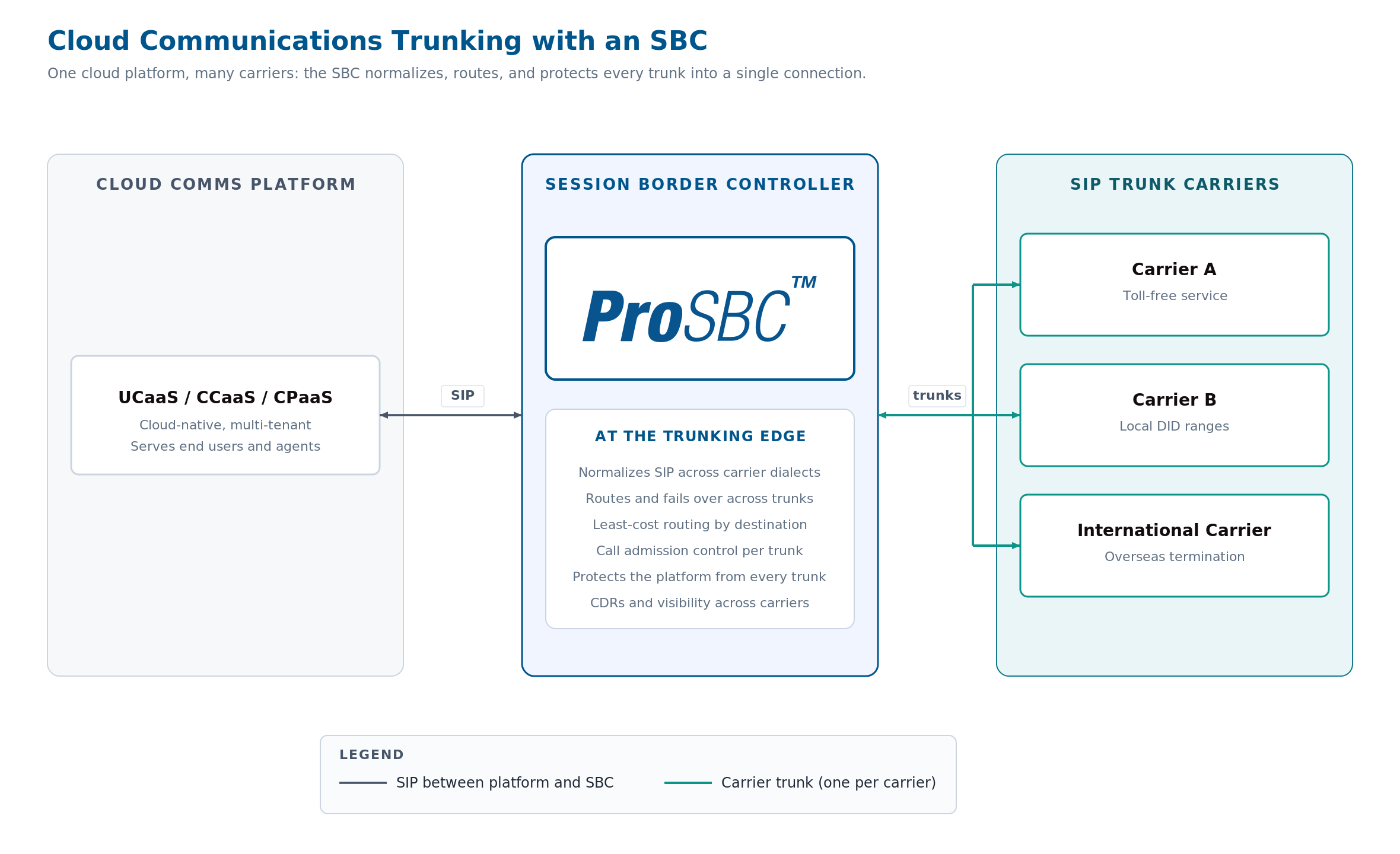
Cloud communications trunking: the cloud platform connects to a single ProSBC, which terminates trunks from several carriers, normalizing SIP and routing traffic across operators. Click to enlarge.
What the SBC Does for Cloud Trunking
Interoperability and Normalization
Because it runs as a Back-to-Back User Agent, the SBC fully terminates each carrier’s call and re-originates a clean one toward the platform. Its SIP header manipulation capability normalizes each operator’s dialect into the single format the platform expects, so adding a carrier does not mean changing the application.
Traffic Routing Across Operators
The SBC routes inbound and outbound calls to the correct carrier and moves traffic between operators based on capacity or availability. For a platform sourcing toll-free, DID, and international service from different operators, this keeps calls flowing to the right trunk without the platform managing it.
Protection of the Cloud Application
The SBC shields the platform from every carrier-facing path, applying access control and admission limits so no single carrier trunk can flood or compromise the application. Because it is cloud-native, it deploys alongside the platform in the same cloud environment.
Works with Major Cloud Voice Platforms
Cloud communications trunking works with the major cloud voice platforms, including CPaaS and UCaaS services such as Twilio, Telestax, and RingCentral. The SBC sits between whichever platform an operator runs and the carriers behind it, which lets a platform assemble its carrier mix freely. This is closely related to the growing pattern of moving off a single bundled communications API toward direct carrier connections, explored in the guide to bring your own carrier.
Deploy It Your Way
A cloud trunking SBC can be run in whatever model suits the platform operator:
Self-Managed
Run ProSBC as software in your own cloud or on-premises infrastructure: AWS, Azure, VMware, KVM, or bare metal. Full control over configuration, routing scripts, and carrier onboarding.
Managed Service
Hand deployment and day-to-day operation to TelcoBridges through the ProSBC managed service. Includes 1+1 HA, 24/7 support, setup, integration, and monitoring. Deploys on your platform or ours.
Fully Hosted
TelcoBridges hosts and manages the SBC entirely. You point your carriers and your application at a managed trunking endpoint with no infrastructure to maintain.
Frequently Asked Questions
What is cloud communications trunking?
It is the connection between a cloud voice platform (UCaaS, CCaaS, CPaaS, or SaaS) and its carriers, managed through an SBC that handles routing, interoperability, and protection across one or more operators so the platform sees a single consistent connection.
How is cloud trunking different from cloud access security?
Trunking is the carrier-facing side, connecting the platform to operators for numbers and termination. Access security is the user-facing side, securing the platform’s remote devices and soft clients. Both use an SBC, but they solve different problems at opposite edges of the platform.
Which cloud platforms does this work with?
It is compatible with major cloud communications platforms, including CPaaS and UCaaS services such as Twilio, Telestax, and RingCentral. The SBC sits between the platform and its carriers regardless of which platform is in use.
Why not connect the platform directly to each carrier?
Direct connections push carrier-management complexity into an application built to serve users. The SBC absorbs SIP interoperability, cross-operator routing, and protection at the boundary, so the platform can add or change carriers without re-engineering its own service.
Trunk Your Cloud Platform to Any Carrier
Talk to a solutions architect about connecting your cloud platform to its carriers through ProSBC, or start evaluating on your own.
Prefer to evaluate on your own first? Start your 30-day free trial.