SBC for ISPs: Session Border Controller for ILECs, CLECs, and Regional VoIP Providers

What an ISP-grade Session Border Controller actually has to do, what changed in 2026, and what the economics look like at carrier scale.
Voice is still a revenue line for ISPs. Whether you run an incumbent local exchange carrier with a public-service mandate, a competitive carrier reselling SIP trunks, or a regional VoIP provider operating your own platform, the infrastructure carrying that revenue is under pressure from every direction at once.
Legacy platforms are reaching end-of-life. The FCC has tightened STIR/SHAKEN, and the own-certificate rule means every voice service provider has to sign with their own SPC token instead of relying on a downstream carrier. Upstream partners like Bandwidth have shifted their attestation policies, pushing the compliance burden back to originators. And operators running Ribbon on VMware have spent the last 18 months watching their licensing math fall apart after the Broadcom acquisition.
A Session Border Controller sits at the centre of all of that. It controls SIP traffic, secures the network edge, normalises signalling between carriers and endpoints, and carries the regulatory work that used to be somebody else’s problem. This page covers what ISPs specifically need from an SBC, what to evaluate against, and what the real economics look like at 500, 1,500, and 5,000 sessions. If you are an ITSP, wholesale carrier, or hosted PBX operator where voice itself is the product, the self-hosted SBC guide for VoIP providers covers the architecture patterns, integration stack, and operational playbook for running your own voice edge.

Why ISPs Need an SBC at the Network Edge
If you carry voice traffic in 2026, several pressures have converged to make an SBC essential rather than optional. The pattern repeats across ILECs, CLECs, and regional VoIP providers, even when the specific trigger differs.
Centralising SIP Traffic for Control and Visibility
ISPs often reach a point where they need to insert themselves into the call path. Without an SBC, traffic flows directly between customers and upstream carriers, and visibility into call quality, billing accuracy, and fraud is limited to what the carrier sends back. An SBC gives you one control point for routing, monitoring, and policy enforcement across every SIP trunk, and accurate CDRs for every call crossing the network. That CDR layer is what makes carrier billing reconciliation honest, and it is the difference between catching revenue leakage in week one and discovering it in the quarterly close.
Legacy Platform Replacement
This is the most common reason ISPs evaluate an SBC. OpenSIPS deployments that started life as lightweight SIP proxies have grown into custom-built platforms that are expensive to maintain and brittle to hand off. One ILEC we worked with had seven sites running OpenSIPS and needed a commercial replacement that could centralise management across all of them. And Ribbon customers running on VMware have been working through the cost increase from the Broadcom acquisition, which made the combined Ribbon-plus-VMware stack difficult to budget year over year. The hardware-to-software replacement guide covers the migration patterns in detail.
STIR/SHAKEN Regulatory Compliance
The FCC’s Eighth Report and Order changed the underlying rules. Voice service providers can no longer rely on downstream carriers to sign with their certificates, and every provider with a STIR/SHAKEN obligation now needs their own SPC token and certificate from an approved CA. For ISPs, that means the SBC has to handle signing, attestation, and verification directly rather than passing it off. The urgency is real: some originators have watched their attestation drop from A-level to C-level as upstream carriers tighten their own policies, and the only durable fix is to take ownership of the signing process instead of borrowing somebody else’s certificate.
Security at Scale
ISPs carrying live voice traffic are real targets. SIP flood attacks, toll fraud, registration scanning, and INVITE floods are not hypothetical. A network firewall cannot inspect SIP at the application layer, it only sees IP packets and ports. It can block port 5060 entirely, but it cannot distinguish a legitimate REGISTER from a credential-stuffing run against valid extensions. The SBC understands SIP as a protocol, so it can enforce per-call security policies, rate limit by method and source, and dynamically blacklist on behaviour rather than just on IP. The SBC security guide walks through each layer.
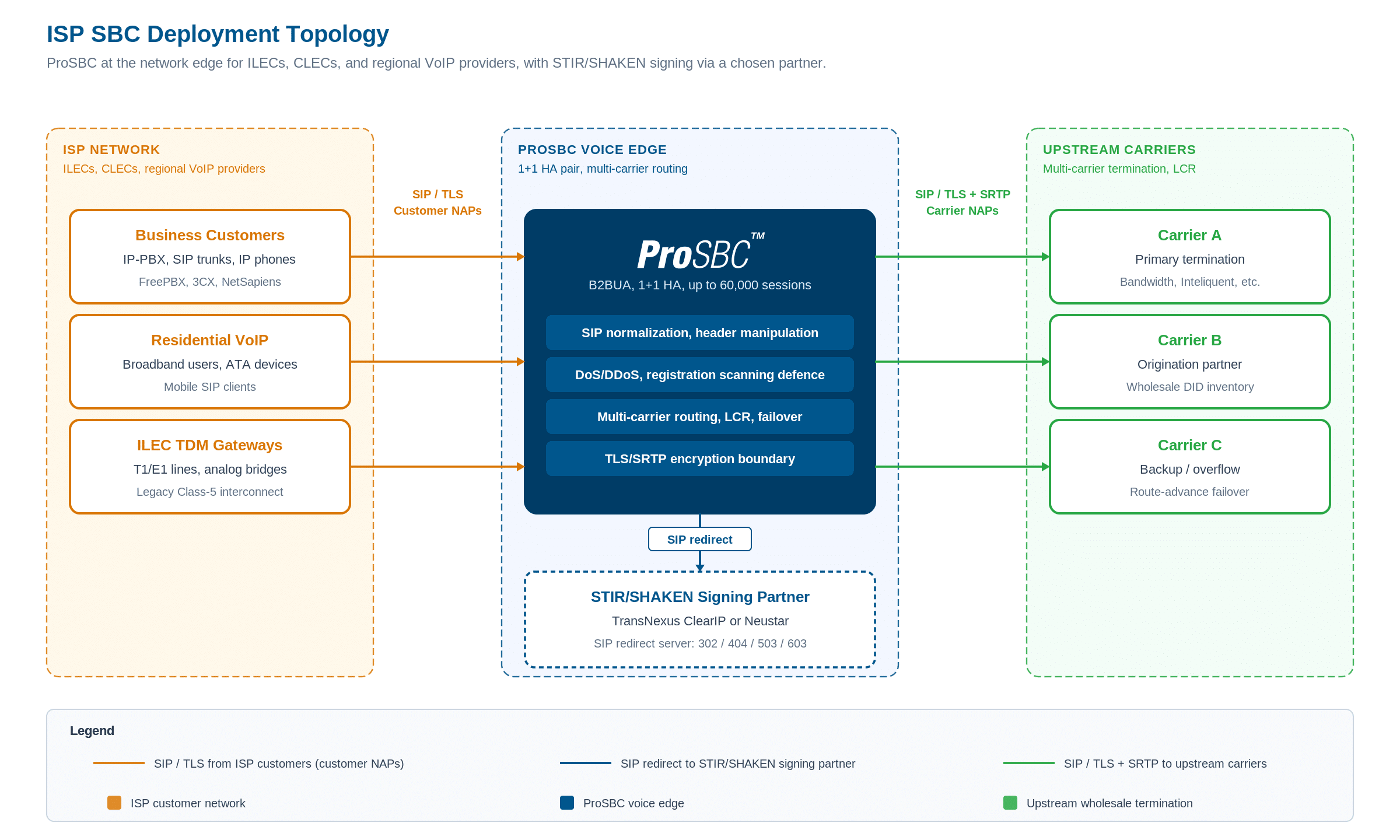
ISP SBC deployment topology: a ProSBC 1+1 HA pair sits between business customers, residential VoIP, and ILEC TDM gateways on the customer side, and upstream carriers and a STIR/SHAKEN signing service on the carrier side. CDR, REST API, and SNMP output flow to the management and billing layer below. Click to enlarge.
What ISPs Should Look for in an SBC
Not every SBC is built for ISP-scale operations. If you are replacing a legacy platform, these are the capabilities your new SBC needs to match or exceed. For a deeper look at the operational side of running your own voice edge, architecture patterns, and integration with billing and provisioning, see the self-hosted SBC guide for VoIP providers.
Carrier-Grade Scale and Reliability
The SBC needs to handle current traffic and scale into growth without a platform migration. ProSBC supports up to 60,000 concurrent sessions per server, 350,000 endpoint registrations, and up to 1,024 NAPs in a single instance. That means each upstream carrier, each customer-facing trunk group, and each internal routing segment can live as its own NAP with its own rules, all under one SBC.
Reliability means high availability, full stop. For an ISP, downtime is dropped calls, lost revenue, and potential regulatory exposure where phone service is mandated. A 1+1 active/standby HA configuration provides redundancy for maximum uptime and minimal downtime, and it should be available at every session tier, not gated behind the largest licence. With ProSBC, a 500-session deployment with HA costs $2,000 per year, which makes redundancy a procurement non-event for regional providers. The VoIP failover guide covers the architectural patterns in depth.
STIR/SHAKEN With an Open Partner Model
The SBC has to handle the full STIR/SHAKEN workflow: signing outbound calls, attesting at the right level, and verifying inbound calls at termination. It also has to do this without locking you into a specific signing partner.
This matters because some SBC vendors ship proprietary STIR/SHAKEN implementations that work with one signing service and one only. If the partner’s pricing or feature roadmap stops fitting, the SBC is the constraint that has to be untangled before anything else changes. ProSBC’s configurable routing engine takes the opposite approach. The deployed integration pattern with TransNexus ClearIP and Neustar runs over SIP or HTTP: ProSBC routes the call to a NAP whose service type is set to AUTHENTICATION, the STI-AS replies as a redirect server (302 with Identity, 404, 503, or 603), and Reason Cause Mapping handles failover. Primary and secondary NAPs, with explicit cause-code overrides, give you signing-service redundancy that does not depend on the partner’s own availability.
The architectural point is that you choose the signing partner. The ProSBC STIR/SHAKEN page covers the integration in more detail, including the open-partner positioning.
SIP Trunking and Multi-Carrier Interoperability
ISPs rarely run a single carrier. The SBC has to normalise SIP across multiple upstream providers, each with its own header conventions, codec preferences, and routing requirements. One carrier may demand a specific P-Asserted-Identity format while another strips it on entry. Without an SBC that can manipulate headers per trunk, the alternative is custom middleware or accepted interoperability failures.
A B2BUA architecture is what makes this work. Unlike a SIP proxy, a B2BUA fully terminates and re-originates every session, giving the SBC complete control over signalling on both legs. You can rewrite headers, translate between carrier requirements, and enforce routing policies without being constrained by what the originating side sends. ProSBC’s routing engine supports multi-route configurations with priority and failover, so when a primary terminator is down or congested, calls advance automatically.
Security at the Network Edge
An ISP’s SBC is the first line of defence for the entire voice network. The capabilities that matter at this layer include built-in DoS and DDoS protection (SIP-aware rate limiting, connection throttling, and automatic mitigation), dynamic blacklisting and call access control with percentage-based greylisting for graduated enforcement, SIP registration scanning protection that distinguishes legitimate re-registration from a flood, and topology hiding that prevents reconnaissance into your internal addressing.
None of this comes from a network firewall. Firewalls work at Layer 3 and 4. They can filter by IP and port, and some include a SIP ALG, but ALGs are unreliable and frequently make things worse rather than better. The SBC sits at Layer 7 of the voice plane, and that is where the attacks actually land.
Deployment Flexibility
ISPs run diverse infrastructure. Some are on AWS top to bottom. Others have invested in on-premises VMware and want to keep it. ILECs often prefer physical hardware they can touch. The SBC has to run wherever you already are.
ProSBC runs on AWS, Microsoft Azure, VMware, KVM (Proxmox), and baremetal. AWS is the most popular deployment platform based on customer data, but the SBC is the same regardless of where it runs. For ISPs operating under data-protection or regulatory regimes that mandate on-premises, the same software image keeps the entire voice plane inside infrastructure you control.
Programmable Routing and API Integration
ISPs need routing logic that goes beyond a static route table. ProSBC’s API-based routing supports custom logic for fraud scoring, STIR/SHAKEN dispatch, LNP dips, external HTTP routing queries, and CRM integration. HTTP query and route modules let the SBC consult external systems in real time before making a routing decision. This is not theoretical: ISPs use it to query fraud databases before connecting calls, look up LNP data to choose the right carrier, and integrate authorisation against their own business systems.
For ISPs managing large DID inventories, the HTTP API supports routing-table lookups against external databases, so the SBC’s internal table size stops being the ceiling. One VoIP provider routes against a 200,000-DID table held in an external system. CDR output in text and RADIUS formats integrates directly with billing and analytics platforms, giving per-call visibility across the entire network. Accurate CDR data is the foundation of carrier billing reconciliation, and generating it at the SBC layer means you are not depending on upstream carrier records alone.
Replacing Legacy Platforms: What ISPs Are Moving From
The migration paths look different on the surface, but the same three legacy platforms account for the bulk of ISP SBC evaluations.
OpenSIPS
OpenSIPS is not a vendor, it is a build-your-own decision. The platform itself is capable, but total cost of ownership includes the engineering time to build, maintain, debug, and update a custom deployment. When the engineer who built it leaves, the organisation has a choice: hire another specialist (who will probably want to rebuild it their way) or move to a commercial SBC with vendor support. The commercial option often costs less in absolute terms once engineering salary, on-call burden, and incident response are accounted for. One ILEC running OpenSIPS across seven sites found the commercial option came out less expensive before on-call hours were even in the comparison. The open-source SBC options comparison covers the engineering economics in detail.
Ribbon on VMware
Ribbon makes a capable SBC product. The problem is the VMware licensing change after Broadcom’s acquisition. ISPs running Ribbon on VMware have been working through unpredictable cost increases, and the combination of Ribbon’s own licensing plus VMware’s new pricing makes total cost difficult to budget. This created a systematic displacement opportunity: if you are already considering a platform change because of VMware costs, the SBC evaluation comes along for free. A software SBC that runs on KVM (Proxmox) or AWS removes the VMware dependency entirely. The Ribbon alternative comparison covers the migration shape in detail.
Oracle (Acme Packet)
Oracle’s SBC works. The issue is total cost of ownership. At roughly $50 to $100 per session per year, a 1,000-session ISP deployment can cost up to around $100,000 annually. A software SBC at as low as $1.40 per session per year brings the same deployment to as low as $2,500 per year. That is a fundamentally different business case, and it is why so many Oracle customers reach for an evaluation at the next renewal. The Oracle Acme Packet alternative comparison covers the TCO math directly.
For any of these migrations, the requirements are the same: carrier-grade reliability from day one, an explicit parallel-run phase before cutover, and a deployment timeline you can trust. Be sceptical of vendors who promise a two-week implementation without first having seen your environment.
Self-Managed vs Managed SBC for ISPs
ISPs split into two broad categories on SBC operations: those with dedicated VoIP engineering staff who want full control, and those (especially ILECs) who carry deep legacy telecom expertise but limited IP voice operations experience.
Self-Managed
Self-managed works well for ISPs with VoIP engineers on staff. You deploy ProSBC on your own infrastructure, configure routing and security policies, and own upgrades and monitoring. ProSBC’s ProSBC Lab is self-serve from download to running instance in about 20 minutes, no sales call required. You keep full control over configuration, routing scripts, and security policies, and the REST API lets you integrate monitoring and status checks into your existing operations stack.
Managed Service
Managed service fills a genuine need for ILECs and smaller ISPs. TelcoBridges’ Managed Service includes ProSBC+ with 1+1 HA, 24/7 support, setup, integration, testing, and ongoing monitoring. You choose where it runs: hosted by TelcoBridges, or on your own AWS, Azure, VMware, or KVM platform. The customer retains full access throughout, so the managed layer adds operational expertise without taking away control. The managed vs self-hosted comparison covers the decision framework in detail.
For ISPs that already have VoIP staff, the managed conversation usually starts when the SBC administrator leaves or gets reassigned. Having the managed path available as a fallback is insurance against staffing changes disrupting voice operations.
How to Evaluate an SBC: An ISP Checklist
Before committing to any SBC platform, work through these questions. Each one addresses a specific failure mode we have seen in real ISP evaluations. The full six-step framework lives in the SBC buyer’s guide; the questions below are the ISP-specific subset.
-
Does it handle your traffic today and scale for growth?Ask about maximum sessions per server, maximum registrations, and trunk-group count. If you run 1,000 sessions today and expect 5,000 in three years, the SBC should handle both without a platform change. Replatforming every time you outgrow the SBC is expensive and disruptive.
-
Does it support your carriers and SIP trunking partners?Verify the SBC’s SIP header manipulation and routing engine can normalise signalling for each of your upstream providers. A B2BUA architecture is what gives you full control over both legs of every call.
-
Does it meet STIR/SHAKEN with an open signing partner model?Confirm the SBC integrates with your chosen signing service, not just the vendor’s preferred one. Ask about redundancy (primary and secondary signing paths) and fallback behaviour when the signing service is unreachable. Your calls should not fail because somebody else’s service is down.
-
Can you test it without a sales call?Self-serve trials and permanent lab licences let you validate the SBC against your actual traffic and carrier configurations before committing budget. If a vendor requires a sales meeting before you can run a test instance, consider what that says about the rest of the onboarding experience.
-
What does the pricing look like at your scale?Get the numbers, not “contact us for a quote.” If a vendor will not put pricing in writing, that is the data point. Budget planning needs predictable costs.
-
Is there a managed option if your VoIP bench is thin?Even if you plan to self-manage, knowing a managed path exists is a fallback if staffing changes. Ask whether the managed service runs on your infrastructure or the vendor’s, and whether you keep direct access.
-
Can it run on your existing infrastructure?Cloud, VM, on-premises, and baremetal options mean you do not have to rebuild your environment around the SBC. If you already run AWS or KVM, the SBC should deploy there without requiring VMware or proprietary hardware.
Frequently Asked Questions
What is the best SBC for an ISP?
The right SBC for an ISP depends on traffic profile and operational model, but the requirements list is consistent: carrier-grade scale (thousands of concurrent sessions), STIR/SHAKEN with an open signing partner model, multi-carrier SIP normalisation, built-in DoS/DDoS protection, and transparent pricing. ProSBC supports up to 60,000 concurrent sessions per server with configurable routing and security policies built for service-provider environments.
How much does an SBC cost for an ISP?
SBC pricing varies significantly by vendor and deployment model. ProSBC uses a transparent per-session subscription starting at as low as $1.40 per session per year. A 500-session deployment with HA is $2,000 per year, and 5,000 sessions with HA is $12,500 per year. This is well below traditional vendors like Oracle (roughly $50 to $100 per session per year) and hardware-based solutions that require upfront capital.
Do ISPs need STIR/SHAKEN compliance?
Yes. ISPs carrying voice traffic are subject to FCC STIR/SHAKEN requirements. The FCC’s own-certificate rule requires every voice service provider with STIR/SHAKEN obligations to obtain and use their own signing certificate from an approved CA. The SBC must handle signing, attestation, and verification directly, and it should integrate with the signing partner of your choice rather than locking you into a vendor’s preferred ecosystem.
Can an ISP use a managed SBC service?
Yes. Managed SBC services fit ISPs without dedicated VoIP engineering staff, particularly ILECs with legacy telecom expertise. TelcoBridges Managed Service includes ProSBC+ with HA, 24/7 support, setup, integration, and ongoing monitoring. You choose whether it runs on TelcoBridges’ infrastructure or your own (AWS, Azure, VMware, or KVM).
What legacy platforms can an SBC replace?
A modern SBC can replace OpenSIPS custom builds, Ribbon on VMware (especially where Broadcom-driven licensing has broken the budget), and Oracle/Acme Packet deployments. The driver is some combination of security, manageability, and total cost of ownership.
Why does an SBC matter more than a firewall for voice security?
A firewall operates at Layer 3 and 4. It can filter by IP and port, but it cannot inspect SIP at the application layer. A registration flood looks like normal SIP traffic to a firewall; an SBC understands what a legitimate REGISTER pattern looks like and can rate-limit, blacklist, and topology-hide accordingly. Production voice deployments run both, with the SBC sitting in front of the call control.
Can ProSBC integrate with our existing fraud and billing systems?
Yes. ProSBC’s Ruby routing API supports HTTP queries to external systems during the signalling phase, so fraud scoring, LNP dips, CRM lookups, and other business-system integrations run per call without media-quality impact. CDR output in text and RADIUS formats feeds billing and analytics platforms directly. Large DID inventories (200,000+) can be routed against external databases rather than internal route tables.
How do I start an evaluation?
The ProSBC Lab is a free, permanent three-session licence that runs on any hypervisor or cloud. Most operators have a working instance in their own environment within 20 minutes of download. Use it to validate carrier interoperability, test STIR/SHAKEN signing, and exercise the management interface against your operational requirements. When you are ready for a fuller production evaluation, the 30-day free trial runs at 500 sessions. Both paths are self-serve.
Deploy an ISP-Grade SBC With ProSBC
ISPs need an SBC that matches operational reality: carrier-grade scale, regulatory compliance, security at the network edge, and pricing that fits a service-provider business model. ProSBC ships as a full B2BUA with up to 60,000 sessions per server, 1,024 NAPs, and 1+1 HA available at every tier. The Ruby routing API handles STIR/SHAKEN through your choice of signing partner, fraud scoring against any HTTP-accessible system, and CDR output that feeds your billing stack directly.
The SBC runs wherever your infrastructure already lives: AWS, Microsoft Azure, VMware, KVM (Proxmox), or baremetal. Managed Service is available if you would rather have TelcoBridges handle setup, integration, and 24/7 operations, hosted on your platform or ours. For operators building a voice-first business who want the full operational playbook for self-hosting, see the VoIP provider self-hosted guide.
Prefer to evaluate on your own first? Start your 30-day free trial.