SIP Firewall vs SBC: Choosing the Right Voice Perimeter
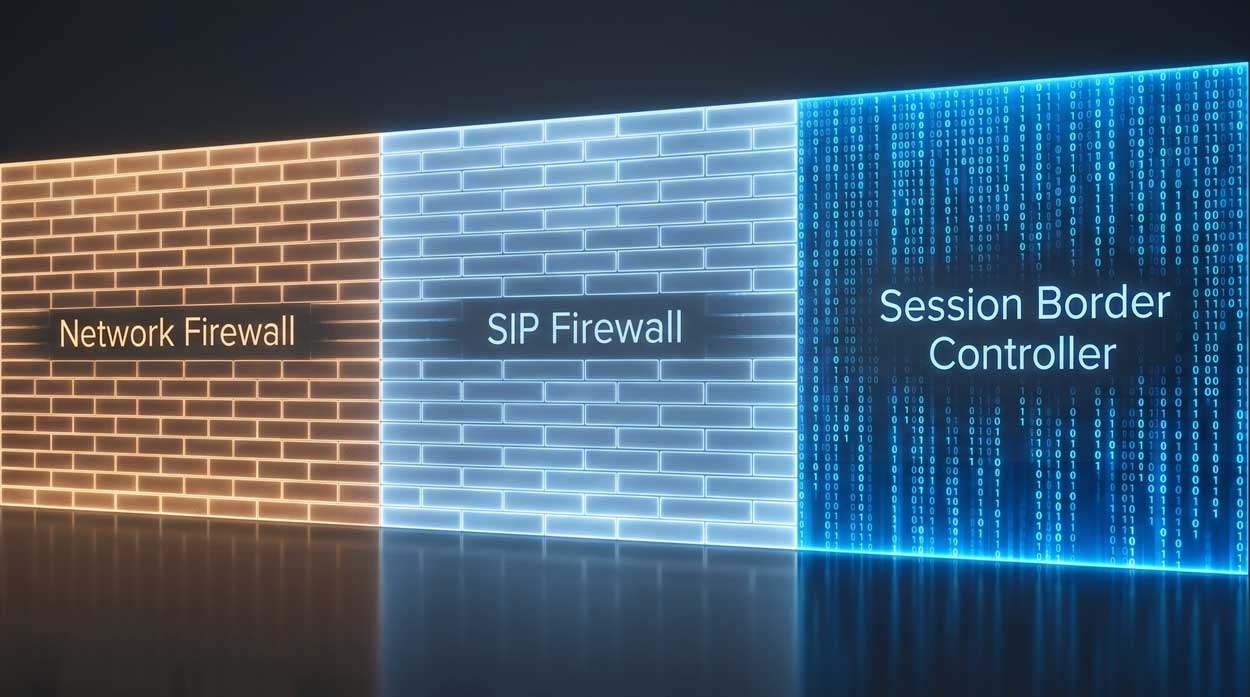
Most “firewall vs SBC” debates collapse three different product categories into two. There is a network firewall, which typically operates at Layer 3/4 and does not perform full SIP-aware control. There is a SIP firewall, which inspects SIP signaling but typically stops short of full media handling. And there is a session border controller, which terminates and re-originates signaling independently and may anchor, relay, secure, or transform media according to policy at the network edge. Treating any two of these as interchangeable leads to over-buying, under-protecting, or both.
The keyword “SIP firewall” is the one that causes the most confusion. It is a real product category sold by vendors like Ingate, certain AudioCodes SKUs, and older Borderware appliances, and it is also a label that some firewalls apply when a SIP Application Layer Gateway (ALG) module is enabled. The two cases are not equivalent. The buyer who asks “do I need a SIP firewall or an SBC?” usually wants a straightforward answer about which product class fits their deployment, not a recital of why a network firewall cannot inspect SIP.
This guide separates the three categories, compares them on the capabilities that actually matter for voice, and walks through six common deployment scenarios so you can map your environment to the right product class. The capability comparison sits in the middle of the article and is the fastest way to scan the differences if you only have a minute.

The Three Product Categories at the Voice Perimeter
Every voice network has a perimeter, and every perimeter needs some combination of three controls. Reading “SIP firewall vs SBC” as a binary question hides the fact that most production deployments use at least two of the three, and some use all three.
A network firewall sits at the edge of the IP network. It enforces who can reach the voice infrastructure at the packet level. Source IP, destination IP, transport protocol, and port number are the controls. The firewall does not parse SIP, does not see RTP as media, and treats both as generic UDP or TCP. Almost every voice deployment has one of these, either as a dedicated appliance or as a cloud-provider security group.
A SIP firewall covers a wider range of products than the name suggests. The category includes purpose-built signaling-aware appliances (Ingate SIParator is the canonical example, with legacy entries from Borderware and older Polycom devices), software modules embedded inside a general-purpose firewall (the SIP ALG on Cisco ASA, Fortinet, Palo Alto, SonicWall), and open-source builds where Kamailio or OpenSIPS is configured as a SIP perimeter. What they share is signaling awareness without full media termination: they parse SIP headers, apply rules to signaling, and typically forward media without establishing independent media control.
A session border controller performs the full set of voice-perimeter functions on both planes. It terminates the incoming SIP dialog, originates a new outbound one, and does the same for the media stream via media anchoring. This architecture, the B2BUA, is what lets the SBC enforce encryption per leg, manipulate headers, hide topology, run routing logic, perform transcoding, anchor and convert SRTP, integrate with STIR/SHAKEN signing services, and absorb application-layer denial-of-service traffic. Most published SBC products today are software-based and run on commodity infrastructure.
The three categories overlap at the edges, especially because vendor marketing sometimes labels the same device as either “SIP firewall” or “session border controller” depending on the audience. The capability table later in this guide is the most reliable way to tell which product class a given device actually belongs to.
What a Network Firewall Does for SIP, and What It Doesn’t
A network firewall is essential for voice. Every voice perimeter should have one. The question is what it can and cannot do once SIP traffic crosses it.
On the things it can do, a network firewall enforces source-IP allowlists for trusted carrier peers, restricts SIP and RTP ports to known ranges, drops obvious volumetric attacks (TCP SYN floods, UDP amplification, ICMP floods) before they reach the voice infrastructure, and provides the basic Layer 3 / Layer 4 access policy that keeps random internet traffic off the SIP listener. In cloud deployments, this is the role of an AWS security group, an Azure NSG, or a Google Cloud firewall rule, plus whatever DDoS scrubbing the cloud provider offers at the network edge.
On the things it cannot do, a network firewall cannot inspect a SIP message body. A SIP INVITE flood, a SIP REGISTER flood, a malformed SIP message designed to exhaust processing resources or trigger parser errors, and a normal call setup all look identical to a firewall: UDP packets to port 5060. The firewall has no way to rate-limit by SIP method, no way to detect that registrations are arriving with sequential or invalid credentials, and no way to identify a flood that uses spoofed source IPs. For a comprehensive walk-through of why SIP floods evade Layer 3 / Layer 4 controls, see the deeper SIP DoS attack prevention guide.
The SIP ALG that ships with most general-purpose firewalls is intended to bridge this gap, and it usually makes things worse. SIP ALGs are well known for rewriting SIP headers in ways that break call flows, interfering with NAT traversal, mishandling re-INVITEs, and producing one-way audio that is difficult to diagnose. Many voice engineers disable the SIP ALG as the first step when troubleshooting a new deployment. The SBC security guide covers the SIP ALG failure modes in detail.
The conclusion is straightforward. A network firewall belongs in the architecture. It is necessary but not sufficient for SIP traffic, and the SIP ALG is rarely the right way to fill the gap.
What a “SIP Firewall” Actually Is
The SIP firewall is the murky middle. The label covers products with very different capabilities, so two buyers comparing “SIP firewalls” can end up looking at devices that do almost nothing alike.
The clearest case is a purpose-built SIP firewall appliance. Ingate SIParator is the long-running reference product in this category and is positioned explicitly as a SIP firewall plus E-SBC hybrid. The device parses SIP, applies allow / deny rules at the SIP layer, can rate-limit by SIP method, handles registration traffic, and either anchors or transparently forwards media depending on configuration. Other vendors have offered similar devices over the years, including legacy Borderware appliances and certain Polycom and AudioCodes E-SBC SKUs marketed in firewall mode for SMB deployments. These are real signaling-aware perimeter devices.
A second case is the SIP ALG inside a general-purpose firewall, which some vendors and resellers refer to as a “SIP firewall” feature. As noted above, the SIP ALG is signaling-aware in theory and operationally fragile in practice. Calling it a SIP firewall blurs the category, because the capability profile is far narrower than a dedicated appliance.
A third case is open-source. Kamailio and OpenSIPS can both be configured to act as a SIP perimeter that filters, rate-limits, and forwards SIP traffic to a downstream call processing platform. Some operators run these in front of an Asterisk or FreePBX installation as a “SIP firewall” tier, often paired with fail2ban for source-IP blacklisting. This works for small deployments where the operator has the engineering depth to maintain it and where media is happy to flow through unmodified.
What most SIP firewalls share is a focus on signaling. They parse SIP messages, apply policy to those messages, and pass RTP through with a pinhole rather than re-originating it. They are typically deployed as SIP proxies rather than as B2BUAs, which means they do not create a hard break between external and internal dialogs. The practical implications are large: limited topology hiding, no per-leg encryption policy, no media-plane rate limiting, and integration challenges with platforms that require strict media handling such as Microsoft Teams Direct Routing.
A SIP firewall is a real and useful product class. It is also a narrower product class than the term implies, and a SIP firewall is not a session border controller even when vendors blur the labels.
What a Full SBC Adds On Top of a SIP Firewall
An SBC starts from the same place a SIP firewall does, which is signaling awareness at the network edge. It then adds the media plane, a routing engine, normalization, registration handling, and topology hiding.
Media anchoring and encryption is the most visible difference. The SBC receives RTP on the external leg and re-transmits it on the internal leg, with separate encryption contexts on each side. This is what makes SRTP relay and RTP-to-SRTP conversion possible. A Microsoft Teams Direct Routing deployment, a WebRTC integration, and a legacy PBX behind a modern carrier all rely on this behaviour. A signaling-only SIP firewall has no media to terminate, so it cannot perform either.
SIP normalization covers the rules that adjust SIP headers per call leg or trunk group to make multi-vendor environments interoperate. SIP header manipulation includes things like P-Asserted-Identity correction for STIR/SHAKEN compatibility, Via header fix-ups for malformed messages, session timer handling under RFC 4028, and removing or adding vendor-specific extensions. A SIP firewall often provides limited normalization, but generally exposes less per-leg control than SBC platforms.
The routing engine is where an SBC turns from a perimeter device into a control point for the call flow. Routing rules can dispatch calls to different carriers by destination prefix, by time of day, by least cost, by attestation level, or by the result of an external API lookup against a fraud-scoring service, an LNP database, or a CRM. The SBC REST API call routing guide walks through this in detail. Most SIP firewalls have a smaller routing surface and rely on a downstream platform for any non-trivial logic.
Registration handling is the other large difference. An SBC can act as a registration forwarder for upstream registrars, can protect the registrar from registration scanning and credential stuffing, and can hold registration state for endpoints behind NAT. Many SIP firewall implementations provide limited registration awareness compared with SBC platforms.
Topology hiding works because of the B2BUA architecture. Routing and topology-sensitive headers are generated by the SBC according to policy, not forwarded from the external side, so internal IP addresses, hostnames, and identifiers never reach the public internet. A SIP firewall in proxy mode forwards the original headers and so leaks more topology unless heavily configured.
STIR/SHAKEN integration is the modern addition. An SBC is the natural place to query a signing service, generate and attach the PASSporT identity information carried in the Identity header into the outbound INVITE, and validate the Identity header on inbound calls. ProSBC supports this through Ruby routing scripts that integrate with TransNexus ClearIP, Neustar, and other STI-AS providers, with primary / secondary redundancy and per-call attestation control. A signaling-only SIP firewall lacks the routing surface to make per-call attestation decisions.
Each of these capabilities is one buyer scenario away from being load-bearing. The decision framework in the next section maps those scenarios to product classes.
Side-by-Side Capability Comparison
The table below maps the capabilities that matter at the voice perimeter to the three product categories. “Partial” is used where the capability is technically present but materially narrower than the category one column to the right.
| Capability | Network Firewall | SIP Firewall | Session Border Controller |
|---|---|---|---|
| IP / port filtering at Layer 3 / 4 |  Primary purpose Primary purpose |
Often included | Per-NAP granularity |
| SIP message inspection (application layer) |  SIP ALG only, often disabled SIP ALG only, often disabled |
Full SIP parsing |
Full SIP parsing |
| B2BUA architecture (full dialog termination) | |
Usually proxy mode |
|
| SIP-aware rate limiting (per method, per source, per trunk) | |
Per method only | All three scopes |
| Dynamic blacklisting and greylisting | Static IP blocks only | Dynamic IP only | Including percentage greylisting |
| Registration scanning protection | |
REGISTER filtering only | Pattern-based detection |
| Media plane handling (RTP anchoring) | Pinholes only |
Pass-through typical | Full media anchor |
| TLS termination for SIP signaling | |
Some products | Per-leg |
| SRTP relay and RTP-to-SRTP conversion | |
|
|
| SIP header manipulation for vendor normalization | |
Drop / pass only | Per-leg rewriting |
| Topology hiding | |
Limited in proxy mode | Native to B2BUA |
| Configurable routing engine | |
Basic rules | API-driven |
| Transcoding (codec conversion) | |
|
Software or hardware DSP |
| STIR/SHAKEN signing and verification | |
|
STI-AS integration |
| Microsoft Teams Direct Routing support | |
No SRTP |
|
Capability comparison across the three product categories at the voice perimeter.
A Decision Framework by Deployment Scenario
The right product class depends on what sits behind the perimeter and what crosses it. The six scenarios below cover most production voice deployments.
Single small business, single PBX, no internet-facing SIP
The site has a hosted PBX or an on-premises PBX that talks to one carrier over a private circuit or a managed SIP trunk on a single static IP. Internet exposure of the voice infrastructure is zero. A network firewall with strict allowlists on the carrier IP and the SIP and RTP port ranges is enough. A SIP firewall adds little, and an SBC is over-buying unless the site needs media encryption, Teams Direct Routing, or multi-carrier routing.
SMB with a SIP trunk over the public internet
The site has one or more SIP trunks reaching the carrier across the public internet. Source IPs from the carrier may rotate, or the carrier may insist on FQDN-based connectivity. A SIP firewall is a defensible choice if the only requirements are signaling filtering and source-IP enforcement. A small SBC is the more common choice in 2026 because the same device gives the site SRTP, header normalization, and the option to add a second carrier later without re-architecting the perimeter.
MSP serving 10 to 200 business clients (Teams Direct Routing)
This is the dominant MSP SBC scenario. Microsoft Teams Direct Routing is the trigger, and Microsoft requires TLS for SIP signaling, SRTP for media, mutual TLS for the Teams interface, and an FQDN that matches a certificate from a Microsoft-trusted CA. A SIP firewall cannot meet these requirements because it does not terminate media and does not run per-leg TLS / SRTP policy. The correct product class is an SBC, deployed multi-tenant so one device serves many client tenants. See the Teams Direct Routing guide for the full configuration walkthrough.
ISP, ILEC, or wholesale voice provider
The operator resells SIP trunks, runs STIR/SHAKEN attestation, peers with multiple carriers, and handles a wide mix of customer endpoints. None of this is in scope for a SIP firewall. The SBC is the only product class that runs the routing engine, the per-call attestation logic, and the multi-vendor header normalization that this profile requires. The STIR/SHAKEN call authentication guide covers why attestation has to live in the routing layer.
Contact center moving to a cloud platform (BYOC)
The contact center is migrating from premises voice to a cloud platform such as Genesys, Five9, or NICE, with a Bring Your Own Carrier model. The cloud platform commonly benefits from an SBC at the edge so the contact center retains carrier choice, fraud control, recording integration, and quality metrics independent of the platform. A SIP firewall does not provide the recording integration points, the fraud-scoring routing hooks, or the per-NAP CDR isolation that a contact center needs. The SBC is the correct class.
Carrier transit and peering
The operator is a transit carrier or a peering hub with many upstream and downstream SIP relationships. Per-peer encryption policy, header normalization, anti-fraud rate limits, and topology hiding from each peer are all load-bearing. This is the original SBC use case, and the SIP firewall product class never targeted it.
The “We Already Have a Firewall” Trap
The most common mistake in voice perimeter planning is concluding that a network firewall covers SIP because it has a SIP ALG checkbox. The previous sections covered why this falls short. Three failure modes are worth flagging explicitly because they tend to surface only after an incident.
SIP flood attacks pass through firewalls unmodified. An INVITE flood, a REGISTER flood, an OPTIONS flood, and a malformed-message attack all look like valid UDP traffic to the firewall. The deeper SIP DoS attack prevention guide covers each attack type and how application-layer rate limiting stops it. A SIP firewall covers part of this surface (signaling-layer rate limiting), and an SBC covers all of it including media-plane floods.
Media encryption is impossible without media termination. SRTP requires the device to handle the RTP stream, derive keys per leg, and re-encrypt on the outbound side. Neither a network firewall nor a signaling-only SIP firewall does this. Deployments that need SRTP for compliance (Teams Direct Routing, WebRTC, HIPAA-related ePHI in transit) require an SBC. See the SBC TLS and SRTP configuration guide for the deployment patterns.
Topology leakage is hard to fix retroactively. A SIP firewall in proxy mode forwards the SIP headers it receives, including Via, Contact, and identity headers that reveal internal IP addresses and hostnames. Once external parties have seen those headers, attackers can target internal infrastructure directly and bypass the perimeter entirely. The B2BUA architecture in an SBC writes new headers on the internal side, so internal topology stays internal. The SBC security guide covers topology hiding alongside the four other security layers.
The correct architecture for a voice deployment that uses any of the modern voice platforms is layered. The network firewall handles Layer 3 / Layer 4 traffic policy. The SBC handles SIP, media, encryption, routing, and topology. The SIP firewall has a narrower fit and is most useful where the deployment genuinely does not need media handling or routing.
Where ProSBC Fits
ProSBC is a software session border controller and covers the full SBC column of the comparison table. The features that appear most often in the buyer scenarios above are all included: B2BUA architecture, TLS and SRTP per leg, full SIP normalization, per-NAP rate limiting and dynamic blacklisting with percentage-based greylisting, SIP registration scanning protection, topology hiding, configurable routing through a Ruby API, and STIR/SHAKEN signing through open partner integrations with TransNexus ClearIP and Neustar.
ProSBC scales to 60,000 sessions per server, supports up to 1,024 NAPs for multi-tenant deployments, and runs on AWS, Azure, VMware, KVM, Proxmox, or bare metal. Pricing starts at as low as $1.40 per session per year on subscription, with a 30-day free trial for commercial evaluation and a permanent ProSBC Lab license that provides three concurrent sessions for testing and integration work.
The most common entry point for buyers comparing SIP firewalls against SBCs is the ProSBC Lab license. It runs the full feature set, takes about 20 minutes to deploy, and lets the buyer test the perimeter behaviour against their actual carrier and platform integrations before committing to a paid tier.
Frequently Asked Questions
Is a SIP firewall the same as an SBC?
No. A SIP firewall is signaling-aware and typically operates as a SIP proxy without terminating media. A session border controller terminates and re-originates signaling independently, and may anchor, relay, secure, or transform media according to policy as a B2BUA, which is what enables SRTP relay, transcoding, per-leg encryption policy, topology hiding, and a configurable routing engine. Some vendors use the labels interchangeably, but the capability profiles differ.
Can I just enable the SIP ALG on my existing firewall?
Most voice engineers disable SIP ALGs as a first troubleshooting step. SIP ALGs rewrite SIP headers in ways that frequently break call setup, NAT traversal, re-INVITEs, and SRTP negotiation, and they offer a small fraction of the capability of either a dedicated SIP firewall or an SBC.
Do I need an SBC for Microsoft Teams Direct Routing?
Yes. Microsoft requires TLS for SIP signaling, SRTP for media, mutual TLS for the Teams interface, an FQDN with a certificate from a Microsoft-trusted CA, and SIP OPTIONS handling for health monitoring. Most SIP firewall products are not designed to satisfy the complete Microsoft Teams Direct Routing requirements because it does not terminate media. Microsoft also publishes a list of certified SBCs; ProSBC supports Teams Direct Routing but is not on the Microsoft certified list at the time of writing.
Where does the network firewall fit if I have an SBC?
Both are present in the architecture. The network firewall enforces Layer 3 and Layer 4 access policy and absorbs volumetric network attacks. The SBC sits behind it and handles every SIP and RTP control. In cloud deployments, the cloud provider’s security groups and DDoS protection cover the network-firewall role.
When is a SIP firewall the right choice over an SBC?
A SIP firewall fits a narrow profile: a deployment that needs application-layer SIP filtering, has no media-plane requirements (no SRTP, no transcoding, no Teams Direct Routing), uses a single homogeneous SIP environment, and prefers a smaller and cheaper device. Once the deployment adds any modern voice platform or encryption requirement, the SBC becomes the correct class.
Is ProSBC also a SIP firewall?
ProSBC includes every capability a SIP firewall offers (signaling parsing, application-layer rate limiting, dynamic blacklisting, registration scanning protection, topology hiding) and adds the full SBC capability set on top of them. Buyers comparing SIP firewall products against ProSBC are comparing a narrower device against a superset.
Choose the Right Voice Perimeter with ProSBC
Most deployments that start by asking “SIP firewall or SBC?” end up choosing an SBC once the requirements list includes Teams Direct Routing, SRTP, STIR/SHAKEN, multi-carrier routing, or contact center integration. ProSBC covers all of those in a single software product, with subscription pricing, multi-tenant scale, and open API integration with the third-party services voice operators already use.
The fastest way to evaluate the difference is hands-on. The ProSBC Lab license runs the full feature set on commodity infrastructure with no time limit, and the 30-day free trial covers commercial evaluation up to 500 concurrent sessions.
Prefer to evaluate on your own first? Start your 30-day free trial.