Wholesale SIP Trunking: Reseller Economics, Margins, and Cost Savings

Every retail SIP trunk sold to a business sits on top of a wholesale one bought in bulk. A reseller buys termination, origination, and phone numbers from an upstream carrier at volume rates, then sells connectivity to end customers at a markup, and the difference is the business. Wholesale SIP trunking is the buy side of that trade, and understanding how the pricing, the margins, and the cost savings actually work is the difference between a profitable voice business and one that leaks money on every call.
This guide explains what a wholesale SIP trunk is and how it differs from a retail one, how wholesale pricing is structured, where the cost savings come from, and how the reseller margin model really behaves once fraud, routing, and billing enter the picture. It then covers the piece of infrastructure that lets a reseller capture and defend that margin: the Session Border Controller at the edge of the network.

What Is a Wholesale SIP Trunk?
A wholesale SIP trunk is a bulk SIP connection sold carrier-to-carrier or carrier-to-reseller, priced for volume rather than for a single business. Where a retail SIP trunk is sold to one company for its own PBX and comes with a fixed number of channels and a per-seat or per-channel monthly rate, a wholesale trunk is a high-capacity pipe sold to someone who intends to resell the connectivity underneath it. The buyer is an internet telephony service provider (ITSP), a competitive local exchange carrier (CLEC), a managed service provider, a hosted PBX operator, or a new entrant building a SIP trunk resale business from scratch.
The value chain runs in layers. A Tier 1 carrier or wholesale aggregator originates and terminates traffic across the phone network at massive scale. A wholesaler buys from that layer and resells to smaller providers. A reseller buys from the wholesaler and sells retail trunks or hosted voice to businesses. Each layer buys in bulk from the one above and sells in smaller units to the one below, and each layer adds a margin for the routing, support, and billing it provides.
Two flows make up the product. Termination covers outbound calls, where the reseller hands a call to an upstream carrier that delivers it to its final destination on the phone network. Origination covers inbound calls, where the reseller buys phone numbers, called DIDs, and the upstream carrier delivers calls dialed to those numbers back to the reseller. A working wholesale relationship almost always includes both, plus a block of DID inventory the reseller can assign to its own customers.
How Wholesale SIP Trunk Pricing Works
Wholesale SIP trunk pricing is built from a few different meters, and a real agreement usually combines several of them at once.
Per-minute termination is priced from a rate deck, a per-destination price list that can run to tens of thousands of prefixes. A call to a landline in one country costs a fraction of a cent per minute, while a call to a mobile number in another can cost many times more. The reseller’s cost for any given call depends entirely on where it lands, and the rate deck is the document that governs it.
Per-DID pricing covers the phone numbers themselves. Inbound numbers are usually billed as a small recurring monthly charge per number, sometimes with a one-time setup fee, plus a per-minute rate for the inbound minutes those numbers carry.
Per-channel or per-session pricing sets the concurrency ceiling. A channel is one simultaneous call, and wholesale trunks are often sold in blocks of concurrent sessions rather than, or alongside, per-minute rates. Commit and volume tiers reward scale, where the buyer agrees to a minimum monthly spend or minute volume in exchange for a lower unit rate.
The contrast with retail pricing is the whole point of the model.
| Cost element | Retail SIP trunk (what you sell) | Wholesale SIP trunk (what you buy) |
|---|---|---|
| Unit of sale | Per channel or per seat, monthly | Bulk minutes, DIDs, and concurrent sessions |
| Per-minute rate | Marked up, often bundled into a flat plan | Rate-deck cost, priced per destination |
| Concurrency | Fixed small channel count | Large session blocks, volume-tiered |
| Buyer | One business, one PBX | A provider reselling to many businesses |
| Margin | The seller’s | Sits below the reseller’s markup |
Where the Cost Savings Come From
The phrase “SIP trunking cost savings” gets used two ways, and it helps to separate them. There is the saving an end business captures by moving off legacy telephony onto SIP, and there is the saving a reseller captures by buying wholesale instead of retail. Both are real, and they compound.
For the end business, the first saving is displacing the old PSTN. A traditional PRI circuit delivers a fixed 23 voice channels whether you use 3 or 23, bills a hefty monthly line charge, and requires on-site hardware. A SIP trunk delivers the same channels over an existing internet or MPLS connection, scales in software, and drops the per-line economics of the copper-era phone network. Consolidating many sites onto a single high-capacity trunk removes duplicate circuits and their duplicate bills.
For the reseller, the saving is structural. Buying termination in bulk against a rate deck costs a fraction of what any single business would pay retail, and the gap between the two is the margin. Running voice on software rather than dedicated hardware then shifts the whole cost base from capital expenditure to operating expenditure, and multi-carrier least-cost routing (LCR) squeezes the termination cost itself by sending each call down the cheapest acceptable path from among several suppliers. The move from fixed hardware to a software voice edge is a large enough shift on its own that many operators replace a hardware SBC with software purely for the cost structure.
The Reseller Margin Model
The reseller margin is the difference between the wholesale buy price and the retail sell price, and it is thinner than newcomers expect. Termination margins on competitive international routes are frequently measured in tenths of a cent per minute. The business works on volume, and it only works if nothing eats the margin between the buy and the sell.
Several things try to. Fraud is the fastest way to turn a profitable month into a loss, because a single compromised customer PBX dialing premium-rate international numbers overnight can rack up thousands of dollars in termination cost that the reseller owes upstream but can never collect downstream. Bad routing erodes margin more quietly, when calls fail on the cheapest route and route-advance to a more expensive one, or when poor answer-seizure ratios mean the reseller pays setup overhead on calls that never connect. Billing leakage is the accountant’s version of the same problem, where the reseller’s records and the carrier’s records disagree and the difference is always billed to the reseller. Support cost is the last drain, because a reseller who cannot see what happened on a call spends expensive engineer time reconstructing it.
Protecting the margin, then, is mostly about controlling those four leaks: stopping fraud before the minutes are spent, routing intelligently across suppliers, owning an accurate record of every call, and being able to see and troubleshoot traffic without guesswork. That is an infrastructure problem, and it lands squarely on the device at the border of the network.
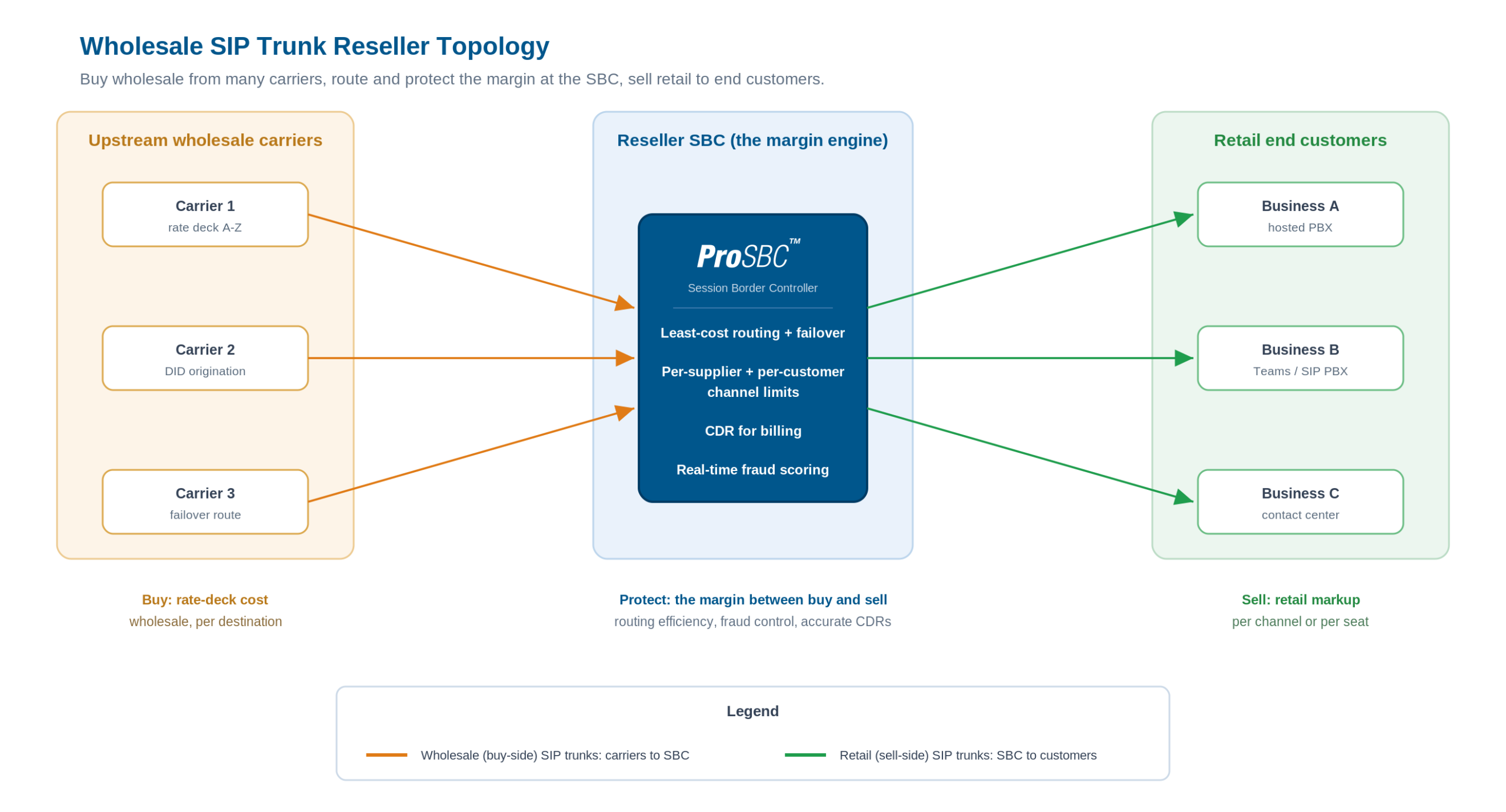
The reseller buys wholesale from several carriers against a rate deck, and the SBC applies least-cost routing, per-supplier and per-customer channel limits, CDR generation, and real-time fraud scoring before selling retail trunks to end customers. The margin lives between the buy on the left and the sell on the right. Click to enlarge.
What a SIP Trunk Reseller Actually Needs to Operate
Reselling wholesale SIP trunks means sitting between two sides you do not fully control: a set of upstream suppliers, each with its own SIP quirks and IP addresses, and a set of downstream customers, each with its own PBX and its own risk profile. The device that mediates that boundary is a Session Border Controller (SBC), and for a reseller it is not optional infrastructure but the core of the operation.
Multi-carrier routing and least-cost routing
A reseller typically contracts with more than one upstream carrier, both to price-shop each destination and to fail over when one supplier degrades. A B2BUA (Back-to-Back User Agent) SBC fully terminates each inbound call and re-originates it toward the chosen supplier, which gives it complete control to pick a route per call, advance to the next supplier on failure, and apply priority and weighting across a portfolio of carriers. ProSBC’s routing engine is rule-based and API-driven, so routing decisions can pull live data, such as a rate lookup or an LNP dip, at call time rather than from a static table.
CDR ownership for billing reconciliation
The SBC generates a Call Detail Record for every call it handles, and because the reseller owns that record, it can reconcile its own view of the traffic against each supplier’s invoice and against what it bills its own customers. When the numbers disagree, and they will, the reseller has independent evidence rather than accepting the carrier’s figure. Validating SBC CDRs against carrier CDRs is one of the most common day-to-day tasks in a wholesale operation.
Fraud protection
Because a single fraud event can wipe out a month of margin, the SBC needs to score risk on every call and act on it in real time. ProSBC provides per-call fraud scoring and integrates with validated partners including TransNexus, SecureLogix, and YouMail, alongside dynamic blacklisting, percentage-based greylisting, and DoS/DDoS mitigation at the edge.
Per-supplier and per-customer channel limits
A reseller sets a channel and calls-per-second limit for each upstream supplier so no single peer can swamp the others, and a limit for each downstream customer so no single account can consume the whole trunk or run up unbounded fraud. This is a concrete, real-world requirement. When a UK new-entrant DID reseller brought a transit SBC online with TelcoBridges, connecting to carriers in Canada and Spain, per-supplier and per-customer channel limits and public signaling IPs for upstream whitelisting were exactly the controls that made the launch possible.
SIP normalization and topology hiding
Every supplier speaks a slightly different dialect of SIP, and the SBC’s header manipulation engine rewrites headers per trunk group so a call from one supplier looks correct to a downstream customer and vice versa. Topology hiding replaces internal addressing in SIP headers with the SBC’s own address, so suppliers and customers never see each other’s networks or the reseller’s internal infrastructure. All of this, along with security, normalization, and admission control, is the standard job of an SBC at the SIP trunk boundary. Managing DID inventory and moving numbers between carriers also puts number porting on the reseller’s regular workload, and the SBC’s routing layer is where LNP dips and port logic execute.
Build vs. Buy: Self-Hosted or Managed SBC
A reseller has to decide whether to run the SBC itself or have it run as a managed service, and the honest answer depends on where voice sits in the business.
Self-hosting makes sense when voice is the core product. An operator whose margin depends on routing efficiency, whose billing depends on owning the CDRs, and whose differentiation comes from programmable routing has good reasons to keep the SBC in-house. That case is made in detail for self-hosted SBCs at VoIP providers and for ISPs reselling SIP trunks. The economics favor it at scale: ProSBC is a software subscription with no hardware to buy, its per-session pricing is published openly and steps down as session count rises, and a single server scales to 60,000 sessions with up to 1,024 trunk groups. Because the rates are transparent and self-serve, a reseller can size and price a deployment before ever talking to sales.
The catch is that the license is the small number. Running an SBC well means staff time, on-call coverage, patch cycles, security response, and the expertise to do all of it, and the full picture is laid out in the true cost of managing your own SBC and the broader hardware-versus-software TCO comparison. For a reseller without a dedicated voice engineering team, a managed SBC service removes that operational load. TelcoBridges runs the SBC with active/standby redundancy for maximum uptime, 24×7 support, and monitoring, hosted either on TelcoBridges infrastructure or on the reseller’s own cloud account, billed as a predictable monthly subscription. The managed-versus-self-hosted comparison walks through which profile fits which operator.
Frequently Asked Questions
What is the difference between a wholesale and a retail SIP trunk?
A retail SIP trunk is sold to a single business for its own phone system, priced per channel or per seat. A wholesale SIP trunk is sold in bulk to a provider who resells the connectivity to many businesses, priced from a rate deck of per-destination minute rates, per-DID charges, and concurrent-session blocks. The reseller’s margin is the gap between the wholesale buy price and the retail sell price.
Do I need my own SBC to resell SIP trunks?
In practice, yes. A reseller sits between multiple upstream suppliers and multiple downstream customers, and needs multi-carrier routing, per-supplier and per-customer channel limits, fraud protection, SIP normalization, and its own call records for billing. Those functions live on a Session Border Controller. You can run it yourself or buy it as a managed service, but the functions are not optional.
How is wholesale SIP trunk pricing structured?
Most agreements combine several meters: per-minute termination priced from a rate deck (the cost depends on the call’s destination), a recurring per-DID charge for inbound numbers, per-channel or per-session pricing for concurrency, and volume or commit tiers that lower the unit rate in exchange for guaranteed spend.
What margin can a SIP trunk reseller realistically expect?
Margins vary widely by route and are often thin on competitive international destinations, sometimes tenths of a cent per minute. The business runs on volume and on protecting the margin from fraud, routing waste, and billing leakage. Illustrative figures here are general to the wholesale market, not a specific guarantee.
How do I protect wholesale margin from fraud?
Score every call for risk in real time, cap each customer and supplier with channel and calls-per-second limits, and use dynamic blacklisting to block abusive sources before minutes are spent. ProSBC provides per-call fraud scoring, integration with fraud partners such as TransNexus and YouMail, and edge DoS/DDoS protection to keep a single compromised account from consuming a month of margin.
Conclusion
Wholesale SIP trunking is a volume business built on simple arithmetic: buy connectivity in bulk against a rate deck, sell it in smaller units at a markup, and keep the margin intact from the buy to the sell. The cost savings are real, both for the end business leaving the PSTN behind and for the reseller buying below retail, but the margin is thin enough that the infrastructure at the network edge decides whether the business is profitable. Multi-carrier least-cost routing, ownership of the call records, real-time fraud protection, and per-supplier and per-customer limits are what turn a wholesale agreement into a working operation.
Run a Profitable Wholesale SIP Trunk Business with ProSBC
ProSBC is a carrier-grade, software-based Session Border Controller built for exactly this model. Its rule-based, API-driven routing engine handles multi-carrier least-cost routing and per-call failover across your supplier portfolio, and it generates a Call Detail Record for every call so your billing reconciles against both your suppliers and your customers.
Real-time fraud scoring, dynamic blacklisting, and per-supplier and per-customer channel limits protect the thin margin that defines the wholesale business, while topology hiding and per-trunk SIP normalization keep a portfolio of mismatched carriers and customers interoperating cleanly. Pricing is a transparent, self-serve per-session subscription with no hardware to buy, and a single server scales to 60,000 sessions, deployable on AWS, Azure, VMware, KVM, or bare metal, or run for you as a managed service.
Prefer to evaluate on your own first? Start your 30-day free trial.