Keeping Every Extension Working When the Softswitch Goes Dark with Local Site Survivability
Phones and softphones register with a softswitch so they can be reached and can place calls. Registration is only one of the roles that softswitch plays, since it normally handles call routing as well, and it is often something the customer does not control. It might sit at a hosted PBX provider, a cloud communications platform, or a carrier’s own core, reachable only over a link the customer does not own either.
When that softswitch becomes unreachable, the damage lands on site. Registered phones lose their registration and can no longer call each other, even for a simple call between two extensions in the same building, although nothing on the premises has failed.
How Local Site Survivability Works
ProSBC keeps a local, continuously updated record of every registered phone. If the softswitch becomes unreachable, Local Site Survivability lets ProSBC keep answering those phones from that record. It recognizes the outage automatically and keeps known, already-registered users placing and receiving calls between each other, with no manual failover and nothing extra to maintain on site. The moment the softswitch is reachable again, ProSBC hands control back and resumes normal operation on its own.
This is a different layer of protection than SBC redundancy. Redundancy protects against the SBC itself failing, while Local Site Survivability protects against losing the softswitch connection while the SBC keeps running.
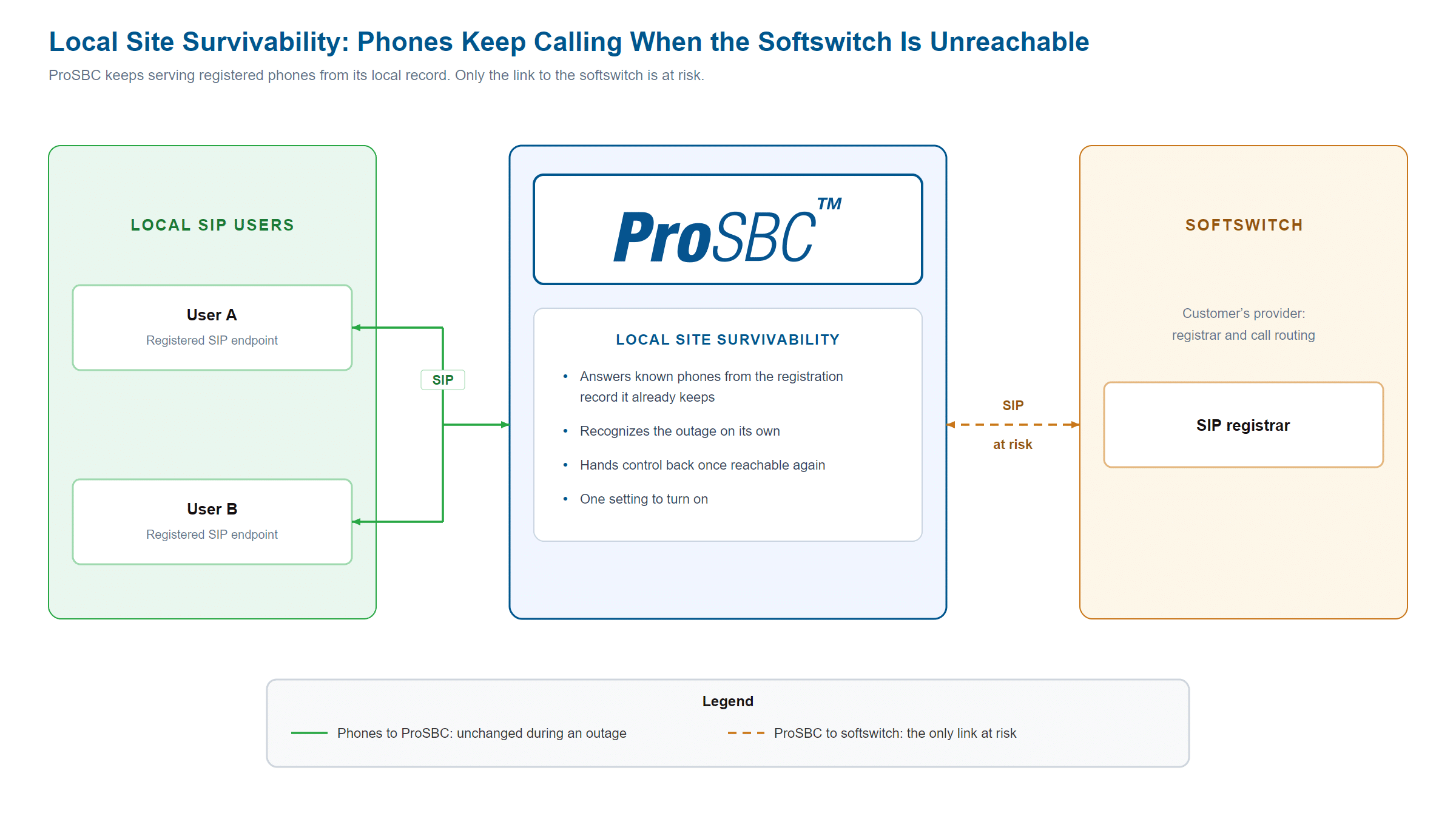
Local Site Survivability: the phones’ link to ProSBC never changes, so the link to the softswitch is the only one at risk. Click to enlarge.
What Local Site Survivability Keeps Running
Calls in Progress Keep Running
An inter-extension call between two locally known users is not dropped when the outage happens. It continues normally until it ends.
Known Users Can Still Call Each Other
Registered users keep placing and receiving new calls between each other during the outage, without waiting for the softswitch connection to come back.
Fully Automatic
ProSBC detects both the outage and the recovery on its own, and known endpoints come back online smoothly as the softswitch returns. Nobody has to trigger a failover.
One Setting to Turn On
Local Site Survivability is a single configuration parameter on the SIP registration domain, so there is no separate system to install or maintain.
ProSBC for Sites That Rely on a Remote Softswitch
ProSBC is a carrier-grade, software-based session border controller built on more than 20 years of SIP deployment experience. For sites whose phones register to a softswitch they do not control, it delivers:
Deploy It Your Way
Self-Managed
Run ProSBC as software on your own infrastructure and turn on Local Site Survivability for the registration domains that need it. You keep full control over configuration and routing.
Managed Service
Hand deployment and operation to TelcoBridges through the ProSBC managed service, running on your own platform. TelcoBridges handles setup, integration, testing, and monitoring, and you keep full access.
Frequently Asked Questions
How is this different from SBC redundancy?
Redundancy covers the SBC itself failing. Local Site Survivability covers losing the connection to the softswitch while the SBC keeps running.
Is this the same as Call Survivability?
No. Call Survivability is a separate capability. Local Site Survivability is specifically about staying operational when the softswitch is unreachable.
Do I lose any calls when the outage happens?
Calls made directly between locally known users are not affected. Calls between those users that would normally be routed through the softswitch can still be placed during the outage, and ProSBC connects them itself for as long as the softswitch stays down.
Which softswitch features keep working during the outage?
None. Softswitch features such as call conferencing, voicemail, and call transfer are unavailable until the softswitch comes back online. Local Site Survivability is specifically about keeping local calls working while the softswitch is unreachable.
Is Local Site Survivability included with the ProSBC call license?
No. An additional license is required.
Keep Your Sites Calling with ProSBC
Talk to a solutions architect about adding Local Site Survivability to your ProSBC deployment, or start evaluating on your own.
By submitting this form, your information will be processed in accordance with our Privacy Policy.
Prefer to evaluate on your own first? Start your 30-day free trial.