VoIP Termination Providers: How Wholesale Voice Termination Works
Every phone call that leaves an IP voice network has to land somewhere on the public phone network, and the service that carries it the last stretch is called termination. When a VoIP provider, a contact center, or a hosted PBX operator dials an ordinary phone number, it hands that call to a wholesale termination carrier, which routes it across the phone network and delivers it to the person on the other end. That handoff is a bought-and-sold product, priced per minute against where the call lands, and it is the quiet machinery underneath almost every business call placed today.
This guide explains what VoIP termination is, how it differs from origination, how a wholesale termination provider actually delivers a call, how termination rates are structured and why they vary so much by destination, and how to choose a provider without buying into hidden quality problems. It then covers the piece of infrastructure that sits at the boundary of your network and every termination carrier you connect to: the Session Border Controller (SBC).

What Is VoIP Termination?
VoIP termination is the service of taking an outbound call from an IP voice network and delivering it onto the public phone network so it reaches an ordinary landline or mobile phone. The word describes the end of the journey: the call terminates when it lands on the destination device. Everything between the caller’s softphone or PBX and that final ring is a chain of networks passing the call along, and the last commercial handoff in that chain, from your network to a carrier that can reach the destination, is the termination you buy.
A useful way to picture it is a physical handoff. Your network can carry a call as far as your own interconnects reach, and no further. To place a call to a mobile number in another country, you hand it to a carrier that has the interconnect agreements and the routes to get it there, and you pay that carrier per minute for the delivery. The carrier may in turn hand it to another carrier closer to the destination. Each handoff is a termination relationship, priced and metered, all the way down to the operator that owns the final subscriber.
Because a single provider cannot interconnect directly with every network on earth, termination is bought wholesale from carriers that specialize in aggregating routes. A wholesale voice carrier maintains hundreds or thousands of interconnects, sells outbound delivery in bulk, and lets a smaller provider reach the whole world through a handful of connections rather than negotiating with every operator individually. For the provider on the buy side, running that outbound service well is the argument for a self-hosted voice edge.
Origination and Termination: Two Halves of the Same Product
Termination is only one direction of traffic. Its counterpart is origination, and most voice businesses buy both from their wholesale carriers, often on the same interconnect.
Termination handles outbound calls. Your customer dials a number, your network hands the call to a termination carrier, and the carrier delivers it to the destination on the phone network. You pay per minute based on where the call lands.
Origination handles inbound calls and works in the opposite direction. You buy phone numbers, usually called DIDs, from a carrier, and when someone dials one of those numbers the carrier delivers the call back into your network. You typically pay a small recurring charge per number plus a per-minute rate for the inbound minutes.
The distinction matters because the two sides are priced and engineered differently. Termination cost is dominated by destination, since reaching a rural mobile network in one country costs far more than reaching a major-city landline in another. Origination cost is dominated by number inventory and inbound minute volume. A working wholesale relationship usually bundles both, so a provider can offer its own customers a complete phone service: numbers to receive calls on, and the ability to dial out to anywhere. The diagram below shows the two flows meeting at the same network edge.
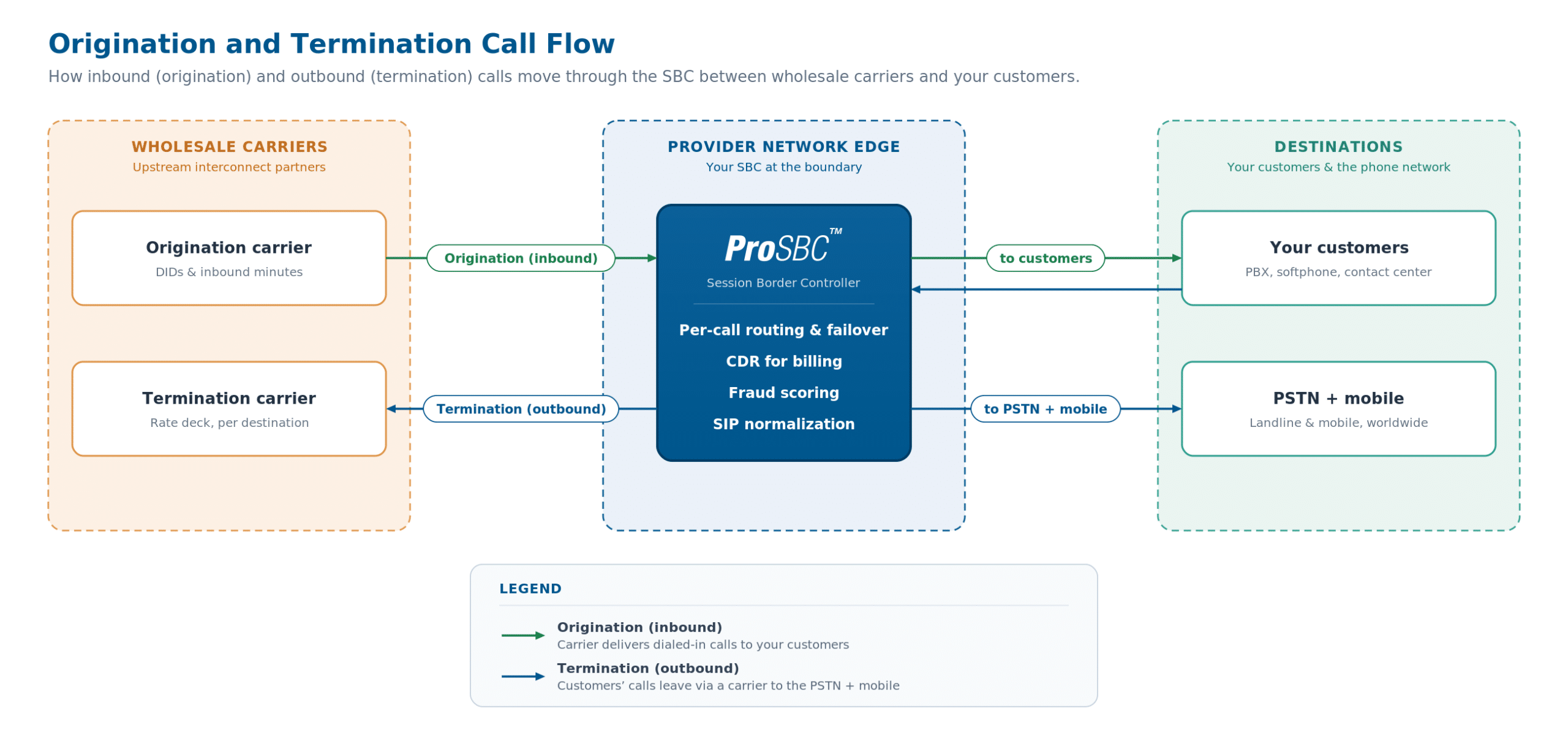
Origination brings inbound calls from a carrier into the provider network, while termination carries outbound calls from the network to a wholesale carrier that delivers them to the PSTN and mobile operators. The SBC sits at the boundary, applying routing, security, and call records to both directions. Click to enlarge.
How a Wholesale Termination Provider Delivers a Call
From the outside, termination looks like a single transaction: hand over a call, pay per minute. Underneath, a wholesale carrier is running a routing operation that decides, call by call, how to reach the destination at an acceptable cost and quality.
Route selection and least-cost routing
A termination carrier holds many possible paths to most destinations, each with its own cost and quality profile, and it selects among them per call using least-cost routing. The cheapest route is not always chosen outright, because a route that is cheap but drops calls or delivers poor audio costs more in failed attempts and unhappy customers than it saves. Good carriers balance price against measured quality and advance to the next route when the first one fails.
Interconnects and the handoff to the PSTN
The carrier reaches the destination either over an IP interconnect with the terminating operator or, where the destination still runs legacy infrastructure, by handing the call across a gateway onto the PSTN. Reaching a modern mobile network may involve codec conversion, since mobile networks and IP networks often speak different codecs, and reaching a landline may involve converting the call from SIP back to traditional signaling. These conversions happen inside the carrier’s network and are invisible to the buyer, but they are part of what the per-minute rate pays for.
Caller ID and CLI handling
How a route treats caller ID matters both commercially and for answer rates. A CLI route preserves the calling number end to end, so the recipient sees who is calling and is more likely to answer. A non-CLI route strips or replaces the caller ID, which is cheaper but hurts answer rates and, in many markets, runs into regulatory and anti-spoofing scrutiny. In North America, caller ID authentication through STIR/SHAKEN now sits on top of this, so how a termination path handles identity increasingly determines whether a call is trusted or labeled as spam.
How VoIP Termination Rates Work
Termination rates are the per-minute prices you pay to deliver calls, and they are set by a rate deck rather than a single flat number. Understanding how the rate deck behaves is what separates a provider that runs a profitable outbound service from one that is surprised by its own carrier invoice.
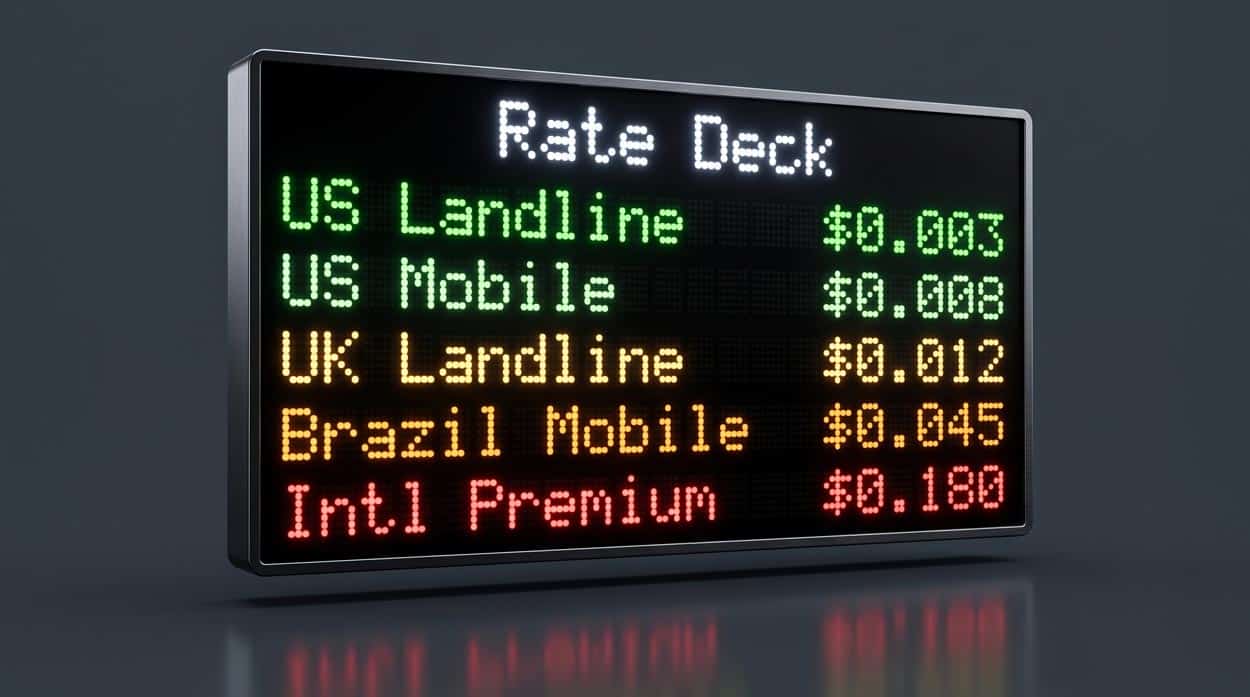
The rate deck is a per-destination price list that can run to tens of thousands of prefixes. Every destination, identified by its country code and often by the specific number range within a country, carries its own per-minute rate. A call to a landline in a major market may cost a small fraction of a cent per minute, while a call to a mobile number in a high-cost country can cost many times more, and a call to a premium or satellite range can cost dollars per minute. The cost of any given call depends entirely on where it lands, and the rate deck is the document that decides it.
Several factors move a rate up or down:
- Destination country and number type is the largest single driver, since mobile termination is usually more expensive than fixed-line, and remote or premium ranges cost more than major-city numbers.
- Route quality separates the price tiers, where a clean CLI route with high answer rates and no false answer supervision costs more than a gray or non-CLI route that trades quality for price.
- Volume commitment lowers the unit rate when a buyer agrees to a minimum monthly spend or minute volume in exchange for better pricing.
- Billing increment quietly affects the real cost, because a carrier billing in 60-second increments charges a full minute for a six-second call, while one billing per second does not.
The practical takeaway is that a single headline rate tells you very little. What matters is the shape of the whole rate deck across the destinations you actually call, the quality tier those rates buy, and the billing increment underneath them. Two carriers advertising the same rate to one country can differ by a wide margin once real traffic runs across their full rate decks.
Choosing a VoIP Termination Provider
Rate decks get most of the attention when buyers compare termination providers, but price is only reliable when the quality behind it is real. A handful of criteria separate a carrier you can build a business on from one that will cost you customers.
Route quality, not just rate
Ask for the measured answer-seizure ratio (ASR) and average call duration (ACD) on the destinations you actually call, and treat a low ACD paired with a high ASR as a warning sign of false answer supervision, where a route reports calls as answered before they truly connect. A rate that looks unbeatable on paper is worthless if the calls do not complete or the audio is poor.
Destination coverage that matches your traffic
A carrier strong in one region may be weak in another. Match the provider’s route strengths to where your traffic actually goes rather than to a global coverage claim, and expect to run more than one carrier so you can price-shop and fail over per destination.
CLI and identity handling
Confirm that the routes you buy preserve caller ID where you need it and that the carrier supports the caller identity requirements in your markets. In North America that means a clear position on STIR/SHAKEN attestation, because a route that damages your caller identity damages your answer rates and your compliance posture at the same time.
Billing transparency
Read the billing increment, the minimum call charge, and the connection or setup fees, not just the per-minute rate. These fine-print terms decide the difference between the quoted rate and the number that lands on your invoice, and they are where a cheap-looking carrier often makes its margin back.
Fraud posture and your own controls
A termination relationship exposes you to toll fraud, since a compromised customer dialing premium international numbers runs up cost that you owe your carrier but may never collect downstream. The provider’s monitoring helps, but the durable protection is your own, applied at your network edge before the minutes are ever handed off. This matters most for the reselling operators covered in the companion guide for ISPs and CLECs reselling SIP trunks, where the margin on each call is thin enough that one fraud event can erase a month of it.
Where the SBC Fits in a Termination Setup
Buying termination is a commercial decision, but connecting to termination carriers safely and profitably is an infrastructure one. The device that sits at the boundary between your network and every carrier you buy from is a Session Border Controller at the SIP trunk boundary, and it is what turns a set of carrier contracts into a working outbound service.
Multi-carrier routing and per-call failover
Because you run more than one termination carrier, the SBC has to pick a route per call and advance to the next carrier when the first one fails or degrades. A B2BUA (Back-to-Back User Agent) SBC fully terminates each inbound call and re-originates it toward the chosen carrier, which gives it the control to apply least-cost routing, priority, and weighting across your whole carrier portfolio. ProSBC’s routing engine is rule-based and API-driven, so a routing decision can pull live data such as a rate lookup or an LNP dip at call time rather than reading a static table.
Owning the call records
The SBC generates a Call Detail Record for every call it handles, so you can reconcile your own view of the traffic against each termination carrier’s invoice and against what you bill your customers. When the numbers disagree, and with per-minute billing across many destinations they will, you have independent evidence rather than accepting the carrier’s figure.
Fraud protection at the edge
Because a single fraud event can erase a month of outbound margin, the SBC scores risk on every call and acts on it in real time. ProSBC provides per-call fraud scoring and integrates with validated partners including TransNexus, SecureLogix, and YouMail, alongside dynamic blacklisting, percentage-based greylisting, and DoS/DDoS mitigation at the edge, so a compromised account is stopped before the expensive minutes are ever handed to a carrier.
SIP normalization across carriers
Every termination carrier speaks a slightly different dialect of SIP, and the SBC’s header manipulation engine rewrites headers per trunk group so a call your network produces looks correct to each carrier and each carrier’s responses look correct coming back. Topology hiding replaces your internal addressing with the SBC’s own address, so no carrier ever sees the shape of your network. Where a carrier needs a different codec than your network delivers, the SBC handles the negotiation on each leg independently.
Frequently Asked Questions
What is the difference between origination and termination in VoIP?
Termination handles outbound calls: your network hands a call to a carrier that delivers it to its destination on the phone network, priced per minute by where it lands. Origination handles inbound calls: you buy phone numbers from a carrier, and it delivers calls dialed to those numbers back into your network, priced per number plus inbound minutes. Most providers buy both, often on the same interconnect.
What is a wholesale VoIP termination provider?
A wholesale termination provider, also called a wholesale voice carrier, sells outbound call delivery in bulk. It maintains interconnects with many operators and the PSTN, so a smaller provider can reach the world through a few connections instead of negotiating with every network individually. It is priced from a rate deck of per-destination per-minute rates.
How are VoIP termination rates set?
Rates come from a rate deck, a per-destination price list that can run to tens of thousands of prefixes. The per-minute price of a call depends on the destination country and number type, the route quality tier, any volume commitment, and the billing increment. Mobile and remote destinations cost more than major-city landlines, and a clean CLI route costs more than a non-CLI one.
How do I compare termination providers beyond the headline rate?
Compare measured answer-seizure ratio and average call duration on the destinations you actually call, the coverage strength in your regions, how routes handle caller ID and STIR/SHAKEN, and the billing fine print such as increment and minimum charge. A low rate paired with poor quality or a 60-second billing increment often costs more in practice than a higher published rate.
Do I need an SBC to buy VoIP termination?
To connect to termination carriers safely and run more than one, in practice yes. An SBC picks a route per call and fails over between carriers, generates your own call records for billing reconciliation, scores calls for fraud before minutes are handed off, and normalizes SIP so each carrier interoperates cleanly. You can run it yourself or buy it as a managed service, but the functions are not optional.
Conclusion
Wholesale VoIP termination is the service that carries a call the last stretch from your IP network onto the public phone network, and it is a metered, per-destination product bought from carriers that aggregate routes to the whole world. Origination is its inbound twin, and most providers buy both together. The rate deck, not the headline rate, is where the real cost lives, and route quality, caller ID handling, and billing fine print decide whether a cheap-looking rate is actually cheap.
Choosing carriers well is half the job. Connecting to them safely and running several at once is the other half, and it lands on the device at the edge of your network.
Run Wholesale Voice Termination on ProSBC
ProSBC is a carrier-grade, software-based Session Border Controller built for providers connecting to a portfolio of termination and origination carriers. Its rule-based, API-driven routing engine handles multi-carrier least-cost routing and per-call failover, and it generates a Call Detail Record for every call so your billing reconciles against both your carriers and your customers.
Real-time fraud scoring, dynamic blacklisting, and per-carrier and per-customer channel limits protect your outbound margin, while topology hiding and per-trunk SIP normalization keep a mix of termination carriers interoperating cleanly. Pricing starts from $1.40 per session per server per year with no hardware to buy, and a single server scales to 60,000 sessions across up to 1,024 trunk groups, deployable on AWS, Azure, VMware, KVM, or bare metal, or run for you as a managed service.
Prefer to evaluate on your own first? Start your 30-day free trial.