IMS Application Server: Where Service Logic Lives in the IMS Core
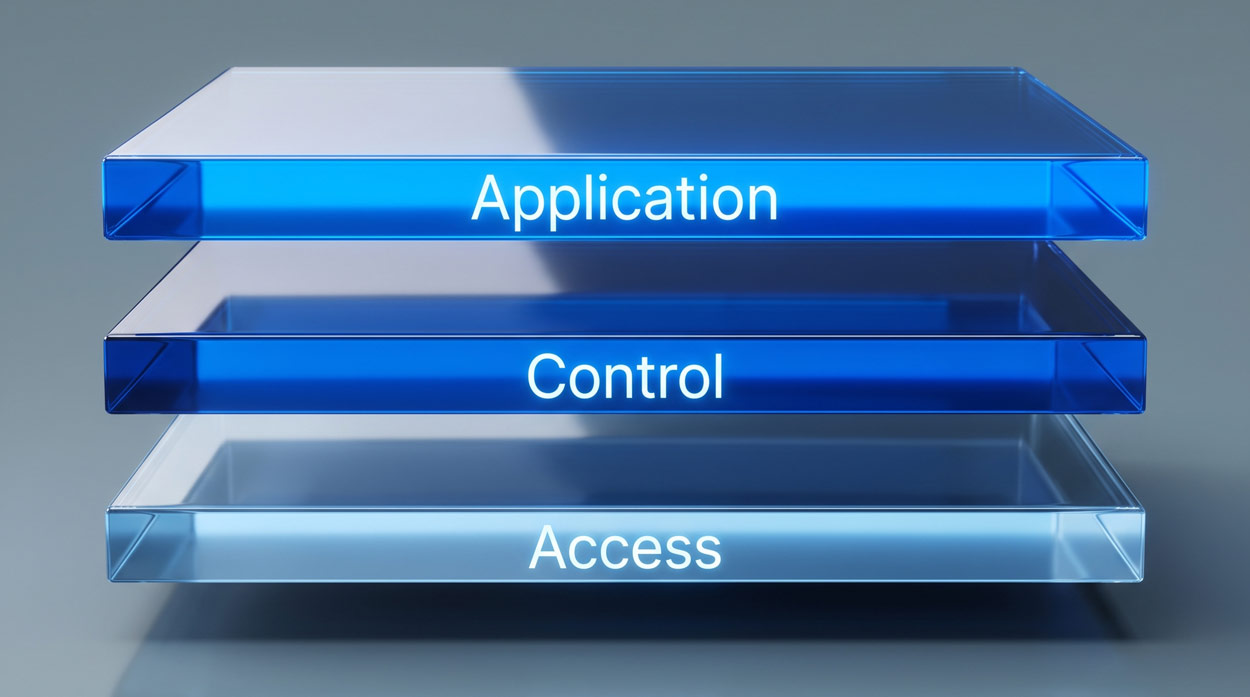
An IMS core can register a subscriber, authenticate them, and route a session to its destination without ever delivering a single feature. Call forwarding, call hold, multiparty conferencing, SMS over IP, the handover that keeps a mobile call alive when it drops off LTE: none of that lives in the routing layer. It lives in the Application Server. The S-CSCF knows how to reach the right Application Server and when to invoke it, but the service logic itself sits one plane up, in software built for exactly that job.
This article focuses on the Application Server (AS) specifically: what it is, the ISC interface that connects it to the IMS core, how the S-CSCF decides to hand a session to it, the modes it can operate in, and the common Application Servers a voice engineer actually meets in production. If you want the full IMS architecture first, our guide to what IMS is covers the control plane and the gateways. Here we go deeper into the one element where features are born. TelcoBridges has spent more than twenty years working at the border where this traffic meets the rest of the world.

What an IMS Application Server Is
IMS is usually drawn as three horizontal planes: an access plane where the device connects, a control plane that registers users and routes sessions, and an application plane where service logic runs. The Application Server lives in that top plane. Where the control-plane elements are concerned with reaching the right subscriber, the AS is concerned with what happens once the session is in flight: whether to forward it, fork it to several destinations, play an announcement, hold it, or generate a message of its own.
An AS is a specialized SIP entity. It speaks the same Session Initiation Protocol as the rest of the core, defined in RFC 3261, and from the S-CSCF’s point of view it is just another SIP destination that sessions can be routed to. Vendors sell Application Server products, and each one maps the standardized behavior onto its own software, but the reference architecture and the interface to the core stay consistent. That is what lets an operator buy a telephony Application Server from one supplier and a messaging Application Server from another and have both sit behind the same S-CSCF. If the protocol layer is unfamiliar, our primer on SIP signaling fundamentals covers the methods and responses that everything here is built on.
The architecture is defined by 3GPP, principally in TS 23.228 for the overall IMS and in TS 23.218 for how the AS and the core interact. The point worth holding onto is the separation of concerns: the core routes, the AS delivers features, and a single SIP interface joins the two.
The ISC Interface: How the Core Reaches the AS
The link between the S-CSCF and an Application Server is the ISC interface, short for IP Multimedia Service Control. It is not a new protocol. ISC is SIP, used as a reference point with defined behavior, which is why an AS can be treated as an ordinary SIP server by the rest of the core.
When the S-CSCF decides a session needs service logic, it routes the request to the AS over ISC, the AS does its work, and in most cases the AS sends the session back to the S-CSCF to continue toward its destination. The session leaves the routing layer, passes through the feature layer, and returns. This round trip is what makes features composable: the S-CSCF can send a single session through several Application Servers in turn, each adding its own behavior, without any of them needing to know about the others.
Because ISC is SIP, the AS sees the same request line, headers, and SDP body that travel on any trunk. If you want a field-level view of what those messages contain, our reference on the step-by-step SIP call flow walks through each one. The difference in IMS is not the messages themselves but the orchestration around them, and that orchestration is driven by the next piece.
How the S-CSCF Decides to Invoke an AS
The S-CSCF does not hand every session to every Application Server. It consults a set of rules called the Initial Filter Criteria, the iFC, which live in the subscriber’s service profile. That profile is stored in the Home Subscriber Server (HSS) and downloaded to the S-CSCF when the user registers, so by the time any session arrives the core already knows the subscriber’s feature entitlements.
Each entry in the iFC pairs a trigger with a target. The trigger is built from one or more Service Point Triggers, the SPTs, each of which tests something about the request: the SIP method, the direction of the session, the presence or value of a header, or a line in the SDP. When a request matches, the S-CSCF routes it over ISC to the Application Server named in that entry. Entries carry a priority, so the S-CSCF evaluates them in order and can chain several Application Servers into a single session, each invoked when its own trigger fires.
An Application Server often needs more about the subscriber than a single SIP request carries. For that it talks to the HSS directly over the Sh interface, a Diameter reference point it uses to read and write the service data a feature depends on, such as a forwarding number or a presence list. The division stays clean: the iFC decides whether to invoke the AS, ISC carries the session to it, and Sh supplies the subscriber data the service runs on.
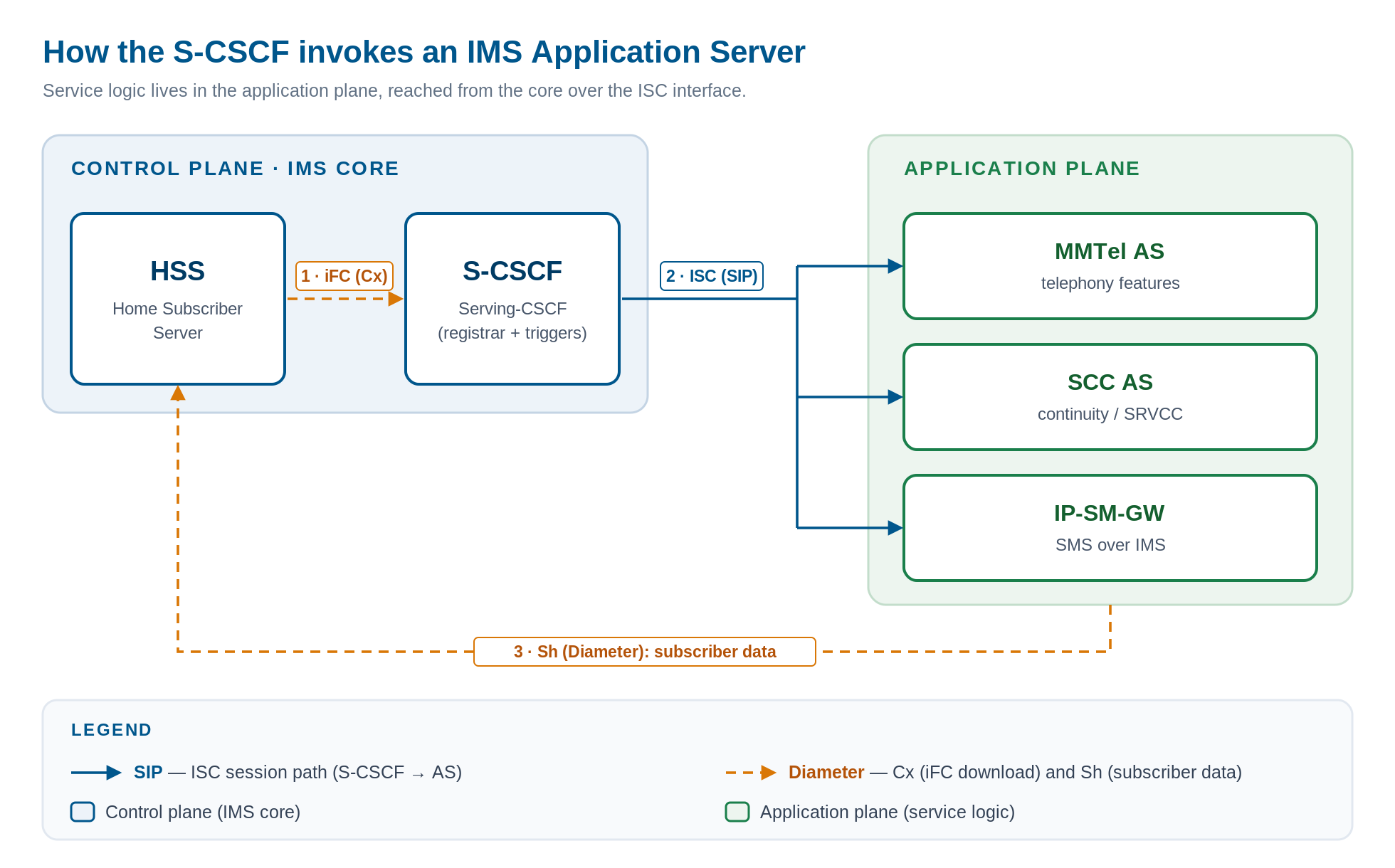
The S-CSCF loads the subscriber’s Initial Filter Criteria from the HSS at registration, then routes matching sessions over the ISC interface to the relevant Application Server (MMTel, SCC, IP-SM-GW), while the AS reads subscriber data from the HSS over the Sh interface. Click to enlarge.
The Modes an Application Server Can Operate In
3GPP TS 23.218 defines how an Application Server behaves as a SIP entity, and the behavior is not a single fixed role. Depending on the feature it is delivering, an AS acts in one of several modes on the ISC interface.
As a terminating user agent the AS is the endpoint of the session. A voicemail server that answers a call the subscriber did not pick up is acting this way, ending the session rather than passing it on. As an originating user agent the AS creates a session of its own, which is how a server generates a notification call or sends a message no subscriber initiated. As a SIP proxy the AS observes and forwards the request with minor changes, suitable for logging, screening, or light routing decisions where the session is not being reshaped.
The most capable mode is the back-to-back user agent (B2BUA), where the AS terminates the incoming leg and originates a new one, giving it full control of the session. Third-party call control depends on this mode: features like call transfer, conferencing, and complex forwarding need the AS to manipulate both sides of a call, which a proxy cannot do. The distinction between a forwarding proxy and a full B2BUA is the same one that separates a lightweight router from a true session controller, and our explainer on what a SIP proxy is versus a B2BUA covers exactly why the difference matters. An AS can also act as a SIP redirect server, telling the core where to send the session instead of carrying it.
Common Application Servers and What They Do
The standards leave the AS deliberately generic so any service can be built on it, but a handful of Application Servers turn up in nearly every operator network, each owning a recognizable job.
The MMTel AS, for multimedia telephony, is the one most sessions touch. It delivers the supplementary services subscribers expect from a phone line: call hold and resume, call forwarding in its several flavors, call barring, multiparty conferencing, and the identity services that present or restrict a caller’s number. When a VoLTE subscriber forwards a call or joins a conference, the MMTel AS is the element making it happen.
The SCC AS, for service centralization and continuity, exists to keep sessions alive across boundaries. Its best-known job is SRVCC, single radio voice call continuity, which hands an in-progress VoLTE call down to a circuit-switched network when the subscriber moves out of LTE coverage. To do that the SCC AS anchors the session so there is a fixed point of control to transfer, which is only possible because it sits in the path as a B2BUA.
The IP-SM-GW, the IP Short Message Gateway, carries SMS over the IMS network. It interworks short messages between the IP domain and the legacy SMS infrastructure so a message sent from a VoLTE handset reaches a subscriber on an older network and the other way around. Messaging and richer services build on the same pattern: a presence server tracks who is available, and an RCS Application Server delivers the rich communication services that extend plain messaging. If you are weighing the messaging side of IMS, our comparison of RCS versus SMS covers where each fits.
Beyond these, operators run Application Servers for everything from ringback tones to regulatory recording. The shape is always the same: a SIP entity the S-CSCF invokes by iFC, talking to the HSS over Sh for whatever subscriber data the feature needs.
Third-Party Registration: How an AS Knows You Are Online
A feature like call forwarding or presence is only useful if the Application Server knows whether the subscriber is registered. The AS does not see the original REGISTER, because that travels between the device and the S-CSCF, so IMS uses a mechanism called third-party registration to close the gap.
When a subscriber registers and the S-CSCF loads their service profile, the iFC can include a trigger that fires on the REGISTER itself. When it does, the S-CSCF sends a separate REGISTER to the named Application Server on the subscriber’s behalf. That third-party REGISTER tells the AS that the user is now online and which S-CSCF is serving them, so the AS can subscribe to registration events, prime its state, and be ready the moment a session arrives. It is the quiet handshake that lets a feature server stay in step with a subscriber it never talks to directly during sign-on.
Where the SBC Fits Relative to the Application Server
For anyone who buys, deploys, or operates session border controllers, the useful question is how the AS and the SBC relate. They are complementary, not competing. The Application Server sits in the application plane and owns service logic. The SBC sits at the network’s edges and owns the border, at the access edge toward devices and at the network-to-network interface toward other operators. An SBC does not host features, and an AS does not secure a perimeter.
The two still interact, because traffic shaped by an Application Server has to cross the same borders as everything else. When an AS anchors media, for instance an announcement or a conference bridge drawn from the media resource function, that media still leaves and enters the network through the SBC. When sessions an AS has touched are handed to another operator, the SBC at the network-to-network interface performs topology hiding so the internal addresses of the core and its Application Servers are never exposed to the far side. And because different operators run Application Servers from different vendors, the SBC normalizes SIP between the dialects each side speaks, so a session that left one network’s AS is understood by the next. That normalization is the same multi-vendor interoperability work an SBC does on any interconnect, here applied to IMS-originated traffic.
There is one mode worth naming explicitly. Both a feature-rich AS and a carrier-grade SBC operate as back-to-back user agents, but for different ends. The AS is a B2BUA in the core so it can control both legs of a call to deliver a service. The SBC is a B2BUA at the border so it can fully terminate and re-originate signaling and media, which is what makes topology hiding, header manipulation, and media security possible. Same architecture, different place in the network, different job.
Frequently Asked Questions
What is an IMS Application Server?
An IMS Application Server (AS) is the element in the application plane of an IMS network that hosts service logic. It is a specialized SIP server the S-CSCF invokes to deliver features such as call forwarding, conferencing, SMS over IP, and presence, while the IMS core handles registration and routing.
What is the ISC interface?
ISC, IP Multimedia Service Control, is the SIP-based reference point between the S-CSCF and an Application Server. The S-CSCF routes a session over ISC to the AS, the AS applies its service logic, and the session normally returns to the S-CSCF to continue to its destination.
How does the S-CSCF decide which Application Server to use?
It uses the Initial Filter Criteria (iFC) from the subscriber’s service profile, downloaded from the HSS at registration. Each iFC entry pairs a trigger, built from Service Point Triggers that test the SIP method, headers, direction, or SDP, with an Application Server, and the S-CSCF evaluates them by priority.
What is the MMTel Application Server?
The MMTel (Multimedia Telephony) AS delivers standardized telephony supplementary services in IMS, including call hold, call forwarding, call barring, multiparty conferencing, and caller identity presentation or restriction. It is the Application Server most voice sessions interact with.
Does an SBC replace an Application Server?
No. An SBC secures and controls the network border, while an Application Server hosts service logic in the core. They are complementary: the SBC handles topology hiding, SIP normalization, and media security at the edge for traffic that Application Servers shape inside the network.
Conclusion
The Application Server is where IMS stops routing and starts delivering. The S-CSCF reaches it over the SIP-based ISC interface, decides when to invoke it from the Initial Filter Criteria in the subscriber’s profile, and can chain several Application Servers into one session. The MMTel AS covers telephony features, the SCC AS keeps calls alive across handovers, the IP-SM-GW carries messaging, and third-party registration keeps each one in step with the subscriber. For a voice engineer at the border, the takeaway is the boundary: service logic belongs to the Application Server in the core, while the controlled, secured edge that this traffic crosses belongs to the SBC.
Secure the IMS Border with ProSBC
ProSBC is a carrier-grade, software-based Session Border Controller that sits at both the access and network-to-network borders of an IMS deployment. It operates as a full back-to-back user agent (B2BUA) with SIP normalization across multi-vendor dialects, topology hiding that conceals the addresses of your core and Application Servers, and built-in DoS/DDoS protection, the border functions an IMS interconnect needs.
It scales to 60,000 sessions per server and 350,000 endpoint registrations, so the same software handles a single access edge or a large operator interconnect. Deploy it on VMware, KVM, AWS, Azure, or baremetal, wherever your network edge already lives.
Prefer to evaluate on your own first? Start your 30-day free trial.