What Is SMS? From SS7 Signaling to IMS and the SBC’s Role at the Messaging Border
You send one every day without thinking about it, yet the text message is one of the most quietly engineered systems in telecommunications. Ask most people what SMS means and you get “texting.” Ask a network engineer and you get a forty-year story about borrowed signaling bandwidth, store-and-forward switches, and a protocol that refused to die as mobile networks moved to all-IP cores.
SMS stands for Short Message Service, the standard for sending short text messages between mobile phones and applications. That is the short answer for anyone searching “what does SMS mean” or “SMS meaning in text.” The longer answer is more interesting, and it matters if you build or operate voice networks. In this article, we’ll walk you through where SMS came from in the SS7 signaling world, how it moved onto IP through IMS and SIP, and where a Session Border Controller (SBC) sits when that messaging-bearing signaling crosses between networks. TelcoBridges has spent more than twenty years working at exactly that boundary between legacy TDM signaling and modern IP, so the SS7-to-IP arc is a story worth telling accurately.

What SMS Looks Like from the Network Side
Short Message Service (SMS) is a store-and-forward messaging protocol originally built on the SS7 signaling layer of GSM mobile networks. For network engineers and voice infrastructure operators, the relevant fact is not what SMS stands for but how it moves between networks: as MAP operations on SS7, as SIP MESSAGE methods on IMS cores, and as SMPP or MM4/MM7 between application servers and carrier gateways. Each of those borders is a point where the SBC has a role.
How SMS Reached the IP Network
SMS originated on the SS7 signaling channel of GSM networks, carried as MAP MO-ForwardSM and MT-ForwardSM operations between the handset, the SMSC (Short Message Service Center), and the HLR. The 160-character limit traces back to the 140-byte payload of the SS7 TCAP layer. As mobile networks migrated to all-IP cores (IMS), SMS followed: the IP-SM-GW (IP Short Message Gateway) translates between the legacy MAP protocol and SIP MESSAGE (RFC 3428), allowing SMS to traverse IP networks as standard SIP transactions.
From GSM to IMS: How SMS Moved onto IP
Mobile networks did not stay on circuit-switched SS7 forever. As operators moved to all-IP cores for 4G and 5G, voice and messaging had to follow. The framework that carries them is the IP Multimedia Subsystem (IMS), the standardized IP core that handles voice over LTE (VoLTE), video, and messaging on a common signaling foundation built around the Session Initiation Protocol (SIP), defined in RFC 3261.
SMS reaches IMS in two main ways. The first preserves the legacy SMSC by bridging it into the IP world through an IP Short Message Gateway (IP-SM-GW), the function defined in 3GPP TS 24.341 that lets a SIP-registered device send and receive SMS while the SMSC keeps doing store-and-forward behind it. The second carries the message natively over SIP using the SIP MESSAGE method, specified in RFC 3428, which extends SIP to carry instant messages as standalone transactions outside a voice session. Either way, the message that began life as an SS7 payload now travels as IP signaling.
The multimedia side has its own interconnect plumbing. SMSCs and Multimedia Message Service Centers (MMSCs) exchange traffic over the MM4 and MM7 interfaces, which connect messaging centers between and within networks. These interfaces are where application-to-person (A2P) traffic, the messages sent by banks, airlines, and two-factor authentication systems, enters the carrier messaging fabric. RCS, the IMS-native successor, layers richer features on top of this same core, but that is a separate discussion best left to a dedicated RCS comparison rather than repeated here.
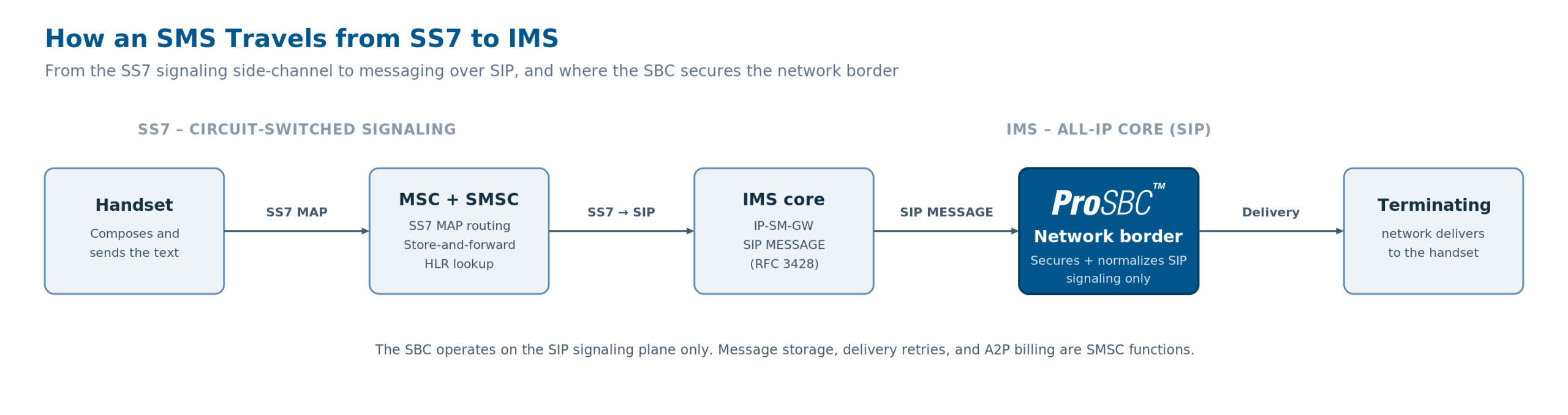
An SMS travels from the handset through the SMSC over SS7, into the IMS core where it can ride SIP via the IP-SM-GW or the SIP MESSAGE method, then across the network border where the SBC secures and normalizes the SIP signaling before the terminating network delivers it. The SBC works on the signaling plane only. Click to enlarge.
Where SMS Crosses Network Borders
A text message rarely stays inside one operator. It crosses from the sender’s network to the recipient’s, and often passes through one or more messaging hubs along the way. This interconnect is where the commercial and security realities of messaging live. Carriers distinguish person-to-person (P2P) traffic from the much larger A2P flow, and they police so-called grey routes where A2P traffic is disguised as P2P to dodge interconnect fees. Filtering, rate control, and signaling validation all happen at these boundaries.
At the network-to-network interface (NNI), signaling from one operator meets signaling from another, and the two sides almost never match perfectly. One network may present traffic over SS7 while the other expects SIP. SIP implementations themselves vary between vendors, with different header conventions, dialects, and quirks. Several things have to happen at this border for traffic to pass cleanly: protocol interworking between SS7 and SIP where the two worlds meet, normalization of SIP signaling so that one vendor’s dialect is understood by the next, security filtering to keep malicious or malformed traffic out, and topology hiding so neither network exposes its internal addressing to the other. That set of jobs is exactly what a session border controller exists to do, which brings us to where the SBC fits.
The SBC’s Role at the Messaging Border
An SBC is a signaling and security device that sits at the edge of a voice network, controlling and protecting the SIP traffic that crosses between networks. It is a Back-to-Back User Agent (B2BUA), meaning it fully terminates SIP on one side and re-originates it on the other, giving it complete control over the signaling in both directions. When the SIP at that edge includes SIP MESSAGE traffic, the SBC handles that signaling the same way it handles call setup signaling: it secures it, normalizes it, and enforces policy on it.
What the SBC governs is the signaling plane at the network edge: encrypting SIP with Transport Layer Security (TLS), normalizing SIP headers so that mismatched vendor dialects interoperate at the NNI, hiding internal network topology from the peer network, and protecting the edge against denial-of-service (DoS) and distributed denial-of-service (DDoS) attacks on the signaling channel.
This is the same network edge that anchors VoLTE voice interconnect between operators, which is why the SBC and the IMS messaging path share infrastructure. An operator bridging mobile and IP voice already leans on the SBC for media handling such as transcoding between mobile and IP codecs, and the messaging-bearing SIP that crosses the same border rides through the same signaling-security layer. TelcoBridges built ProSBC out of more than two decades of SS7 and SIP signaling work, so the SBC’s job at this border is grounded in exactly the TDM-to-IP heritage that SMS itself came from.
Frequently Asked Questions
Can an SBC filter or rate-limit A2P SMS traffic?
Yes. When A2P (application-to-person) SMS traverses the SBC as SIP MESSAGE, the SBC can apply per-source rate limiting, destination filtering, and content-type inspection the same way it handles voice traffic. This is the same programmable routing layer used for voice fraud prevention, applied to messaging.
What is the difference between SMS and MMS?
SMS carries plain text only and is limited to 160 characters per message. Multimedia Messaging Service (MMS) carries images, audio, and video, has no 160-character limit, and uses a different transport built around the MMSC rather than the plain SMS path.
Is SMS still used now that IMS and RCS exist?
Yes. SMS remains the universal fallback that every mobile device supports, and it carries the bulk of application-to-person traffic such as alerts and two-factor authentication codes. IMS and RCS add capability on top, but SMS stays in the path as the lowest common denominator.
Does a session border controller send SMS?
No. An SBC secures and normalizes the SIP signaling at the network border, including SIP MESSAGE traffic where it is present, but it does not store, originate, or deliver text messages. Message storage and delivery are SMSC functions, not SBC functions.
Conclusion
The meaning of SMS is simple on the surface and layered underneath. It is the Short Message Service, the 160-character text standard that began as a clever reuse of spare SS7 signaling bandwidth, matured around the store-and-forward SMSC, and moved onto IP as networks adopted the IMS core and the SIP MESSAGE method. Across that whole arc, the constant is signaling crossing borders between networks, and the cleaner that border behaves, the more reliably messages and calls get through.
Secure the Messaging Border with ProSBC
The signaling at a messaging-bearing SIP border needs carrier-grade security and multi-vendor normalization, whether it is carrying VoLTE voice or SIP MESSAGE traffic. ProSBC is a software SBC that handles the signaling-plane role at the network edge, with B2BUA architecture, SIP normalization across carrier dialects, topology hiding, and DoS protection on the signaling channel.
You can validate it against your own carrier interconnect with the free, self-serve ProSBC Lab before committing to anything.
Prefer to evaluate on your own first? Start your 30-day free trial.